
Finnish Cases in Everyday Conversation: Which Endings Should Beginners Learn First?

You have seen the full chart of 15 Finnish cases. You may even have memorized respectable chunks of it. Then someone asks where you are staying, and the sentence dies at the noun, because you cannot decide in real time whether the house takes -ssa, -sta, or -on.
That freeze is not a memory failure. The chart hands you fifteen labels in a column, but a real exchange asks a much smaller set of questions: whose thing is this, how much of it, where is it, where did it come from, where is it going. Nothing in the column tells you which ending answers which question.
So here is the order that holds up in conversation. The Institute for the Languages of Finland lists 15 cases, and you do not need equal depth in all of them. Learn the basic form, the genitive, and the partitive first.
Add the six local cases as two direction-based sets. Then attach common verbs to the case each one demands, and let the rest wait for a real sentence. This guide walks that sequence and gives you a checkpoint for each step. If you are still choosing study tools, the Finnish resource guide covers courses, apps, references, and practice setups; this piece only decides what you study first.
Start With the Basic Form, Genitive, and Partitive Before Adding Local Cases
Treat the basic form as the dictionary anchor for every new noun. Then add one genitive form and one partitive form inside complete phrases, not as bare endings. Those three forms already cover naming, possession, quantities, and several sentence patterns English never marks with an ending, so you get a lot of conversation out of very little grammar.
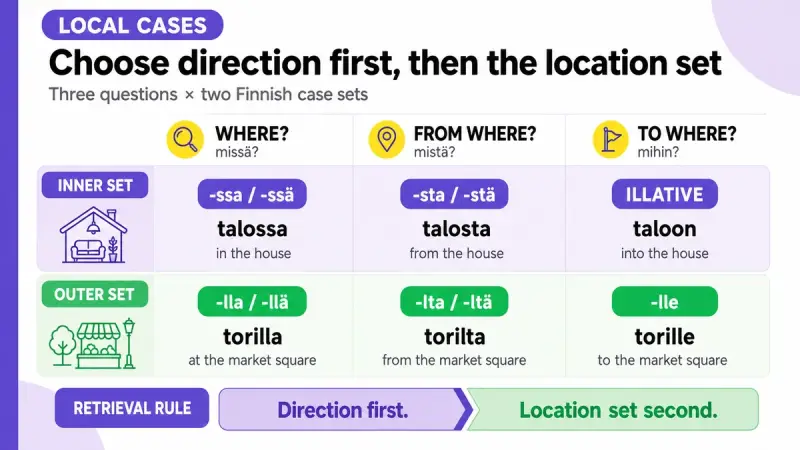
Only after that should the six local cases enter, and they should enter as two sets of three. Each set answers one direction question: where, from where, or to where. Six answers to three questions are far easier to pull up mid-sentence than six unrelated case names.
The whole sequence has five layers, and they are a learning order, not a difficulty ranking: an anchor layer, a relationship layer, a quantity-and-action layer, a location-and-direction layer, and a verb-pattern layer. This table shows what each layer does for you and how to tell you have it.
| Layer | Forms | First everyday job | You have it when |
|---|---|---|---|
| 1. Anchor | Basic form, often called nominative | Name and look up a person, place, or thing | You can use the dictionary entry in a simple naming sentence |
| 2. Relationship | Genitive, singular usually -n | Possession, postpositions, some obligation structures | You can say whose item or which larger phrase is described |
| 3. Quantity and action | Partitive, with endings such as -a/-ä, -ta/-tä, -tta/-ttä | Quantities, certain negative patterns, incomplete action, some verbs | You can name the trigger behind the form |
| 4. Location and direction | Six local cases | Where, from where, and to where in two sets | You pick the direction first, then the set |
| 5. Verb pattern | The case a common verb requires | Phrases like "like something" or "trust someone" | You recall the verb and its case partner together |
The first three forms work as a compact decision system, not as the first three rows of a longer chart. Learn them through a small set of sentences you actually say, and add new word types as they show up. Otherwise formation rules crowd out the only thing that matters mid-conversation: why this form, here.
How Do the Basic Form and Genitive Help You Name Things and Show Possession?
The basic form is the headword you see in a dictionary: kirja for book, auto for car. It carries simple naming sentences like Tämä on kirja, "This is a book," and it is your comparison point for spotting what changed once an ending got added.
The singular genitive usually ends in -n. Aalto University's open Finnish grammar materials use examples like Sannan kurssi, "Sanna's course," and Pasin kirja, "Pasi's book." The same materials show the genitive doing other jobs too: it pairs with postpositions, as in ystävän kanssa, "with a friend," and tuolin alla, "under the chair," and it turns up in obligation structures like Minun täytyy puhua suomea.
| Meaning task | Example | What the form does |
|---|---|---|
| Name an item | Tämä on kirja. | kirja stays in its basic form |
| Show an owner | Sannan kirja | Sannan marks the possessor |
| Connect two nouns | Italian pääkaupunki | The first noun specifies the second |
| Pair with a postposition | ystävän kanssa | The genitive noun forms a unit with "with" |
| Express obligation | Minun täytyy puhua suomea. | minun marks who must act; suomea is partitive for a separate reason |
Resist turning "genitive means possession" into a translation rule. Possession is a good first cue, but real phrases keep showing the same case doing other work, so save the whole phrase whenever a postposition or a construction is what forced the form.
That last example also shows why cases refuse to be learned one at a time. Minun täytyy puhua suomea holds a genitive and a partitive for two different reasons. When you review it, label each choice on its own instead of giving the whole sentence one grammar tag.
Why Does the Partitive Appear With Quantities, Negative Sentences, Ongoing Actions, and Common Verbs?
The partitive has no single English equivalent, which is exactly why translating it fails. What works is a short trigger map. Aalto's materials bring in indefinite amounts of food and drink, numbers from two upward, and verbs like puhua, rakastaa, juoda, syödä, and opiskella. Uusi kielemme's partitive reference adds the contrast beginners usually meet last but need first: ongoing or incomplete action versus an intended whole result.
| Trigger | Finnish example | Practical reading |
|---|---|---|
| Number other than one | kaksi kuppia | two cups |
| Quantity expression | kuppi kahvia | a cup of coffee |
| Indefinite mass | Juon maitoa. | I drink, or am drinking, some milk |
| Negative object | En ostanut autoa. | I did not buy a car |
| Ongoing or incomplete action | Luen kirjaa. | I am reading the book, or some of it |
| Intended whole result | Luen kirjan. | I will read the whole book |
| Partitive-governing verb | Opiskelen suomea. | I study Finnish |
The negative cue needs a fence around it. Uusi kielemme is specific: negative object, possessive, and existential sentences use the partitive in the patterns it describes, but a complement sentence such as Auto ei ole punainen keeps the basic-form adjective. So "negative means partitive" only helps after you have identified the word's role in the sentence.
The partitive is best learned as a bundle of sentence patterns: quantity, negation in specific structures, unfinished scope, and verb government. When you get it wrong, ask which trigger you missed. That gives you something to fix, while "wrong ending" tells you nothing.
Drill one contrast at a time: Luen kirjaa against Luen kirjan, or Minulla on auto against Minulla ei ole autoa. Mixing quantity, negation, and completion in one session blurs the cues you are trying to separate.
How Do the Two Local-Case Sets Express Where, From Where, and To Where?
Finnish has six local cases, and Aalto's materials sort them along two questions: what kind of place relationship is involved, and whether you are staying, leaving, or heading there. The inner set tends to frame something as inside or within; the outer set tends to frame a surface, an open area, or a conventional pairing. Place names and set expressions still have to be picked up in context, because convention beats physics often enough.
The grid below crosses the three direction questions with the two sets. That grid is the entire system.
| Direction question | Inner set | Example | Outer set | Example |
|---|---|---|---|---|
| Where? missä? | Inessive -ssa/-ssä | talossa, in the house | Adessive -lla/-llä | torilla, at the market square |
| From where? mistä? | Elative -sta/-stä | talosta, from the house | Ablative -lta/-ltä | torilta, from the market square |
| To where? mihin? | Illative, several formation patterns | taloon, into the house | Allative -lle | torille, to the market square |
Local cases turn into six manageable choices once you pick the direction first and the location set second. For taloon, decide first that the movement answers "to where," then that a house takes the inner set. Starting from an English preposition and hunting for a matching ending is the slower, less reliable route.
Build triplets around places you actually talk about: talossa, talosta, taloon and torilla, torilta, torille. Attach a verb so each form lives inside a sentence about going, being, or coming. Keep the exceptions glued to their nouns instead of forcing every place through a physical rule.
One warning from the listening side: spoken Finnish can change how some endings sound, so recognizing cases is an input problem as well as a grammar problem. The guide to spoken and standard Finnish shows how to match an attested spoken form to its standard anchor without assuming one colloquial pattern works everywhere.
Why Should You Learn Common Verbs Together With the Case They Require?
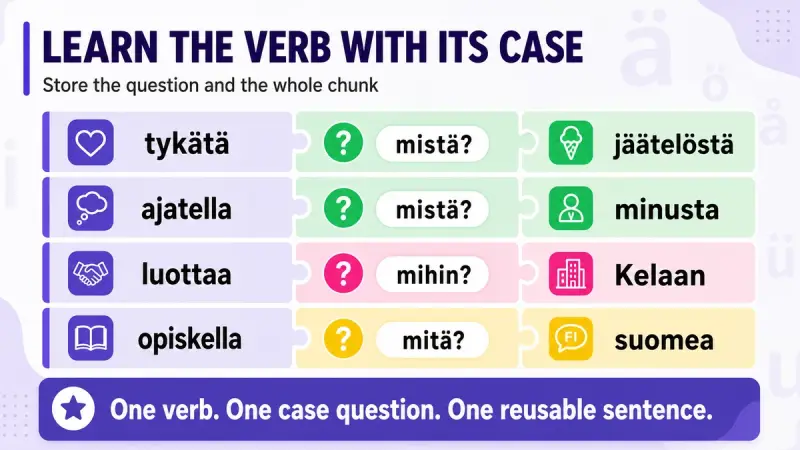
Some Finnish verbs force a connected word into a particular case, a pattern usually called government or rection. Uusi kielemme's rection reference compares it to learning an English verb with its preposition, except Finnish often packs the relationship into a suffix, so English gives you nothing to guess from.
| Learn this chunk | Case question | Example | Why it helps |
|---|---|---|---|
| tykätä jostakin | mistä?, elative | Tykkäätkö jäätelöstä? | "Like" is stored with its required form |
| ajatella jostakin, "have an opinion about" | mistä?, elative | Mitä ajattelet minusta? | The case belongs to this verb meaning |
| luottaa johonkuhun/johonkin | mihin?, illative | Enemmistö luottaa Kelaan. | English "trust" hides the Finnish ending |
| opiskella jotakin | partitive object | Opiskelen suomea. | Verb and object pattern come back together |
A verb-plus-case chunk beats a verb on one flashcard and an ending on another. Store one affirmative sentence and one question, then add a negative later. When a verb takes different cases for different meanings, give each meaning its own entry rather than merging them.
Chunks also make corrections usable. If someone fixes your tykätä phrase, record the corrected chunk together with the question it answers. A bare ending swap is hard to reuse because it hides what selected the case in the first place.
Which Less Common Cases Can Wait Until You Meet Them in a Real Sentence?
Kotus lists 15 cases in total, including essive, translative, abessive, comitative, and instructive. Know that they exist; do not give them the same hours as the layers above. Your order should follow the sentences you actually need, not the official inventory.
Essive and translative are the natural next additions once real examples appear. Essive can mark a role, and translative can mark change or a resulting form. Keep one phrase that fits your life, such as opettajana, "as a teacher," or suomeksi, "in Finnish," and let repeated need decide when to expand.
| Later layer | Do this | Not yet |
|---|---|---|
| Essive and translative | Save complete phrases from your own life and label the meaning | Memorizing every formation type before using a phrase |
| Abessive, comitative, instructive | Recognize the name when a reference explains a real sentence | Big isolated declension drills with no communicative need |
| Accusative and the wider object system | Control the common partitive-versus-total-object contrast; follow your course's terminology | Treating "accusative" as one rare suffix you can simply postpone |
The accusative earns that separate warning because Finnish object grammar involves more than one visible shape, and references label it differently. You can make real progress on common object contrasts before trying to reconcile every terminology choice.
The stop rule is simple. If a later case has not appeared in a sentence you want to understand or say, recognition is enough for now. Come back when an actual example gives you a reason to.
How Can You Practice Case Choices in Short Finnish Exchanges on HelloTalk?
Keep each exchange short enough that the case choice stays visible. HelloTalk's Finnish page lists the chat, community, and live environments this loop uses. In a HelloTalk text chat, send two related lines like Olen talossa and Tulen talosta, then ask your partner to answer with the destination. In a voice exchange, run one place through the full where, from where, and to where triplet so pronunciation cannot hide the contrast.
HelloTalk's Moments feed suits a two-sentence comparison: post Luen kirjaa next to Luen kirjan, say which meaning you intend for each, and ask whether the sentences carry those meanings. In HelloTalk's Voicerooms or Livestreams, listen for one target chunk, a location phrase or a verb rection, and write down the whole sentence rather than only the ending.
HelloTalk's AI Grammar and speaking tools let you draft and rehearse a standard sentence privately before trying it on a person. Follow up with a human anyway, because an automated form check cannot tell you which case a particular speaker would choose for an ambiguous intended meaning. And give your partner an equally focused task in your language; the language exchange guide shows how.
| Practice round | Prompt | Keep as evidence | Next change |
|---|---|---|---|
| Chat-based learning | One where/from/to question and answer | The full prompt and reply | Change only the direction |
| Moments | Two partitive or total-object meanings | Replies that identify the intended meaning | Reuse the contrast with a new noun |
| Voiceroom or Livestream listening | One verb-plus-case chunk | The exact sentence and context | Check the chunk in a reference |
| AI preparation | One drafted standard sentence | The version before human use | Compare with a correction or natural reply |
This loop follows the wider input and output practice cycle: notice a form, try it for a clear purpose, inspect the response, reuse the corrected pattern. Just do not read an uncorrected message as proof you got everything right; a partner may respond to your meaning without correcting the ending.
Frequently Asked Questions
Do beginners need to memorize all 15 Finnish cases?
No. Know the full system exists, then prioritize the basic form, genitive, partitive, the local-case grid, and case patterns attached to common verbs. Add the rest when real sentences call for them.
Is the partitive always used in a negative sentence?
No. It is central in negative object, possessive, and existential patterns, but not every word in a negative sentence turns partitive. Work out the word's role before applying the cue.
Should I learn local cases by their Finnish names?
The names help when you use a grammar reference, but start from missä, mistä, and mihin plus the inner or outer set. Meaning and retrieval first; terminology can follow.
How many examples should I keep for one verb rection?
One affirmative sentence and one question with the same meaning. Add a negative or past example once the verb-plus-case chunk feels stable.
Can a native speaker's correction replace a grammar explanation?
It shows a better form in that one sentence. Ask what meaning or pattern selected the case and verify it in a reliable reference, so the local fix becomes a rule with a clear boundary.
Finnish cases stop being intimidating when every ending answers a question you can see. Start with the smallest system that works, practice contrasts in complete sentences, and expand only when a new meaning demands another form. When you are ready to try your first where, from where, and to where triplet on a real conversation, open HelloTalk and send it as your next message.