
How Do ‘Mm-Hm,’ ‘Right,’ and ‘I See’ Keep English Conversations Moving?

You are on an English voice call, and you stay quiet because interrupting feels rude. Halfway through a story, the other person stops and asks, "Are you still there?" Your silence, which felt like respect, sounded like a dead line.
So you fix it the obvious way: you start saying right more often. Except now some of your rights land as agreement you never meant, one sounds impatient, and another apparently signals that you want to take over the turn. The same word did three different jobs, and you did not choose any of them.
What you were missing is not vocabulary. It is a small family of listener signals that English speakers call backchannels: mm-hm, right, I see, really?, oh. A backchannel keeps the other person's turn open, and it does not automatically mean you agree.
The skill has three parts: picking a form, placing it after a complete idea, and letting your delivery match the reaction you actually want to show. This article walks through those choices so you can sound present on a call without hijacking it.
Backchannels Keep the Speaker’s Turn Open Without Always Signaling Agreement
Here is the mental shift that helps most: a backchannel is not a turn. Research on listener responses groups these short contributions under labels like backchannels or listener responses, and treats them as moves whose meaning depends on where they land in the unfolding conversation. In plain terms: while the other person still holds the floor, you send a brief signal, and that signal can say keep going, I got that, or wow, depending on the moment.
That is different from answering a question, fixing a misunderstanding, or launching your own point. If the conversation has actually broken down, a backchannel will not rescue it; you need clarification, which is a different move covered in how misunderstanding repair becomes a learning event.
The confusing part is that several of these moves sound alike to a learner. This table pulls them apart by what each one actually does, and by whether you end up holding the floor afterward.
| Listener move | Typical form | What it does | Does the listener take the floor? |
|---|---|---|---|
| Continuer | mm-hm, uh-huh | Encourages the speaker to continue | Usually no |
| Receipt signal | I see, right | Shows that information was received or understood | Usually no |
| Reaction | really?, wow, oh no | Displays surprise, interest, or sympathy | Briefly, but often returns the floor |
| Agreement | exactly, I agree | Endorses the speaker's position | Sometimes |
| Repair request | What do you mean? | Signals a problem that needs clarification | Yes |
Understanding, interest, and agreement are separate jobs, even when one word can do more than one of them. When your right gets misread, the problem is rarely the word itself. It is that the move you performed did not match the move you meant.
Which English Backchannels Show Attention, Understanding, Surprise, Sympathy, or Agreement?
English refuses to give each short response one fixed meaning, which is inconvenient but manageable. What you can do is sort the common forms by their most frequent job, then treat each real use as a guess you check against context. That beats memorizing a flat list of translations.
| Main job | Useful English forms | Important boundary |
|---|---|---|
| Attention and continuation | mm-hm, uh-huh, yeah | Yeah can also signal agreement |
| Understanding or receipt | I see, right, got it | Understanding is not endorsement |
| Surprise or interest | really?, oh?, no way | Pitch can make the reaction warm or doubtful |
| Sympathy | oh no, that's hard, I understand | A longer response may fit serious news better |
| Agreement | exactly, absolutely, that's true | These are stronger than a neutral continuer |
Hold these loosely. Right can mean "I am following," "that is correct," or "let us move on," depending on timing and tone. I see often just acknowledges new information, so do not read agreement into it until you hear what the person says next.
This sorting work is one piece of the bigger picture in effective communication in language learning: take in the message, show how you are processing it, and keep your response proportionate. Backchannels are the visible version of that middle step, performed while the other person still has the floor.
Where in a Speaker’s Turn Do “Mm-Hm,” “Right,” and “I See” Sound Natural?
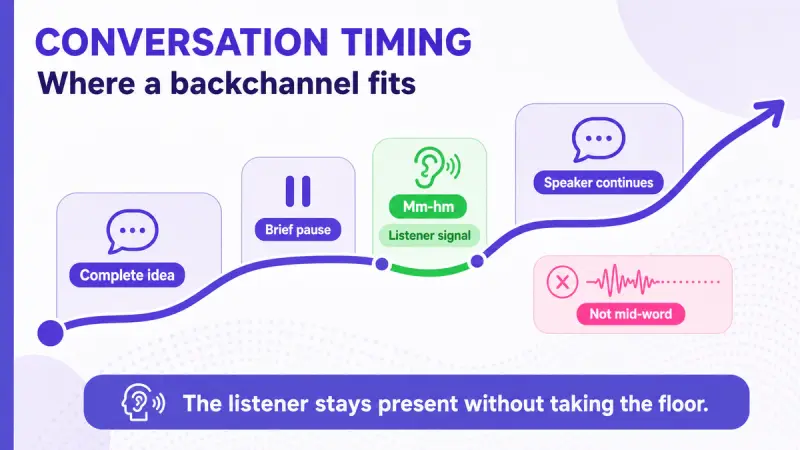
Placement matters more than the word you choose. Backchannels tend to appear where the speaker has finished a small unit of meaning but has not wrapped up the whole turn: after a clause, at a short pause, at a pitch change, or right after a detail that invites a reaction. Conversation research on backchannel behavior treats these spots as part of the interaction itself, not as random gaps you are free to fill.
Look at where the listener comes in here:
A: I started a new job last Monday, (brief pause) but the commute is much longer now.
B: Mm-hm.
A: So I am trying to change my morning routine.
The mm-hm arrives after a complete piece of information and leaves the story open. A full comment at the same spot could drag the topic toward you. Total silence, meanwhile, is exactly what earned you the "Are you still there?" question.
The safest entry point is a short pause after a complete idea, not the middle of a stressed word or an unfinished phrase. Before you try responding at full conversational speed, spend some listening time just marking these completion points in recordings. Once you can hear them coming, dropping a signal there stops feeling like a gamble.
How Do Pitch, Length, and Repetition Change the Same Backchannel?
The written form hides half the meaning. A rising right? asks for confirmation. A level right files the information away.
A clipped right can sound like you want the topic closed. Stretch out an mm-hm and it can sound warmly engaged in one conversation and hesitant in another.
When you listen, track three features together:
- Pitch: rising, falling, or level.
- Length: quick or stretched.
- Repetition: a single response or a run like right, right.
Resist the urge to turn these into a universal code. Speakers differ from each other, and the same person shifts delivery across topics. The question that actually helps is not "What does rising pitch always mean?" but "What is this response doing at this point in this conversation?"
This is also why transcripts will only take you so far, and why you need to hear your own delivery too. The drills in how to practice effective communication in a foreign language include ways to record and compare attempts without turning every chat into a test.
How Do Backchannels Change Across Casual Chats, Meetings, Voice Calls, and Video Calls?
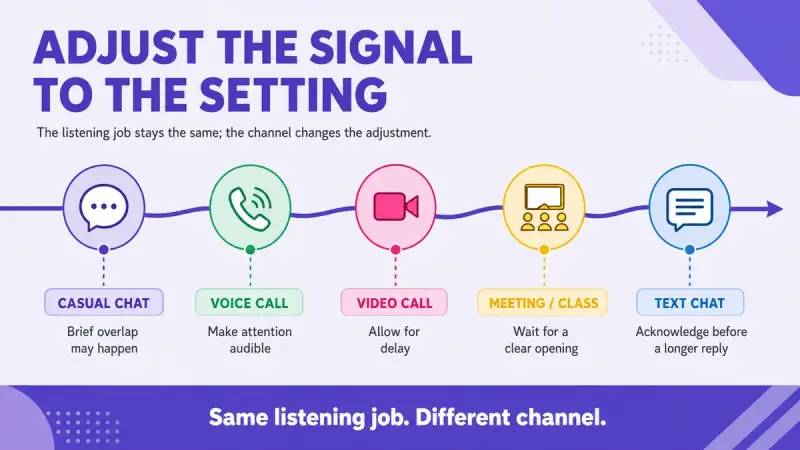
The room changes the rules. Friends chatting face to face may overlap lightly, with yeah and mm-hm scattered everywhere. In a meeting, listeners hold back, drop a short right at a transition, and wait for a clear handover. On a voice call, nobody can see you nod, which is precisely how silent politeness turns into a dropped-call check.
Here is how the same listening job shifts across settings, and what to adjust in each:
| Setting | Signals you can observe | Practical adjustment |
|---|---|---|
| Casual face-to-face chat | Voice, gaze, nods, facial expression | Brief overlap may be accepted, but watch the other person's rhythm |
| Voice call | Voice only | Make attention audible because nods are invisible |
| Video call | Voice plus some visual signals | Allow for delay before interpreting silence or overlap |
| Meeting or class | More explicit turn allocation | Use shorter acknowledgments and wait for a clear opening before adding a full point |
| Text chat | Words, emoji, reply timing | Send a short acknowledgment before a longer reply when receipt needs to be clear |
One more caution: none of this is universal. Research comparing listener responses across groups found that frequency and preferred forms can vary between speaker groups, so one conversation partner's habits are data, not law. For the wider link between wording, norms, and interpretation, see language learning and cross-cultural communication.
When Can Backchanneling Sound Impatient, Skeptical, or Like an Interruption?
You already know this misfire from the inside: those extra rights were not neutral. A listener response goes wrong when its form, timing, or frequency clashes with the moment.
A rapid right, right can read as "hurry up." A sharp rise on really? can tip from interest into doubt. A big reaction during sensitive news can compete with the speaker instead of supporting them.
Rather than guessing how a response landed, watch for possible signs in what the speaker does next: they might stop earlier than expected, restart the same phrase, or ask to finish. If you notice one of these, back off. Respond less often, place your signals after bigger chunks of meaning, and if you clearly stepped on something, a quick "Sorry, please continue" hands the turn back without making it a scene.
Good backchanneling is responsive rather than frequent: the goal is to help the other person continue, not to fill every pause with a sound. That is also why watching several different speakers beats copying one recording on repeat.
How Can You Notice and Practice Backchanneling in HelloTalk Conversations?
Reading about timing only gets you to the starting line. The skill lives in live exchanges, where pauses are real and every speaker delivers these signals a little differently. The HelloTalk platform supports text, voice messages, voice calls, and video calls, so you can compare what listener support looks and sounds like across formats. HelloTalk's correction and translation tools handle the wording side, while the conversations themselves supply the timing and speaker variation that no phrase list contains.
Two more places to watch before you perform anything: HelloTalk Moments shows how people acknowledge and react to community posts in writing, and HelloTalk Livestreams lets you follow the pacing of live questions and answers. For private rehearsal, HelloTalk's AI Grammar and SpeakUp AI cover writing and pronunciation practice separately; the timing of a real backchannel, though, only becomes visible in live chats, calls, and VoiceRooms.
Rather than trying to perform every form at once, run a small observation loop, one pass at a time:
| Pass | What to do | What to save |
|---|---|---|
| Notice | Listen for one short listener response in a VoiceRoom or conversation | The phrase and the point where it appeared |
| Interpret | Ask what it seemed to signal: continuation, receipt, reaction, or agreement | Your best context-based explanation |
| Compare | Catch the same form from another speaker or in another setting | A difference in timing, pitch, or function |
| Try | Use one neutral continuer in a suitable pause | A short note on how the conversation continued |
| Check | Ask a conversation partner how the response sounded in that moment | Their interpretation, treated as one speaker's judgment |
HelloTalk VoiceRooms let you listen before joining a live discussion, which makes them a low-pressure place to study listener signals before you have to manage a full turn of your own. When you are ready to work on bigger conversation moves, English conversation practice methods and apps covers opening, sustaining, and closing an exchange.
Frequently Asked Questions
Does “mm-hm” always mean yes?
No. It often means "I am listening" or "keep going," though context can push it toward agreement. Check what the speaker says next before treating it as a yes.
Is “I see” polite in every situation?
It is usually a neutral receipt signal, but a clipped or repeated delivery can sound distant. For emotional news, add a response that matches the content instead of leaning on I see alone.
Can I use backchannels in text chat?
Yes, but text runs on different timing cues. A short acknowledgment such as "got it" or a relevant reaction shows receipt before your longer reply arrives.
How often should I say “right” or “mm-hm”?
There is no universal frequency. Place a response where it helps the current speaker continue, then adjust to that person's rhythm and the setting you are in.
What should I do if my backchannel interrupts someone?
Hand the floor back with "Sorry, please continue," then wait for a more complete idea or a clearer pause before responding again. Match the other person's pace on your next turn instead of adding another quick signal right away.
Pick one form to notice this week. Listen to how several people use it, mark where it lands, then try it once in a real exchange. HelloTalk gives you voice, video, text, and community settings where these small listening skills stop being theory and start being audible.