How to Practice English Conversation: Methods That Work and the Apps That Help (2026)
Vocabulary apps teach you words. Grammar apps teach you rules. But a conversation is neither, it's a live, two-way, unpredictable exchange, and it's the exact thing most learners have never practiced. You can know 5,000 words and still freeze when someone actually talks to you, because conversation is its own skill with its own moves: taking turns, asking follow-ups, buying time when you're stuck, recovering when you don't understand.
The good news is that those moves can be learned and drilled, on your own, for free or close to it. This guide shows you how to practice English conversation, the techniques, the exact phrases, and the apps that fit each stage, so you go from rehearsing dialogues alone to holding a real conversation with another person.

Why conversation is a separate skill
In a real conversation you're doing five things at once: listening, understanding, recalling words, forming a reply, and timing it, all while the other person keeps moving. School trains none of this; it trains reading and writing, which you do slowly and alone. That's why "good at English on paper, frozen in person" is so common. The fix isn't more study. It's practicing the conversational moves until they're automatic, and the path that works is scripted, then AI, then real people.
How to practice English conversation, step by step
Stage 1: Internalize how conversations sound (scripted)
Before you improvise, absorb the patterns. Listen to and read along with real dialogues, then say them out loud, copying the rhythm. Scripted conversation apps are perfect scaffolding here: they show you how a coffee order, a small-talk exchange, or a phone call actually flows. Shadowing these (speaking along in real time) trains your mouth to produce natural English before you have to invent it yourself.
Stage 2: Learn the moves that keep a conversation alive
A conversation doesn't stall because you lack vocabulary, it stalls because you don't know the moves. Drill these until they're reflexes:
- Follow-up questions. The engine of any conversation. "Oh really? How did that happen?" "What was that like?" Ask one and you're never stuck for what to say next.
- Buying time. Native speakers pause constantly. "That's a good question, let me think…" "Hmm, how do I put this…" These keep you talking while your brain catches up, far better than silence.
- Repair phrases. For when you don't understand: "Sorry, could you say that again?" "What do you mean by ___?" Knowing these removes the fear of a breakdown.
- Reacting. "No way!" "That makes sense." "I know what you mean." Short reactions show you're engaged and buy a beat before your full reply.
- Working around missing words. Can't recall a word? Describe it: "it's the thing you use to…" This is a core fluency skill, not a failure.
Stage 3: Rehearse unscripted with AI
Now practice improvising with zero stakes. Ask an AI partner to chat on a topic and follow up on your answers, then ask it to correct you at the end, and re-say the better version out loud. AI is the perfect bridge between safe scripts and unpredictable humans. (Full method and tools in how to practice English speaking with AI.)
Stage 4: Have real conversations with people
This is the goal everything else builds toward. Use your follow-up questions and time-buying phrases on a real person who responds in ways no app can predict. Start with text, move to voice, then live conversation. Lean on topics you genuinely care about, you'll always have more to say about your favorite show or your work than about a textbook prompt.
The best apps to practice English conversation (by stage)
Match the app to the stage you're in.
For scripted practice (Stage 1)
- English Conversation Practice (TalkEnglish), 200+ free everyday dialogues with audio, quizzes, and a recording tool to compare yourself to the model. Great, zero-cost scaffolding.
- PORO (English Listening・Speaking), 750+ daily-life dialogues with native audio, from greetings to business situations.
These are one-way, they won't react to you, but they're the best free way to internalize how dialogue sounds before you talk to anyone.
For unscripted AI practice (Stage 3)
- Speak, purpose-built AI conversation with strong feedback; the best on-ramp from study to talking.
- TalkPal, scenario-based AI roleplay (interviews, travel, debates) so you're never staring at a blank prompt.
For real conversation with people (Stage 4)
- HelloTalk, the standout for genuine, unscripted dialogue. As a language exchange used by 70M+ people across 200+ countries, exchanging over 1 billion messages daily, it connects you with native English speakers learning your language, so conversations are real, free, and low-pressure (your partner is a nervous learner too). Its gradual ladder is built for conversation: text to find your footing, voice messages to practice speaking without a live clock, Voicerooms for group discussion, and video calls when you're ready for the real thing.
- Speaky: a simpler free exchange app, a fine backup for finding more partners.
- Cambly / italki, paid tutors on demand or by booking, when you want a real person to guide the conversation rather than just chat.
This guide focuses on English specifically. If you're after chat-based practice in any language, our ranking of the best language learning chat apps covers the wider field.
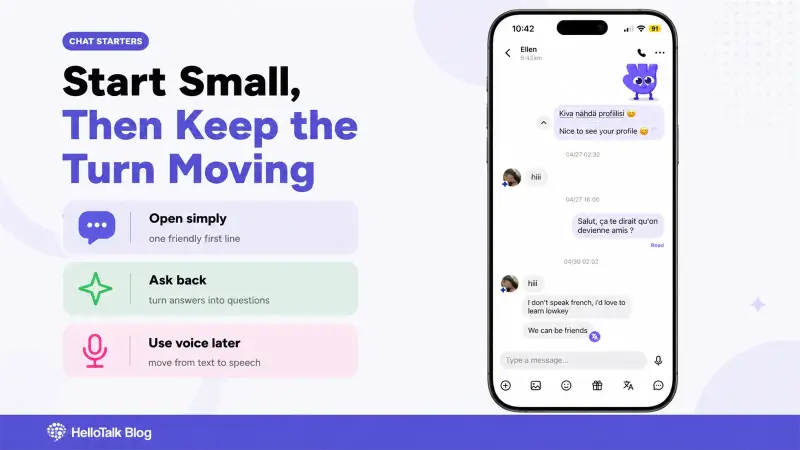
How to start a conversation when you don't know what to say
The blank-first-message problem is real. Two fixes:
- Open with a specific question about a shared interest, not "hello." "I saw you like hiking, what's the best trail you've done?" gives the other person something easy to answer.
- Prepare three topics before any call so you're never improvising from zero. Your job, a hobby, something in the news you have an opinion on.
For a complete daily system that folds conversation practice into a real schedule, see our pillar guide on how to practice English speaking without a teacher, and the full app comparison in best English speaking apps.
Common mistakes that keep conversations stuck
- Staying in scripted apps forever. They're scaffolding, not the destination, real conversations don't follow a script.
- Treating it as a Q&A interrogation. Share and ask back. A conversation is a two-way exchange, not a quiz.
- Going silent when stuck. Use a time-buying phrase instead of freezing. Pauses are normal; silence ends conversations.
- Chasing perfect grammar mid-sentence. Communicate first, polish later. Getting your meaning across beats a flawless sentence you never finish.
- Practicing only with AI. AI builds confidence; people build fluency. Make the jump.
FAQ
What's the best app for English conversation practice? For real, unscripted conversation, a language exchange app like HelloTalk wins, it puts you in genuine dialogue with native speakers for free. For private practice first, Speak's AI is the best bridge. For scripted basics, TalkEnglish is a solid free start.
How do I practice English conversation if I have no one to talk to? Work the stages: scripted apps to learn the patterns, AI to rehearse unscripted with no judgment, then a language exchange app to talk with native speakers who are free and equally motivated. You never need an English-speaking friend to start.
I freeze in real conversations. Where do I begin? Drill the conversational "moves" first, follow-up questions, time-buying phrases, repair phrases, then practice them with AI, then with people. The gradual ladder inside HelloTalk (text, then voice message, then video) is built for exactly this build-up.
Are scripted conversation apps useful, or a waste of time? Useful scaffolding, great for beginners learning how dialogue flows, but they have a ceiling because real conversations don't follow a script. Treat them as a starting point, not the destination.
Can I practice English conversation for free? Yes. HelloTalk and Speaky offer free real conversation with partners, scripted apps like TalkEnglish are free, and AI options like ChatGPT voice are free to start. See our best free English speaking apps guide.
AI conversation or real conversation, which is better? AI is better for low-pressure reps and is available anytime; real conversation is better for genuine fluency. Use AI to get ready, then talk to people. Most learners benefit from both.
Start a real conversation today
A conversation app only helps if it gets you conversing, not just listening or tapping. Learn the moves, rehearse them with AI, then have the real thing. That's what HelloTalk is built for: native speakers around the world ready to talk with you and learn your language in return. Drill a few follow-up questions, send your first message today, and work your way up to a conversation that actually flows.