
What Do German Modal Particles Like doch, mal, and ja Actually Do in Conversation?

You know every word in Komm doch mal. Komm is "come," and doch and mal are both in the dictionary. Yet the entries explain almost nothing.
Drop doch and the invitation cools off slightly. Drop mal and it edges toward an order. Keep both and the sentence somehow connects to whatever your friend just said, in a way you can hear but cannot name.
That gap is not a vocabulary problem. It is the puzzle of German modal particles, the small words like ja, doch, and mal that German speakers scatter through casual speech and that translation tools quietly skip. You can pass a grammar test and still miss half of what a chat message is actually doing.
Here is the short answer up front. German modal particles tell the listener how to take a sentence, while the core fact of the sentence stays the same. They mark stance, shared knowledge, and tone. The rest of this article shows what each of the big three does in real exchanges, how to compare sentences with and without them before reaching for a translation, and how to test your reading with actual German speakers, extending the habits from German speaking practice with native speakers.
They Mark Stance, Shared Knowledge, and Tone Without Changing the Core Fact
So what are these words actually doing? They work as pragmatic markers: each one expresses the speaker's intention or attitude and an expected effect on the listener, which is how Penn State's CALPER materials frame them. They show up most in informal spoken conversation and in digital exchanges that behave like conversation, which is exactly where you will meet them as a learner.
Two things make them slippery. First, they usually have no direct English equivalent, so a dictionary gloss keeps failing you. Second, if you delete one, the sentence normally stays grammatical and says roughly the same thing about the world, but the interpersonal effect shifts. That is why they feel invisible right up until a message lands wrong.
There is also a trap in the word forms themselves. A stand-alone ja is just "yes." A stand-alone Doch! contradicts a negative statement. Mal is related to einmal, "once."
None of those are modal-particle uses. The modal versions sit inside the sentence, not alone as an answer and not in first position.
Watch the predicate stay stable while the relationship shifts:
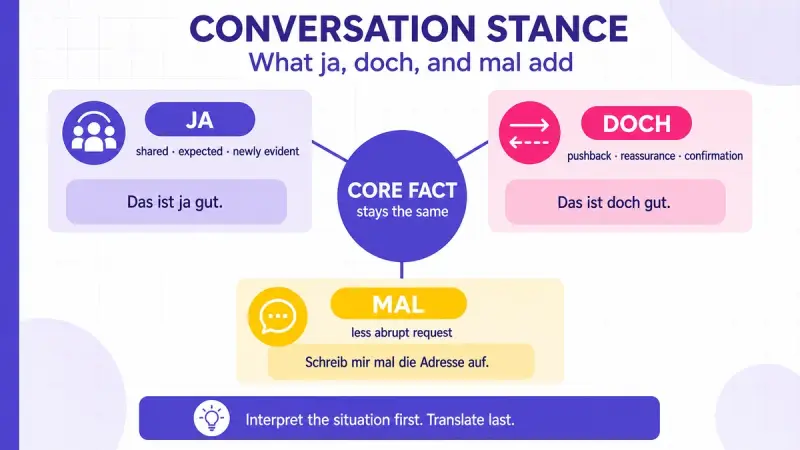
- Das ist gut. states that something is good.
- Das ist ja gut. can present the evaluation as obvious, newly apparent, or already shared.
- Das ist doch gut. can reassure someone or push back against the assumption that it is not good.
All three say the thing is good. What changes is where the speaker stands relative to you and to the conversation so far. Intonation and context decide which reading is live, which is why no single English word ever quite covers it.
Compare the Same Sentence in Context, With and Without the Particle, Before You Translate It
The unit worth studying is not the particle by itself. It is a matched pair of sentences inside a short, concrete situation. That noticing-first habit has solid backing: Penn State's CALPER materials were built the same way, on a corpus of 2,180 emails and 200 chat exchanges from more than 200 German and American university students. Real usage first, production later.
The table below is a set of worked pairs, not a phrasebook. For each row, hold the grammatical core steady, picture the situation, and ask what the particle adds to that specific moment. The effects listed are readings of these contexts, not fixed translations you can paste elsewhere.
| Situation | Without the particle | With the particle | Likely contextual effect |
|---|---|---|---|
| A friend forgot a fact you both discussed | Du kennst Anna. | Du kennst Anna ja. | Treats Anna's identity as shared knowledge |
| Someone assumes the plan is impossible | Das geht. | Das geht doch. | Counters the assumption and invites a rethink |
| A request risks sounding abrupt | Schreib mir die Adresse auf. | Schreib mir mal die Adresse auf. | Makes the request feel incidental, less imposing |
| A fact has just become clear | Das ist interessant. | Das ist ja interessant! | Marks a fresh realization |
| The speaker expected this to be settled | Wir müssen heute fertig werden, oder? | Wir müssen doch heute fertig werden, oder? | Signals this was supposedly already understood |
A useful reading of a particle explains why it fits this shared situation, not which single English word replaces it. English often carries the same effect through intonation, a tag question, "you know," "after all," or nothing at all.
If you are still building the sentence core itself, slot this work into the free German roadmap from beginner study to conversation. Particles come after you can parse the clause, but before you start believing that the grammar is the whole message.
Ja Frames Information as Shared, Expected, or Newly Obvious
Modal ja trips learners up precisely because the same two letters also mean "yes." Inside a statement or exclamation, though, it can point to knowledge presented as shared, signal that something follows from what you both already accept, or carry an evaluation; that range is laid out in the CALPER handout on ja. There is also a surprise reading, which the University of Texas Grimm Grammar pages note: ja can flag that something is suddenly, visibly obvious.
Two examples show the range. In Du weißt ja, dass der Zug früh fährt, the speaker treats the early train as something you already know; the sentence reminds rather than informs. In Das ist ja einfach!, the speaker has just discovered the ease of something: "oh, this is actually easy." Both readings present the information as available or evident instead of introducing it neutrally.
Keep the answering word separate in your notes:
A: Kommst du morgen?
B: Ja.
That ja is a complete "yes." Modal ja never works that way; it sits inside an utterance and colors it.
Modal ja does not mean "yes"; it asks the listener to treat the information as shared, expected, or newly evident in that moment. When you collect examples, save the line that came before as well. Without the preceding turn, you cannot tell which reading was active, and your notes turn into guesses.
Doch Pushes Back on an Assumption or Seeks Confirmation
Modal doch also works on shared knowledge, but it adds friction. It introduces a mild contradiction against something assumed or said, together with a push to overcome that contradiction or to get confirmation, the combination the CALPER handout on doch pins down. Depending on delivery, that can sound corrective, reassuring, persuasive, or simply checking.
Say a friend sighs Das schaffe ich nicht, "I can't do this." Replying Das schaffst du doch pushes back gently: I believe otherwise, and you sort of know it too. In Heute müssen wir doch alles fertig machen, oder?, doch frames the deadline as something already agreed, while oder? asks you to confirm it.
Imperatives take doch as well. Komm doch mit can invite someone along while acknowledging their hesitation, which is part of why the Komm doch mal from the opening feels warmer than bare Komm. But doch is not automatically soft. In an argument, with a sharp tone, the pushback gets harder, not gentler.
And again, split off the stand-alone use:
A: Du kommst nicht?
B: Doch.
That Doch flips a negative assumption all by itself. Inside Du kommst doch, the same word form is doing quieter work within the sentence. The clause you can check in any grammar reference; the particle only starts making sense once you ask why the speaker chose that clause right now.
Mal Often Makes Requests and Suggestions Less Abrupt
Mal is related to einmal, but as a modal particle it does not really mean the action happens once. In requests, commands, and suggestions, it lowers the sense of imposition and makes the action sound temporary or done in passing, the same softening, casual effect the Grimm Grammar pages describe.
Compare Schreib mir deine Adresse auf! with Schreib mir mal deine Adresse auf!, a contrast the CALPER materials work through. The second can sound friendlier because the ask carries less weight. You will hear the pattern constantly in Schau mal, Hör mal, and Probier das mal.
Mal can soften a request, but it cannot make an unreasonable demand polite on its own. The relationship, the wording, the volume, and the tone still decide the outcome. A clipped Mach mal! snapped at someone stays abrupt, particle or not.
One more place you will meet it: statements about intentions, like Das muss ich mal ausprobieren. There it loosens the commitment, more "sometime" than "once." Which is exactly why translating every modal mal as "once" leads you astray.
Use HelloTalk Voice Notes to Compare Context, Stress, and Listener Reactions
Everything so far you can do with text. But particles live in timing, stress, and shared context, and at some point you need a real listener. HelloTalk chats support text and voice messages, with translation, pronunciation, transliteration, and correction aids built into the conversation. The 70M+ registered users the platform reports describe its reach; if you do connect with several German speakers there, treat each reply as one individual speaking style, not the official answer per particle.
Keep each session small: one contrast, one situation. Send the two-line context first, record both versions as voice notes, and ask what difference your partner hears. A ready-made question is Wie wirkt der Satz mit ja im Vergleich zum Satz ohne ja? ("How does the sentence with ja come across compared with the one without it?")
Different parts of this task fit different HelloTalk spaces, so this table sorts them by what each can actually tell you rather than treating them as interchangeable:
| HelloTalk space | What to do with modal particles | What the evidence tells you |
|---|---|---|
| Chat-based learning | Send a two-line context plus one target sentence; use the correction, translation, or read-aloud tools as needed | Whether your wording and intended situation are clear |
| Moments | Post both versions and ask several readers how they differ | A range of judgments, not one universal rule |
| Voicerooms and Livestreams | Listen for ja, doch, and mal and note what happened right before each one | How particles behave in longer, live interaction |
| AI learning tools | Check the grammar and pronunciation of your sentence before asking about its effect | Form-level feedback that supports, but never replaces, a human reading |
Voice notes earn their place here because a partner can hear if you stressed the particle as though it were the answer word or the adverb. If several speakers respond to a Moments post, you can see where they agree and where they split, and Voicerooms lets you observe particles in the wild before you attempt one live. For the give-and-take structure underneath all of this, see how language exchange works.
One native speaker's reaction is evidence about one utterance in one context, not a rule for every region, age group, or relationship. Save the context, the audio, and the explanation together, and the disagreements you collect become data instead of contradictions.
Recognize Particles Reliably Before You Produce or Stack Them
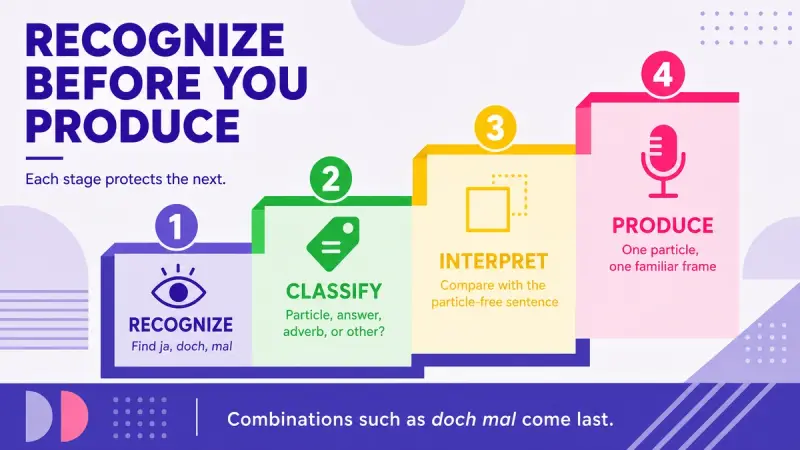
It is tempting to start dropping particles into your own sentences right away, but ja, doch, and mal each have non-modal doubles waiting to confuse you. Recognition has to come first, and the sequence worth copying (observe and define, analyze in context, then communicative use) is the order the CALPER materials teach in. Building on that principle, here is a four-part progression you can work through in sequence: recognize the form, classify its job, interpret its contextual effect, and only then produce one controlled example. It is a practice design, not a law of acquisition, but each stage protects the next.
The table is your checklist for moving from one stage to the next:
| Stage | Practice task | Ready-to-move-on signal |
|---|---|---|
| Recognize | Mark every ja, doch, and mal in a short transcript | You find them without translating |
| Classify | Decide whether each one is modal, an answer, an adverb, or another use | You can justify the call from position and function |
| Interpret | Compare the utterance with its particle-free twin | You can describe the stance in plain language |
| Produce | Record one particle in one familiar sentence frame | A listener hears the effect you intended |
Combinations like doch mal come last for a reason. Their order is conventional, each element contributes something different, and memorizing a stack as decoration makes it harder to notice when it actually fits. Earn each particle separately first.
None of this is about squeezing a particle into every sentence. It is about hearing when a speaker is managing shared knowledge, resistance, or social pressure, and answering that message instead of just the words. That skill feeds directly into the bigger picture in effective communication and language learning.
Frequently Asked Questions
Are German modal particles optional?
Grammatically, usually yes: removing one normally leaves a complete sentence. Pragmatically, the particle may carry the cue about attitude, shared knowledge, or the expected response, so the message changes without it.
Does ja always mean "yes"?
No. Stand-alone ja answers "yes," while modal ja sits inside a sentence and frames its information as shared, expected, or newly evident.
Is doch always argumentative?
No. It marks tension with an assumption, but that tension can serve reassurance, encouragement, correction, or a request for confirmation. Tone and relationship decide how strong it sounds.
Does mal always make a command polite?
No. It often lowers the imposition of a request or suggestion, but it cannot override rude wording, a mismatched relationship, or an angry delivery.
Should beginners use several particles in one sentence?
Not at first. Learn to recognize each particle's modal and non-modal uses, produce one controlled contrast, and only then study common combinations inside complete contexts.
Pick one particle and one sentence pair this week. Use HelloTalk to record both versions, hear how real listeners read the difference, and build your sense of these small words from context rather than the dictionary.