
How to Turn a French Course Lesson Into a Voice-Message Exchange

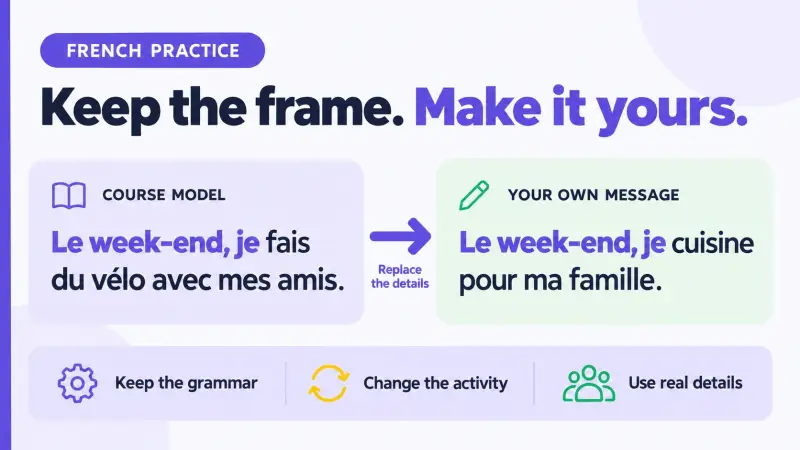
Your course can carry you a long way alone, until what you need next is another person's own answer. The lesson ends on "Le week-end, je fais du vélo avec mes amis." The app marks your repetition correct and nothing follows, because you don't own a bike. So rewrite the line as your real weekend, add a question someone can answer, and send it as a voice message on HelloTalk, where a partner may reply in their own words.
Choose One Course Sentence You Have a Reason to Use
Look at what the model sentence is teaching, not only at what it means. "Le week-end, je fais du vélo avec mes amis" means "On weekends, I ride my bike with my friends", and it is built from a time expression, a present-tense habit, an activity, then "avec" plus the people involved. That pattern is reusable even when the bike is not.
Pick a course sentence you can name a recipient for; if nobody comes to mind, take another one from the same lesson. Forcing a sentence you have no use for produces a recording you will not want to send.
Check the level of the material too. If the sentence comes from a unit you only half follow, your recording time goes into decoding your own script instead of saying something. When you are still deciding where your sentences should come from in the first place, the guide to daily French courses and apps covers that choice.
Make It True for You and Add a Question Your Partner Can Answer
Keep the frame and swap the content words. Suppose your weekend has no bike in it but does have a Saturday morning in the kitchen: "Le week-end, je cuisine pour ma famille." (On weekends, I cook for my family.) Then push it one step further, since a specific sentence is easier for someone to react to: "Le samedi matin, je prépare une soupe de légumes pour ma famille." (On Saturday mornings, I make a vegetable soup for my family.)
A habit gets its edges from what you don't do, so add a negative. "Je ne cuisine pas pendant la semaine, parce que je rentre tard du travail." (I don't cook during the week, because I get home late from work.) The "ne ... pas" wraps around the conjugated verb, which is worth noticing while you still have the written line in front of you.
One finished event gives your partner something concrete to picture, so add last Saturday as well. One way a first draft can go wrong is "Samedi dernier, je fais une soupe aux carottes", and that is the kind of line to look at again before you record anything.
Then close with a question aimed at their life, not at your grammar, since this is the line that gives your HelloTalk partner a reason to answer in their own words instead of only ruling on yours: "Et toi, qu'est-ce que tu cuisines le week-end ?" (And you, what do you cook on weekends?)
A question about your partner's own routine gives them something to say beyond « c'est correct ». Grammar questions are still worth asking, and people do answer them with explanations; this one simply also hands the other person a topic they know better than you do.
Send the Voice Message on HelloTalk and Continue the Same Topic
Rehearse with the plain voice recorder already on your phone, reading from your notes. Reading your script out loud is where you catch the mistakes you can already fix yourself. "Samedi dernier, je fais une soupe aux carottes" puts a finished Saturday next to a present-tense verb; the past-tense pages of your own course give you "Samedi dernier, j'ai fait une soupe aux carottes", while the routine line before it stays in the present, because that part really is a habit.
Record it again with the fix in place. How many takes that needs is up to you, and something around twenty to thirty seconds is a handy size to aim at rather than a threshold anyone measured.
Then send the recording as a voice message on HelloTalk, because speaking is what you are practising here and only a listener can tell you whether your weekend came through. HelloTalk carries text and voice messages inside the same chat and lets a partner attach a correction to one specific message, so when a reply mentions your third sentence, you are both pointing at the same line.
Two more HelloTalk features matter for this particular exchange: in-chat translation and voice transcription, which help you work out a reply you only half caught, with the usual caution that an automatic transcript or translation can be off. How two people trade their languages in the first place is covered in the language exchange guide, and what chat translation actually does in translation in a chat, only deeper.
The exchange below was written as a teaching example for this page. It is not a transcript, and "Emma" is an invented partner, not a real user.
Your voice message: "Bonjour Emma ! Le samedi matin, je prépare une soupe de légumes pour ma famille. Je ne cuisine pas pendant la semaine, parce que je rentre tard du travail. Samedi dernier, j'ai fait une soupe aux carottes. Et toi, qu'est-ce que tu cuisines le week-end ?"
(Hi Emma! On Saturday mornings I make a vegetable soup for my family. I don't cook during the week, because I get home late from work. Last Saturday I made a carrot soup. And you, what do you cook on weekends?)
A plausible reply: "Moi, je ne cuisine pas beaucoup pendant la semaine, mais le dimanche, je fais souvent un poulet rôti avec ma mère. Petite remarque : « préparer une soupe » se dit très bien ; moi, je dis plutôt « faire une soupe »." (Me, I don't cook much during the week, but on Sundays I often make a roast chicken with my mother. Small note: "préparer une soupe" is perfectly fine; personally, I'd rather say "faire une soupe".)
Your follow-up: Keep it as a voice message in the same HelloTalk chat and point it at her chicken rather than at your own sentence, so the topic stays on something she can actually tell you about: "Qui t'a appris cette recette ?" (Who taught you this recipe?) Or, to practise a pronoun: "Tu le fais avec des pommes de terre ?" (Do you make it with potatoes? Here "le" stands for "le poulet".)
Exchange partners answer as people with their own weekends, not as graders. The invented partner above brings in a mother and a Sunday chicken because an illustrative partner can answer out of their own experience, and real exchange partners have their own learning goals running alongside yours. That cuts both ways: their time is not a free tutoring slot, and a remark about French usage is worth checking rather than filing away as a rule.
Use One Piece of Feedback in Your Next Version
Two different things arrive in that reply. Cooking on Sunday rather than Saturday is not a correction at all, just a different weekend. The note about "faire une soupe" is the language item, and even that is one speaker's preferred alternative rather than a mistake you made or a rule that holds for everyone.
Pick one item before you write back, and decide how you will ask about it on HelloTalk and how you will check the answer. Those are three separate moves, and checking is the one people skip, which is why the table below keeps it in its own column alongside what you do with the result.
| What you want sorted out | How to ask for it | How to check the answer | How to reuse it |
|---|---|---|---|
| One verb tense | On HelloTalk, ask about that one line only: "Est-ce que « Samedi dernier, j'ai fait » est correct ici ?" Your course shows the form, and a partner can comment on this actual sentence | Compare it with the past-tense pages of your own course | Say one new past-tense sentence about last weekend |
| One word's pronunciation | Ask for one spoken model in the same HelloTalk chat: "Tu peux dire « légumes » lentement, s'il te plaît ?" A spoken reply gives you their own model to listen back against | Record yourself saying it and listen to both versions back to back | Keep that word in your next voice message instead of avoiding it |
| Whether a phrase sounds natural | Put the choice to your HelloTalk partner: "On dit « faire une soupe » ou « préparer une soupe » ?" A speaker can tell you which one they would actually say, alongside what your course and dictionary show about usage | Ask for one example sentence, then look both up in your course or dictionary | Use the version they modelled in your next line |
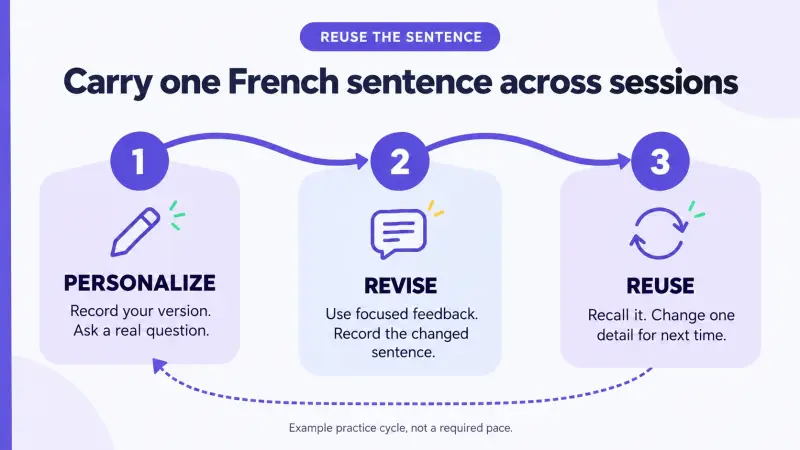
A correction is already worth something once you understand it. Reusing it is the part that tells you whether it transferred, and that means saying something new and true with it rather than repeating the corrected sentence back.
Put it in your next voice message to the same HelloTalk partner, since the first version is already in that chat and they can pick the topic back up if they choose to answer: "Dimanche dernier, j'ai fait un gâteau au chocolat avec ma fille, et nous l'avons mangé le soir même." (Last Sunday I made a chocolate cake with my daughter, and we ate it that same evening. Here "l'" stands for "le gâteau".)
Reusing a correction in a sentence nobody corrected for you is how you check that you can apply it, not only recognise it. And if a correction surprises you, check it before adopting it. People correct from habit, usage varies by region, and a confident answer is not automatically a verified one.
Keep Today's Practice Useful Even if the Reply Comes Later
A reply might come in an hour, tomorrow, or not at all from that particular person. HelloTalk's chat FAQ explains that time zones, busy schedules and mismatched interests all affect whether someone answers, and it suggests filling out your profile, trying other partners and posting to Moments. None of that promises a speed, and silence is not a verdict on your French.
Save the one message you will actually use again. HelloTalk lets you keep a message or a correction in your favorites, so Emma's note about « faire une soupe » is still there the next time you want it, and a label like "passé composé" or "le week-end" can sit next to the recording in your own notes.
The cake sentence leans on a different source: the past-tense pages of your own course, which you checked yourself. Open the saved message when you want her wording, and look at that course note again before you put j'ai fait next to a cake.
The recording also keeps working while you wait. Re-record the same script tomorrow from the same notes and listen to both takes. That mostly tells you about your delivery, and it can also surface a line that sounds wrong to you and is worth checking against your course, though the recording on its own confirms nothing about whether you got it right. It is a different result from a human reply rather than a replacement for one.
A late answer is still an answer, and it does not change what you asked. "Qu'est-ce que tu cuisines le week-end ?" is about what someone does in general, so it reads the same on Wednesday as it did on Saturday. Only if you switch to one particular weekend that has already happened does the tense move with it: "Qu'est-ce que tu as cuisiné le week-end dernier ?" (What did you cook last weekend?)
When your own version of the cooking message is ready, HelloTalk is where you send it and ask your question.