
Your First Japanese Self-Introduction: Practice the Next Two Turns
Once your prepared introduction is ready, the next task is responding to a real person's follow-up, and a text or voice exchange on HelloTalk is where that happens. Rehearsal is solo work; two lines come back, you can read some of it, and the empty message box feels heavier than the introduction did. A reply carries facts you cannot write in advance.
The introduction is the part you can finish in advance, while the next two turns have to be practiced as branches rather than as a longer script.
Start With an Introduction You Can Actually Talk About
An introduction that survives the next turn is built from details you can say a second sentence about. If you list a hobby because the word was short, the follow-up question lands on something you have no vocabulary for. Pick the version of each fact that is true for you and that you would not mind a stranger asking about.
Alex and Yuki below are teaching examples I wrote for this page, not messages captured from a real chat. In the romaji, vowel sequences are written out as the kana spell them, so you will see ryouri, benkyou and Oosaka. The romaji is reading support only; it does not describe how the sentence sounds when a person actually says it.
Alex is an adult beginner from Canada, living in Berlin, about three months into studying Japanese. Here is the full version:
はじめまして。アレックスです。 Hajimemashite. Arekkusu desu. Nice to meet you. I am Alex.
カナダから来ました。 Kanada kara kimashita. I am from Canada.
今、ベルリンに住んでいます。 Ima, Berurin ni sunde imasu. Right now I live in Berlin.
日本の料理が好きです。 Nihon no ryouri ga suki desu. I like Japanese food.
日本語を勉強しています。 Nihongo o benkyou shite imasu. I am studying Japanese.
よろしくお願いします。 Yoroshiku onegaishimasu. A set closing for a first message. In this context it works as "I am glad to meet you, and I hope we can keep talking." It is not asking the other person for a specific favor here.
That is a worked example, not a required length. What you actually need is a short greeting, one or two true details you are willing to be asked about, and a polite close. A three-line introduction starts a conversation perfectly well, and a six-line one is not better for being longer.
Choose the details with the follow-up in mind. For the place lines, your country or city is usually enough, and there is no reason to hand your neighborhood, street, school or workplace to someone you just met. For the interest line, name something you actually follow, since that is the line a partner is most likely to pick up. Leave out any level or test result you could not explain if asked.
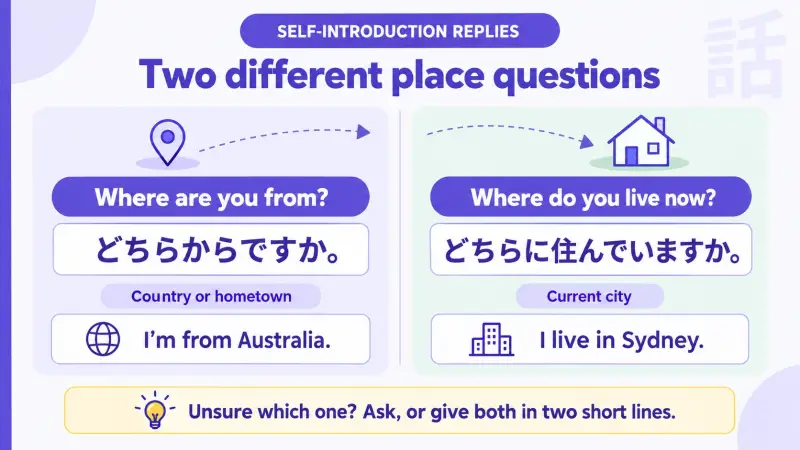
から来ました states where you are from, 住んでいます states where you live now, and a partner can ask about either one without the other. In fast messages and casual speech you will also meet the shortened 住んでます (sunde masu); 住んでいます is the fuller form, and neither one is a mistake.
If you have not settled what to prepare before a first real conversation at all, what to have ready before your first real Japanese conversation covers that groundwork, and this page picks up after it.
When Your Partner Asks a Question About You
In the polite written Japanese you are most likely to receive in a first exchange, a question often ends in ですか or ますか, and a question word points at what is being asked: どちら (dochira, where, polite), 何 (nani or nan, what), どうして (doushite, why), いつ (itsu, when), どう (dou, how).
Treat those as clues in examples like the ones below, not as a test you can apply to every message. Yes/no questions carry no question word at all, casual messages often drop か, and a line without か can still be asking you something. What settles it is what the message wants from you. When the shape does not tell you, use the context of what you just wrote, or ask.
Say Yuki writes:
どちらからですか。 Dochira kara desu ka. Where are you from?
Answer in one short sentence, then hand the same question back. On HelloTalk that handoff gives your partner something specific to answer without needing new grammar from you, and if they reply, their own origin or studies give you the next thing to react to, which is material you could not have prepared.
カナダから来ました。ユキさんは、どちらからですか。 Kanada kara kimashita. Yuki-san wa, dochira kara desu ka. I am from Canada. Yuki, where are you from?
The same two-part shape works elsewhere. If Yuki asks 日本語の勉強はどうですか (Nihongo no benkyou wa dou desu ka, "How is your Japanese study going?"), you can answer 難しいですが、楽しいです (Muzukashii desu ga, tanoshii desu, "It is difficult, but it is fun") and then ask ユキさんは、何を勉強していますか (Yuki-san wa, nani o benkyou shite imasu ka, "Yuki, what are you studying?").
One thing to watch: a question about where you live is not the same question as where you are from, even though both can feel like "where are you." If the question is about your current home, answer with 住んでいます instead of repeating から来ました.
When Your Partner Shares Something About Themselves
Not every reply is a question. Many partners answer by offering a fact of their own, because they want a turn too. A line like this one gives you new information and asks you nothing directly:
私は大阪に住んでいます。 Watashi wa Oosaka ni sunde imasu. I live in Osaka.
The useful move here is not a new topic. React briefly, then take one noun out of their sentence and ask about it. On HelloTalk that keeps the thread on the fact your partner already supplied, which gives them something specific to answer instead of a question you could have asked anyone.
そうなんですね。大阪はどうですか。 Sou nan desu ne. Oosaka wa dou desu ka. Oh, I see. What is Osaka like?
A third kind of reply is a short confirmation or compliment, such as 日本語が上手ですね (Nihongo ga jouzu desu ne, "Your Japanese is good"). It carries no new information you have to process, so a brief thanks plus one true sentence is enough: ありがとうございます。まだ勉強中です (Arigatou gozaimasu. Mada benkyou-chuu desu, "Thank you. I am still in the middle of studying"), where 勉強中 means "in the middle of studying."
Preparing by what a reply is doing beats preparing by script, because you cannot know which sentence a particular person will send. Real partners mix these kinds, skip them, or bring up something you never asked about.
When You Do Not Understand the Reply
Sometimes you can read every character and still not know what the message wants from you. This is the branch worth rehearsing most, because this is where beginners go quiet and the exchange ends by accident.
Three short requests cover most of it:
すみません、もう一度お願いします。 Sumimasen, mou ichido onegaishimasu. Sorry, could you say that once more?
もう少し、ゆっくり言ってください。 Mou sukoshi, yukkuri itte kudasai. Please say it a little more slowly.
すみません、「〜」はどういう意味ですか。 Sumimasen, "..." wa dou iu imi desu ka. Sorry, what does "..." mean?
The third one is the most useful in text, because on HelloTalk you can paste the exact word you got stuck on between the quotation marks and ask your partner what it means. The quoted word shows them which part you need explained, so you have something to work from when you attempt the next response. A short request to repeat, slow down, or explain a word is an ordinary conversational turn, not an interruption of the practice.
For a wider set of Japanese phrases for repeating, confirming and keeping a reply moving, see asking for repeats and keeping a Japanese reply going; this page keeps only what you need to stay in the exchange.
The four branches above fit on one screen. Use the table as the thing you glance at while typing, sorted by what the reply is doing rather than by its grammar.
| Reply kind | What you need to notice | What you do next |
|---|---|---|
| A question about you | It asks for your side of something: your origin, your city, your studies, your interests | Answer in one short sentence on HelloTalk, then hand the same question back with 〜さんは so the other person has something of their own to tell you |
| Something about themselves | It gives you a new fact about them and asks you nothing | React briefly, then pick one noun from their sentence and ask about it on HelloTalk, which keeps the topic on ground they chose |
| A confirmation or compliment | It adds no information you have to answer | Thank them on HelloTalk and add one true sentence about yourself, which leaves the exchange somewhere to go |
| Something you cannot interpret | You can read it but cannot say what it wants from you | Quote the exact word on HelloTalk and ask your partner what it means, or ask for a repeat, then continue from what they send |
Try the Exchange on HelloTalk, Then Change One Detail
Carry that reference into one real exchange. On HelloTalk you can send your introduction as a text message or as a voice message, and both are worth doing at some point: text gives you time to check the branch table, voice makes you commit to a reading. Looking at your notes while you record is fine.
HelloTalk's translation and voice transcription support can help you work out an incoming line, but treat the output as a hint rather than a verdict, since both can misread casual Japanese.
HelloTalk's Speak function reads text aloud with synthesized audio, which helps you hear a shape before you record, but it is not the partner's own voice, and following a transcript is not the same as understanding an audio message unaided.
What makes this worth more than another rehearsal is that the other person has their own origin, interests and reasons for being there. Their reply will not be the one in your table, and working out which branch it belongs to is the practice.
Afterwards you can ask for one focused correction instead of a full review. Attach the particular sentence you were unsure about on HelloTalk and send the request with it, so the other person knows exactly which line to look at:
この文を直してもらえますか。 Kono bun o naoshite moraemasu ka. Could you correct this sentence for me?
That request is optional, and no particular wording guarantees an answer. HelloTalk partners can send corrections directly on your messages, and you can save messages and corrections to look at again later. What comes back is informal feedback from another member, not a graded answer key, so if a correction surprises you, ask why or check it against a textbook before you rewrite your introduction around it. Replies also do not need to be immediate; a partner in another time zone answering tomorrow is normal.
If a message or correction turns out to be useful, save it to your favorites on HelloTalk and open it again before your next exchange, so what you learned goes back into a real turn.
Then change one true detail, send the new version to a partner on HelloTalk, and sort whatever comes back using the same four branches. The interest line swaps cleanly, because the frame stays put:
音楽が好きです。 Ongaku ga suki desu. I like music.
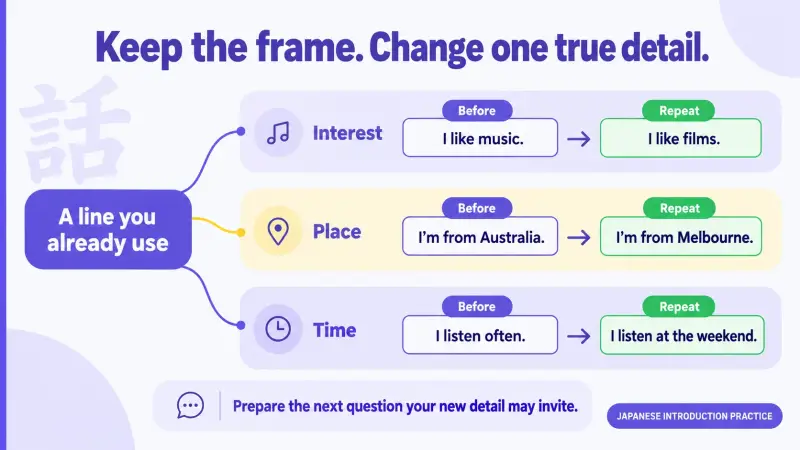
Origin and residence do not work that way. Replacing から来ました with 住んでいます changes which question you are answering, so practice them as two different exchanges rather than as one sentence with a replaceable word.
Keeping the frame fixed while the content moves is what turns a memorized introduction into something you can use with a different person. For a wider weekly routine that runs this alongside kana work, see practicing kana and short exchanges in parallel. For starting exchanges while the writing systems are still shaky, short Japanese exchanges before the writing systems are solid approaches the same habit from the other direction.
Write your own short version tonight, using details that are actually yours, and send it to one partner on HelloTalk tomorrow.