
What Should a Japanese Beginner Know Before the First Real Conversation?

You finished hiragana, you can read the example sentences in your app, and this week you typed はじめまして into a chat box twice without pressing send. The blocker is usually not vocabulary. It is the second half of the exchange: you can introduce yourself, but you have no plan for what happens after the other person answers, so the safest move feels like closing the app and doing another lesson.
The honest answer to "what do I need first" is smaller than most study plans suggest. You need one complete short exchange you can produce and repair, plus a way to capture what comes back. The rest of this article sets that minimum line, names what can wait, and shows how to turn a first real reply into your next practice session.
The Minimum You Need Before a First Japanese Conversation
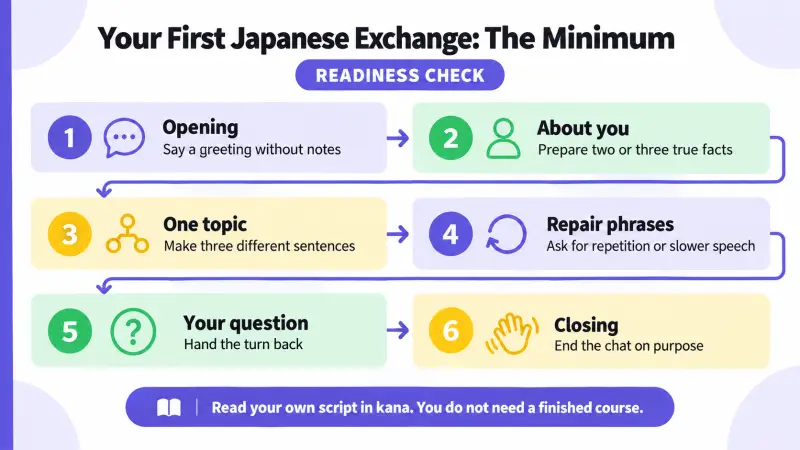
Define your minimum by the shape of the exchange, not by a word count. Almost every first conversation has the same slots: an opening, a little information about you, one topic you can extend, phrases to fix a breakdown, a question that hands the turn back, and an ending. If you have one working line for each slot, you can finish a conversation even when you understand only half of what comes at you.
The minimum preparation for a first Japanese conversation is one complete short exchange you can produce and repair, not a vocabulary total: an opening, two or three sentences about yourself, one topic you can extend, three repair phrases, one question that hands the turn back, and a closing line.
The checklist below is the version worth writing out before you book any practice. Read it as a self-test rather than a syllabus: the third column is what proves you actually have the item, not just that you have seen it in a lesson.
| Readiness item | Example you can build | How to know it is ready |
|---|---|---|
| Opening line | はじめまして。アレックスです。よろしくおねがいします。 | You can say it without looking at your notes |
| Two or three facts about you | カナダから来ました。エンジニアです。日本語を勉強しています。 | You can say all three in under 20 seconds |
| One topic with 8 to 10 usable words | Food, music, pets, travel, or your job | You can make three different sentences about it |
| Three repair phrases | もう一度おねがいします。ゆっくりおねがいします。それは何ですか。 | You produce one within a second or two of getting stuck |
| One question that hands the turn back | 〜は何ですか。〜が好きですか。 | You can ask it about a topic you did not rehearse |
| A closing line | ありがとうございました。また話しましょう。 | You can end the chat on purpose instead of going quiet |
| Kana reading for your own script | Your rehearsed lines written in hiragana and katakana | You can read them off the screen, not only from memory |
If you want source material already organized this way, the Japan Foundation's Irodori Starter book opens with greeting and self-introduction tasks instead of grammar tables. Starter Lesson 1 is the one to pull up, and it is published as a downloadable PDF with audio on the Japan Foundation's Irodori site, so you can search the title and lesson number and find it without a link. This article covers one narrow slice of a longer path, so if you are still deciding what your overall first weeks should contain, the wider guide to learning Japanese fast as a beginner sets the sequence assumed here.
What You Do Not Need to Master Before You Start Speaking
Most people delay their first conversation because of items that belong to a later stage. Clearing them off the list is what makes the first chat schedulable this week instead of next quarter.
Kanji, keigo, and full verb conjugation are not entry requirements for a first conversation, because a beginner exchange runs on です and ます forms, set phrases, and short questions.
Here is what you can safely leave unfinished, and the point at which each one starts to matter:
-
Kanji beyond recognition. A first text chat can be read with kana plus the transliteration and translation tools in your chat app. Kanji becomes urgent when you want to read what your partner writes without support, usually well after your first few conversations.
-
Keigo and humble forms. Language partners talking casually do not expect honorific speech from a beginner. です and ます carry a first conversation. Register work becomes real when you start writing to teachers, colleagues, or strangers in formal settings.
-
Complete verb conjugation. You need 好きです, 食べます, 行きたいです, and a handful of others in the forms you rehearsed. Conjugation tables start paying off when your sentences get longer than one clause.
-
Understanding every reply. Partial understanding plus a repair phrase is a working conversation. Chasing full comprehension is what makes people freeze.
-
A finished course. Finishing a unit is not what unlocks speaking; having a repeatable exchange is.
Whether speaking should wait for the writing systems at all is answered separately in the piece on starting Japanese micro-conversations before the writing systems. The short version is that kana supports your own script, and kanji can follow behind your speaking.
Choose One Topic and Build a Small Response Map
Once you accept a narrow entry line, the next question is what to actually say. A response map is one topic written in three columns: what you say, the kinds of replies you are likely to get, and what you say next. It takes about twenty minutes to build and it removes the specific moment where beginners stall, which is turn three.
One topic prepared three sentences deep is more useful in a first conversation than five topics prepared one sentence deep, because real replies follow up on what you just said.
The map below is suggested practice for a food topic, written the way you would write your own. The middle column is deliberately approximate: you are not predicting exact wording, you are preparing for reply types so that an unfamiliar sentence still lands in a category you planned for.
| Your line | Reply type you may get | Your prepared next move |
|---|---|---|
| ラーメンが好きです。よく食べます。 | A follow-up about which kind, such as どんなラーメンが好きですか | とんこつラーメンが好きです。〜さんは? |
| とんこつラーメンが好きです。 | Agreement or a personal comment, such as 私も好きです | いいですね。おすすめのお店はありますか。 |
| おすすめのお店はありますか。 | A place name plus words you have never seen | それは何ですか。すみません、もう一度おねがいします。 |
| 日本に行きたいです。 | A question in a form you have not studied, such as 日本に行ったことがありますか | まだありません。いつか行きたいです。 |
Notice that two of the four "next moves" are repair phrases. That is intentional. The map is not there to keep the conversation on rails, it is there to make sure that falling off the rails has a scripted response. Keep the whole thing to one page and reuse it across your next three conversations rather than building a new one each time.
Rehearse the Exchange Before a Real Person Replies
A response map on paper is still silent. Rehearsal is the step that turns it into something your mouth can do under mild pressure, and it works best in short sessions of five or ten minutes rather than one long one.
Rehearsal makes your own sentences faster to produce, but it cannot supply the unpredictable half of a conversation, which is why every rehearsed sequence should end on a question you hand back.
A suggested rehearsal routine, spread over two or three days before your first chat: read your opening and self-introduction aloud five times, then record yourself on your phone and listen for anything that made you slow down. Next, practice only the repair phrases, out of order, until one comes out without thinking. Then run the full map once from start to finish, saying the other side's likely replies out loud too, so your turn arrives at a familiar rhythm.
Structured apps are useful here for stabilizing the patterns you are about to use. A course app such as Duolingo or Busuu can drill 〜が好きです or 〜は何ですか far past the point where you would bother repeating it yourself, and both are free to start with optional paid plans, so you can test the fit before committing. What those drills cannot do is give you a response that was not written in advance.
Listening warm-up helps too, and it does not require you to speak. The HelloTalk platform hosts Voicerooms you can join as a listener, and HelloTalk's Voiceroom subtitles show spoken content as text while Tap-to-Translate can translate a word or sentence you select, so you can follow more of a live room than your listening alone would allow. Sitting in one for ten minutes before your first chat gets your ear used to real speed without putting you on the spot.
Use HelloTalk Text and Voice Messages for a Controlled First Conversation
Rehearsal ends the moment a real person replies with something you did not write. The way to keep that manageable is to control the channel, because a first conversation in text is a different difficulty level from a first conversation on a live call.
Five things happen in one useful practice cycle, and it helps to know all five before you start: the material you bring, the sentence you send, the reply you get, the review you do on that reply, and the task you set for next time. A chat thread is one of the few places where all five can happen in the same window.
Start with text. You bring your rehearsed lines from your course app or your response map, send the opening, and keep your map open beside you. When the reply arrives, HelloTalk's chat tools let you translate the message, see a transliteration of the kana and kanji, and play it aloud, so an unfamiliar sentence becomes something you can decode instead of something that ends the conversation. That decoding is the review step, and it happens inside the same thread rather than in a separate notebook.
Move to voice messages for the second or third conversation. A voice message is recorded, which means you can listen back, delete, and re-record before anyone hears it, and it still gives your partner your real pronunciation to respond to. That middle step between typing and a live call is where most beginners find their footing.
If you do not have a regular partner yet, posting is the lower-pressure entry. HelloTalk's Moments lets you publish two or three sentences publicly, and the correction feature works on both chat messages and Moments posts, so several native speakers can respond to the same short paragraph. Replies depend on who is online and interested, so treat any single post as one attempt rather than a scheduled lesson, and keep your first chat short, roughly six to ten turns, ending while you still have material left. You can register on HelloTalk and run this entire first exchange in text before you ever use the microphone. For how this layer sits alongside courses, audio, and review tools, the breakdown on building a beginner stack around real Japanese speakers covers the combination in more detail.
Turn Corrections and New Phrases Into the Next Practice Session
The first conversation produces more material than the conversation itself was worth. That material arrives in three forms: corrections to your grammar, comments about what sounds natural, and phrases your partner used that you never studied. All three are worth keeping, but only if you write down the situation along with the sentence.
A correction turns into learning when you reuse the corrected sentence in a new situation, not when you read the corrected version once.
Log each item in three parts: what you originally wrote, what the corrected or more natural version was, and the reason or context your partner gave. Then convert it into one small task. The table below maps the feedback types you are most likely to collect in a first conversation onto the task that actually uses them, so that your next session starts with something concrete instead of a blank page.
| What you received | What it tells you | Next practice task (suggested) |
|---|---|---|
| A particle change, such as ラーメンを好きです corrected to ラーメンが好きです | You are carrying an English pattern into a Japanese structure | Write four new 〜が好きです sentences on other topics and send one in your next chat |
| A more natural phrasing, such as あなたは何をしますか replaced with お仕事は何ですか | Your sentence was grammatical but not what people say in that situation | Save both versions with the situation attached, and use the natural one with a new partner |
| A word you did not know in the reply | A gap in topic vocabulary, not a grammar problem | Add it to your review app inside the full sentence it appeared in, never as a bare word |
| A question you could not answer | Your response map is missing a branch | Add the branch, write your answer, read it aloud five times before the next chat |
| A pronunciation note on a voice message, such as おばさん and おばあさん | A vowel length or rhythm issue that text will never reveal | Re-record the same sentence, compare it with the read-aloud audio, send the second take |
One caution about the middle row. A single partner's naturalness judgment is that person's preference in that context, not a universal rule, so collect a second opinion before you rewrite a phrase you learned from a course. Corrections about grammar are usually safe to apply immediately; corrections about style are worth checking twice.
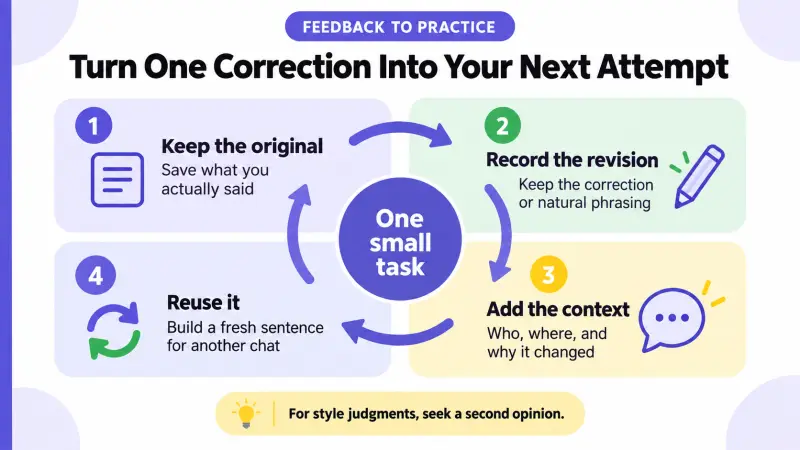
Do the conversion within a day while you still remember the exchange, and keep the list short. Five saved items reused across the next two conversations beats thirty items saved and never touched again.
Frequently Asked Questions About a First Japanese Conversation
How many Japanese words do I need before my first conversation?
There is no fixed threshold, and counting words is the wrong measure. What matters is whether your words cover the six slots of an exchange: greeting, self-introduction, one topic, repair, a question, and a closing. In practice that tends to land somewhere around 60 to 100 words if they are the right ones, which is far less than most beginners assume.
Should my first conversation be text or voice?
Text first. It lets you keep your response map open, look up an unfamiliar word before replying, and take as long as you need on each turn. Voice messages are the natural second step because you can record and re-record privately, and live calls are worth saving until the text version feels routine.
What should I say when I do not understand the reply?
Use a repair phrase rather than silence: もう一度おねがいします for a repeat, ゆっくりおねがいします for slower speech, or それは何ですか for a specific word. In text you can also ask your partner to write it in hiragana, which is often easier than asking for a translation. Needing repair several times in a first conversation is normal, not a sign that you started too early.
Do I need to learn keigo before talking to a Japanese speaker?
Not for a casual conversation with a language partner. です and ます forms are appropriate and expected from a beginner. Honorific and humble language becomes relevant when you are writing to teachers, customers, or people in formal roles, and it is much easier to learn once you already have basic sentences that work.
How long should a first conversation be?
Short on purpose. Six to ten turns of text, or about ten minutes, is enough to produce feedback without exhausting your prepared material. Ending while you still have something left to say makes the second conversation far easier to start.
What if the other person switches to English?
Say what you want directly, either in Japanese with 日本語で話したいです or in English with a simple request to keep part of the chat in Japanese. A split arrangement, where each of you writes in the language you are learning, works well because both sides get practice. If someone only wants English, it is fine to thank them and find another partner.
Can I practice a first conversation without a regular partner?
Yes. Posting two or three sentences to HelloTalk's Moments gets your writing in front of multiple native speakers, and joining a Voiceroom as a listener gives you real speech to follow before you speak in one. Neither replaces a back-and-forth exchange, but both let you start collecting real reactions while you are still looking for a partner you click with.