
The Fastest Korean Learning Order: Hangul, Sentence Patterns, Listening, and Conversation
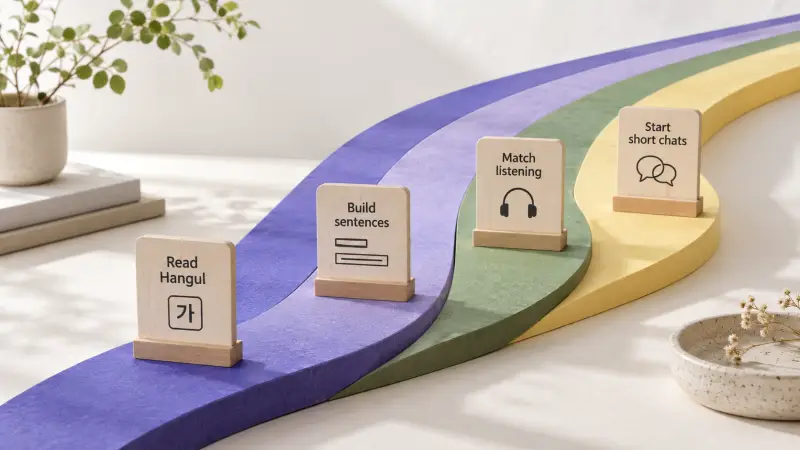
You spent a weekend on Hangul, and now you can sound out 안녕하세요 at roughly one syllable per second. Then you opened a beginner grammar course, a vocabulary deck, and a Korean variety clip on the same evening, understood almost nothing in the clip, and closed all three because nothing told you which one was supposed to come first.
The honest answer to "what order is fastest" is that the four pieces are not four stages you finish one at a time. Hangul genuinely comes first, but sentence patterns and listening should start overlapping with it within days, and short conversations should begin while your grammar still has obvious holes. Below is how far to take each piece before adding the next, and what signal tells you the overlap is working.
The Fastest Useful Order Is Overlapping, Not Strictly Linear
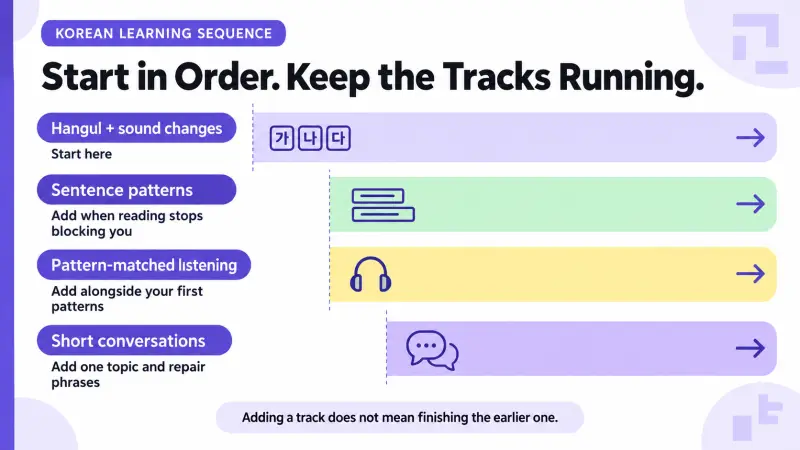
Think of the four pieces as four tracks rather than four levels. Track one is Hangul and the sound changes that come with it. Track two is high-frequency sentence patterns. Track three is listening that uses the patterns you are currently studying. Track four is short real conversations. They start in that order, but once a track starts it keeps running, so by week three or four you should have three of them active in the same week.
The fastest workable Korean order is Hangul first, then sentence patterns and listening running in parallel, with short conversations starting before your grammar feels complete. Strictly linear plans break in predictable ways. If you finish "all the vocabulary" before touching grammar, you own a pile of nouns with no frame to put them in. If you read for months before listening, your eyes learn Korean and your ears never learn where one word ends and the next begins. If you wait for confidence before speaking, you never train retrieval under time pressure, which is the actual bottleneck in a real exchange.
The table below is a planning summary, not a ranking. Read it by row when you are deciding whether a track is ready to hand off to the next one, and treat the third column as "good enough to move on," not as mastery.
| Track | Start it when | "Good enough for now" looks like | What it unlocks next |
|---|---|---|---|
| Hangul and sound changes | Day one | You read a short sentence aloud without spelling it out, and you recognize a handful of common sound changes when you hear them | Studying from Korean text instead of romanization |
| High-frequency sentence patterns | As soon as reading stops being the bottleneck | You can build eight to ten sentence frames from memory and swap nouns and verbs into them | Producing your own sentences instead of reciting memorized lines |
| Pattern-matched listening | The same week your first patterns start | You catch the sentence ending and the main noun in slow beginner audio | Understanding replies that contain the patterns you already use |
| Short real conversations | Once you have one topic plus two or three repair phrases | You survive a five-message exchange with help | New vocabulary, register feedback, and material for the next study block |
How much of this fits in a week is a separate question from what order to do it in, and the scheduling side is worked through in this guide to learning Korean quickly around a busy schedule. This article stays on sequence and overlap.
Start With Hangul and the Sound Changes You Meet Immediately
Hangul's 24 basic letters, 14 consonants and 10 vowels, combine into syllable blocks, which is exactly why the alphabet feels finished after a weekend and then stops working the moment someone speaks. You can read 좋아요 correctly letter by letter and still not recognize it in audio, because it is pronounced 조아요.
Learning Hangul is not finished when you can read the letters; it is finished when written Korean and spoken Korean stop sounding like two different languages to you. The gap between them is mostly a short list of sound changes you meet in your first week of real sentences:
- Linking: a final consonant moves onto the next syllable, so 있어요 sounds like 이써요.
- ㅎ weakening: 좋아요 sounds like 조아요 and 많이 sounds like 마니.
- Nasal assimilation: 감사합니다 sounds like 감사함니다, and 학년 sounds like 항년.
- Liquid assimilation: 신라 sounds like 실라.
- Palatalization: 같이 sounds like 가치.
- Final consonant neutralization: 맛, 맏, and 맞 all end in the same stopped sound when nothing follows them.
You do not need the rule names, and you do not need to memorize the full set before moving on. You need to expect that the written form and the spoken form will differ, so that mismatch stops feeling like a mistake on your part.
Here is a suggested practice block, not a tested protocol: take five sentences from any beginner lesson that has audio, read them aloud and record yourself, then play the original and mark every syllable where your version and the audio disagree. Almost all of those marks land on sound-change points, and that list becomes your pronunciation homework for the week.
Once the alphabet is done, most learners hit an awkward stretch where the beginner content is finished but nothing obviously says what to study next. That gap, and the resources that do and do not cover it, is handled in this piece on what to study after Hangul.
Add High-Frequency Sentence Patterns Before Large Vocabulary Lists
A vocabulary list without patterns gives you words you can recognize and cannot use. A pattern list without vocabulary is uncomfortable for about two days and then fills itself, because every new word you meet slots into frames you already control.
Ten sentence patterns and forty nouns generate hundreds of sentences you can actually produce, while four hundred isolated words generate none. That is arithmetic, not a study finding, but it is the reason pattern-first beginners start sounding functional earlier than list-first beginners.
A workable starter set for the first month looks like this, and each one should be practiced as a frame with a blank you can fill:
- 저는 ___이에요 or ___예요 for identity and basic description.
- ___이 있어요 and ___이 없어요 for existence and possession.
- ___을 좋아해요 and ___을 싫어해요 for preferences.
- ___에 가요 for destinations, ___에서 ___해요 for where an action happens.
- ___고 싶어요 for wants.
- ___을 수 있어요 and ___을 수 없어요 for ability.
- ___아 주세요 or ___어 주세요 for requests.
- ___았어요 and ___었어요 for the past.
Widely used beginner resources organize themselves around exactly these frames. Talk To Me In Korean's Level 1 audio lessons and the free written grammar explanations on How to Study Korean both move pattern by pattern rather than list by list, and the National Institute of Korean Language publishes reference material and a standard curriculum outline if you want to see which structures the field treats as foundational. Access terms differ across these, some of it free and some behind paid books or plans, so check the current terms before you build a plan around any one of them.
Suggested practice for a pattern block: pick one frame, write ten sentences that are true about your actual week, then say all ten out loud twice. True sentences are easier to recall later because you have a reason to say them again.
Train Listening With the Same Patterns You Are Learning to Build
The usual listening mistake is reaching straight for full-speed drama or variety audio, understanding nothing, and concluding that your ears are broken. The opposite mistake is staying on textbook audio recorded at an unnaturally slow pace for months, which trains you to understand a speaking style no one uses.
The fix is matching the content to the patterns you already study. If this week's frames are ___고 싶어요 and ___을 수 있어요, your listening job is to find those endings in real speech, not to understand the whole clip.
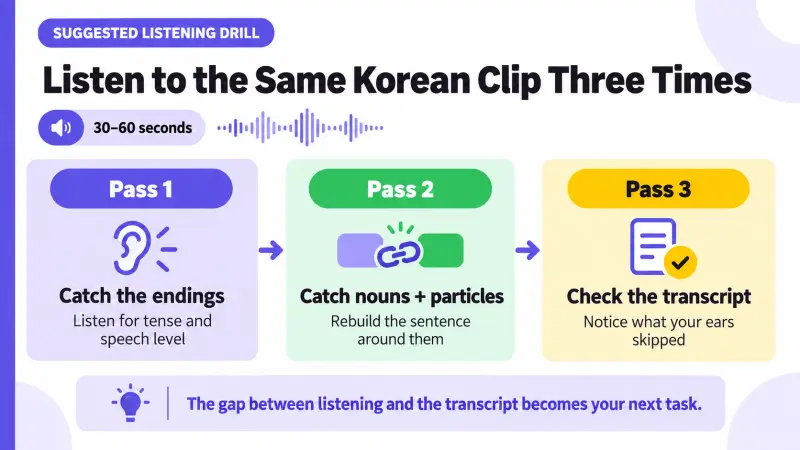
Korean puts the verb and its politeness ending at the end of the sentence, and that ending carries tense and speech level, so beginner listening gets easier when you learn to catch the final chunk first and rebuild the rest around it. Try a three-pass routine on a clip of about thirty to sixty seconds, as a suggested drill: first pass, catch only sentence endings; second pass, catch the nouns and particles; third pass, read the transcript or subtitles and see what your ears skipped. The gap between pass two and pass three is your real listening homework.
Keep two kinds of listening in rotation. Targeted listening is short, repeated, and analyzed. Tolerance listening is long, unanalyzed, and meant to get you used to speed and rhythm without stopping. Beginners who only do the second kind stall, and beginners who only do the first never get comfortable with natural pace.
Voice messages from real people sit usefully between the two, because they are conversational speed but short enough to replay. On HelloTalk, Voicerooms also let you enter as a listener before you ever speak, and the subtitle feature displays spoken content as text while Tap-to-Translate can translate a word or sentence you select. That is a controlled way to hear unscripted Korean with a safety net, as long as you treat it as listening practice rather than a translation feed.
Begin Short Conversations Before Your Knowledge Feels Complete
Waiting until you feel ready is the slowest path, because the thing you are waiting to develop only develops in conversation. Recognizing 어디에서 왔어요 on a page and producing an answer within two seconds while someone waits are different skills, and the second one has to be built directly.
A first Korean conversation needs one topic, a handful of patterns, and two or three repair phrases; it does not need past tense, honorifics, or a large vocabulary. The repair phrases matter more than the grammar: 천천히 말해 주세요 for speed, 다시 한번 말해 주세요 for repetition, 한국어로 뭐라고 해요 for the word you are missing, and 잠깐만요 to buy yourself a moment. With those four, a conversation that goes sideways becomes a conversation that continues.
Lower the cost of the first attempt by stepping through formats instead of jumping to live voice. Text first, where you can look things up. Then voice messages, which you can re-record before sending. Then live voice, once the first two feel routine. Video and live rooms come after that.
Here is a suggested first-exchange plan you can reuse for any topic. Choose one subject you can actually talk about, such as food you cook, and prepare six sentences with your current patterns: two statements, two questions, and two follow-ups. Send the opener, respond to whatever comes back using your prepared material where possible, and stop at five or six turns. A short exchange you complete beats a long one you abandon. If you want more formats for getting output volume up, the options are compared in this rundown of Korean speaking practice methods.
Use HelloTalk and Language Partners to Check Register and Naturalness
There is a class of question no course answers well: not "is this grammatical" but "would a person actually say this to me, in this situation." Korean makes that question unavoidable early, because speech level is tied to relationship and setting rather than to a single correct form. Reference material from the National Institute of Korean Language treats speech level as a function of who is speaking to whom and in what situation, which means a partner's answer is a contextual preference, not a universal rule.
For a beginner, a practical starting scope is 해요체, the polite -요 style, for most everyday conversation, and 합니다체, the formal -습니다 style, for public or formal settings. That scope is enough to function while you collect real examples, and the examples are what eventually replace the rule of thumb.
This is where a language partner does work that no lesson or drill can. A complete loop has five parts: source material from your course or pattern list, your own expression built from it, a real response from a person, a review step where you keep the correction and the context, and a next learning task that reuses the sentence somewhere new. A HelloTalk exchange can carry the middle three of those. You send a sentence you built yourself in chat or post it to Moments, where the official correction feature lets native speakers correct chat messages and Moments posts directly, and you get back not only an edit but an actual reply with new words in it. Built-in translation, transliteration, and read-aloud help you decode that reply without leaving the conversation, and the new vocabulary it contains becomes next week's study material.
Keep expectations honest about what partners can and cannot give you. Reply timing varies, availability varies, and one person's judgment about naturalness is one person's judgment. For register questions especially, collect two or three opinions before you treat something as settled, and always describe the situation when you ask.
Not every question belongs to a partner, though, and asking the wrong source is a common way to waste the exchange. The table below sorts the questions that come up in a typical beginner week.
| Question you have | Best first source | What to do with the answer |
|---|---|---|
| Why does this ending change after a consonant? | Your grammar course or a reference explanation | Add the rule to your pattern list, then build two fresh sentences with it |
| What does this word mean here? | A dictionary with example sentences | Save the whole example sentence, not the isolated word |
| Does this sound natural to a classmate my age? | A language partner, plus one second opinion | Rewrite it and reuse it in your next message |
| Am I actually distinguishing 어 and 오? | Record yourself, then ask a native-speaker listener | Re-record the same sentence after the feedback |
| Should this be 해요 or 합니다 here? | A partner who knows the situation you described | Note the situation, not only the ending |
If the missing track in your week is the fourth one, a real person who answers with content instead of a score, setting up a Korean-learning profile on HelloTalk and starting with text before moving to voice messages is the cheapest way to get that track running.
Frequently Asked Questions About Learning Korean Faster
How long should I spend on Hangul before moving on?
Long enough to read a short sentence aloud without spelling it out, which for most learners is days rather than weeks with daily practice. Do not wait for speed or perfect pronunciation. Reading fluency keeps improving while you study sentence patterns, and it improves faster once you are reading real sentences instead of syllable charts.
Do I need to learn all the Korean sound change rules before I start speaking?
No. Learn to expect that spelling and pronunciation will differ, get comfortable with the common cases like linking, ㅎ weakening, and nasal assimilation, and let the rest arrive through listening. Trying to memorize the complete rule set up front delays everything else and does not make your ear faster.
Should I learn 해요체 or 합니다체 first?
Most beginner courses start with 해요체 because it covers the widest range of ordinary conversation, and 합니다체 follows for formal and public situations. Treat that as a starting scope rather than a rule, since the appropriate level depends on your relationship with the person and the setting you are in, and check specific situations with people who know the context.
Can I learn vocabulary from dramas and songs at the beginner stage?
Yes for listening exposure and motivation, with one caution. Scripted dialogue often uses casual speech, slang, or dramatic register that will not fit your own conversations, so treat drama vocabulary as recognition material first and check anything you want to use yourself before you use it.
When should I stop using romanization?
As soon as you can read Hangul at any speed. Romanization systems cannot represent Korean vowel and consonant distinctions accurately, so every extra week you spend on it builds pronunciation habits you will later have to unlearn. Slow Hangul reading is more useful than fast romanization.
How many sentence patterns do I need before a first conversation?
Roughly eight to ten frames you can produce without looking them up, plus two or three repair phrases, is enough for a five-turn exchange on one prepared topic. The frames matter more than the count; patterns for identity, existence, preference, destination, and wants cover most beginner small talk.
What if I can read Korean but understand nothing at normal speed?
That is the normal result of reading-heavy study, and the fix is targeted listening rather than more reading. Take short clips, listen for sentence endings first, then nouns and particles, then compare against a transcript or subtitles. Add voice messages from real conversations, since those are natural speed but short enough to replay until the words separate.