
How to Talk Like a Native English Speaker: A Real Plan That Works
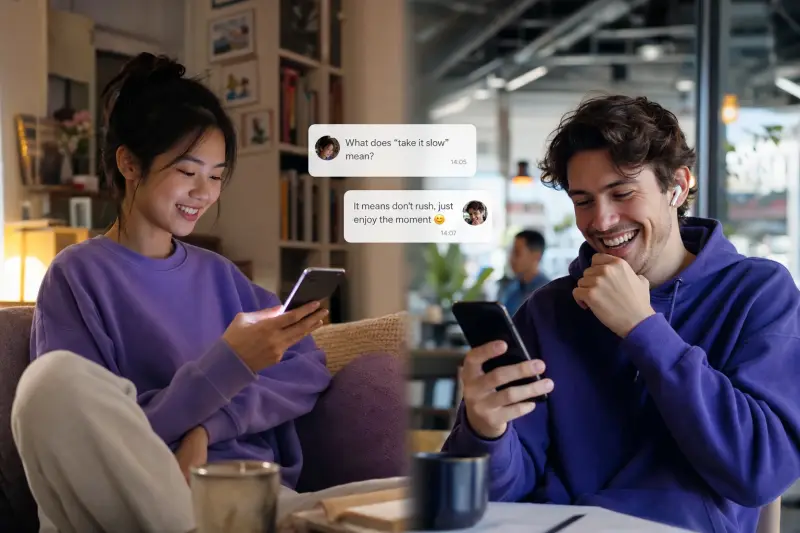
You can construct a perfect English sentence. Your grammar is clean, your vocabulary is wide, and on paper you sound advanced. Then you say it out loud and something is off. It comes out too formal, too even, too careful. A native speaker hears it in one second and knows you learned English from books. The words are right, but the music is wrong. That is the thing separating "fluent" from "sounds native," and it is almost never about grammar.
Talking like a native speaker is not about eliminating your accent, and it is not about knowing more words. It is about rhythm, reductions, timing, and the small unwritten habits that no textbook teaches because native speakers do them without thinking. This guide breaks down what those habits actually are and gives you a plan to build them, the only way they can be built, which is by talking to actual native speakers.
What "Talking Like a Native" Actually Means
Let's kill the biggest myth first. Sounding native is not about having no accent. Plenty of native English speakers have strong regional accents and nobody questions that they are native. Accent is not the target.
Here is what actually makes someone sound native.
-
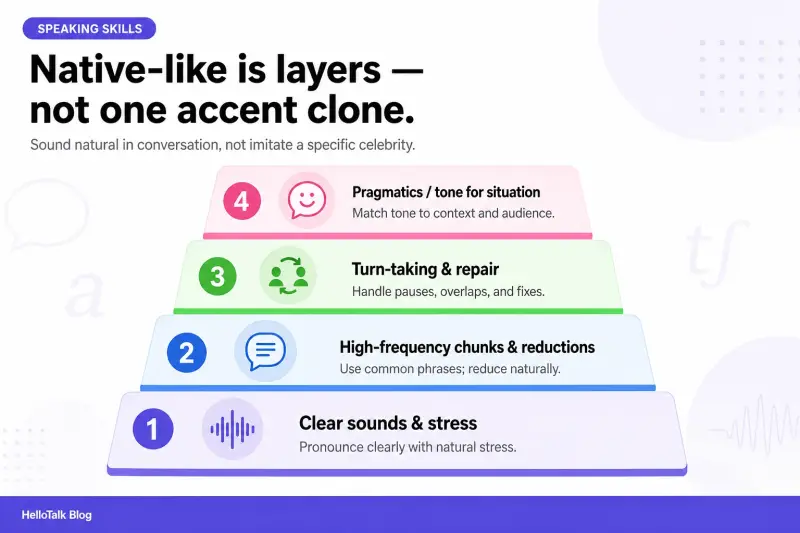
Reductions. Native speakers do not say "what are you going to do." They say "whatcha gonna do." The full forms sound stiff and foreign.
-
Rhythm and stress. English is a stress-timed language. Native speakers hammer the important words and rush through the small ones, which creates a bouncing rhythm learners often flatten.
-
Chunking. Natives speak in prefabricated phrases, "no worries," "fair enough," "to be honest," not word by word.
-
Timing and fillers. Knowing when to say "um," "like," or "you know," and when to just pause, is deeply native and impossible to script.
None of these show up on a grammar test. All of them show up the moment you open your mouth.
Why Textbooks and Apps Can Only Take You So Far
Textbooks teach you the complete, correct, formal version of English. That is genuinely useful for a foundation. The problem is that native speakers almost never speak that version in daily life. They contract, reduce, interrupt, and use slang the book would mark as improper. So the more faithfully you follow the textbook, the more you sound like a textbook, which is exactly the opposite of native.
Scripted apps have the same limit. They drill you on clean sentences delivered at a slow, artificial pace. You get good at understanding the app and then discover real people sound nothing like it. Even AI conversation tools speak in complete, tidy turns, so they train you for a conversation that does not exist in the real world.
The uncomfortable truth: the native sound lives entirely in the messy, unscripted stuff, and messy unscripted stuff can only be learned from messy unscripted humans. There is no shortcut around real conversation.
Study Methods Compared: What Builds the Native Sound
Not all practice builds the same thing. Here is what each method actually develops.
| Method | Builds | Misses | Role in sounding native |
|---|---|---|---|
| Textbooks and grammar drills | Correct structure, foundation | Rhythm, slang, reductions | Base only, not the goal |
| Scripted apps (Duolingo, Busuu) | Vocabulary, basic patterns | Real speed, natural phrasing | Warm-up, not fluency |
| Pronunciation AI (ELSA) | Individual sound accuracy | Sentence rhythm, spontaneity | Fixing specific problem sounds |
| Watching shows and podcasts | Ear for rhythm and slang (input) | Speaking practice (output) | Great input, half the picture |
| Talking to native speakers | Rhythm, reductions, timing, real correction | Requires courage to speak | The core of sounding native |
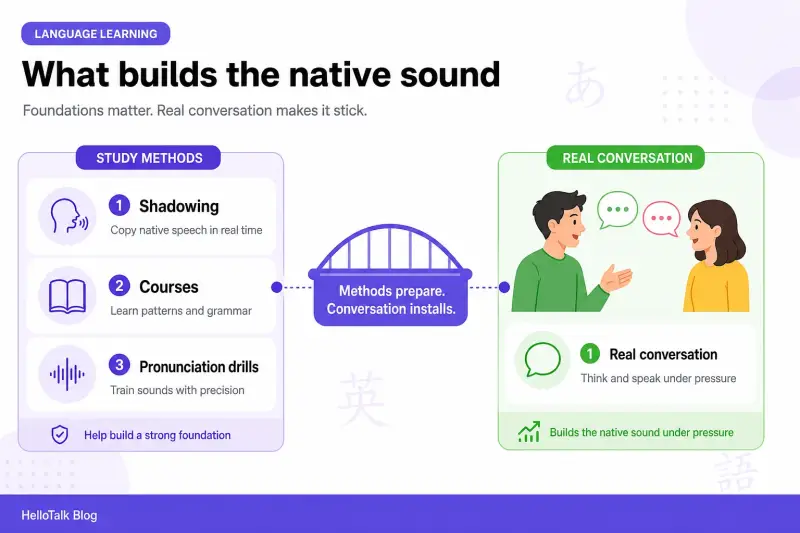
Notice that only the last row builds all the native-specific skills at once, and it is the only one that gives you output plus real-time correction. Everything above it is preparation for that row.
The Only Method That Builds the Native Sound: Real Conversation
You cannot learn rhythm by reading about rhythm. You learn it by hearing a real person say "I dunno, honestly" and copying the exact melody, then having them tell you when yours is off. That loop, hear it, copy it, get corrected, is how the native sound actually transfers.
On HelloTalk, you connect with native English speakers among 70M+ registered users across 200+ countries, so you are copying rhythm from real people instead of a recording that cannot correct you. Here is how the loop runs in practice. You hear a native partner use a phrase like "fair enough" in a voice message. You send it back in your own voice message, trying to match the stress and speed. They tell you it is close but you are stressing the wrong word, and they say it again. You copy again. That is the entire mechanism of sounding native, and it needs a human on the other end.
The listening half matters just as much. Drop into a Voiceroom and just absorb native speakers talking to each other, interrupting, laughing, reducing every other word. Ten minutes of that trains your ear for the rhythm no app delivers, because the app speaks in clean complete turns and real people never do. Catch a Livestream and you hear English used naturally, at full speed, with all the slang intact. HelloTalk was recognized as the 2017 Google Play Best Social App and featured on Google Play's global homepage in 2024 for exactly this kind of real human exchange.
The inline correction tool is where the native details get fixed. A partner taps your message and shows you that "I am very tired" would more naturally be "I'm beat" or "I'm exhausted," then explains the difference. That is the layer between correct English and native English, and only a native speaker can hand it to you.
Your 4-Week Plan to Sound More Native
Here is a concrete plan you can start this week. It moves from input to output on purpose.
Week 1: Train your ear. Spend ten minutes a day just listening, in Voicerooms, podcasts, or shows without subtitles. Do not try to speak yet. Your only job is to notice reductions and rhythm. Write down five phrases you hear over and over.
Week 2: Shadow. Take those five phrases and copy them out loud, matching the exact melody, then send them as voice messages to a native partner and ask, "does this sound natural?" You are moving from hearing to producing.
Week 3: Have real conversations. Send daily voice messages to native partners about your real life. Ask them to correct only the phrasing that sounds unnatural, not every grammar slip. You want the native-sound corrections, not the textbook ones.
Week 4: Layer in fillers and timing. Now consciously add "honestly," "to be fair," "I mean," in the right spots, and let pauses sit where a native would pause. Ask a partner if your timing feels natural. This is the final polish.
Repeat the cycle with new phrases each month. The native sound is not a finish line, it is a habit you keep sharpening.
FAQ
Can a non-native speaker ever sound like a native?
Many adults get remarkably close in rhythm, phrasing, and slang, which is what makes speech sound native. A slight accent may remain, and that is fine, because accent is not what makes you sound native. Rhythm, reductions, and timing are, and those can absolutely be learned.
Is sounding native about getting rid of my accent?
No. Plenty of native English speakers have strong accents. The native sound comes from rhythm, contractions, natural phrasing, and timing, not from erasing your accent. Focus your effort there.
Why do I sound unnatural even though my grammar is perfect?
Because natural English relies on reductions, stress patterns, and chunked phrases that textbooks do not teach. Perfect grammar delivered in a flat, careful rhythm is exactly what marks someone as a learner. Copying real speakers fixes it.
Can apps like Duolingo help me sound native?
They build vocabulary and structure, which is a useful base, but they speak in clean, slow sentences that real people never use. To sound native you need real conversation with native speakers, where you can copy rhythm and get corrected.
How long does it take to start sounding more natural?
Most learners notice a real difference within a month of daily listening and speaking with native speakers. Ear training comes first, then production, then timing, so consistency matters more than long sessions.
What is the fastest way to learn natural phrasing?
Listen for phrases native speakers repeat, copy them out loud, and get a native partner to correct your version. This hear, copy, correct loop builds natural phrasing faster than any amount of solo study.
For a balanced solo-and-human routine, see our guide to AI English conversation apps.
Want to actually sound like a native speaker, not a textbook? Practice with native English speakers on HelloTalk and start copying real rhythm today.