English to Spanish Conversion App: Translation Isn't Learning (Here's What Is)
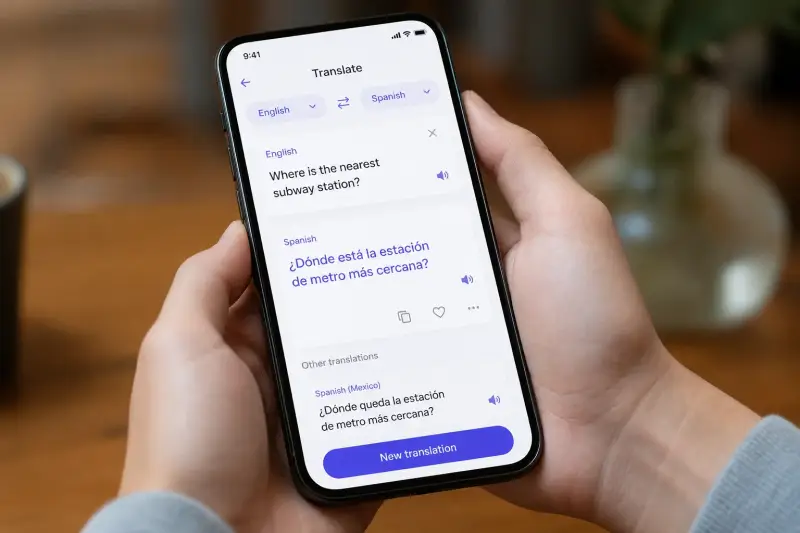
You are standing in a market in Mexico City, phone out, thumb hovering over an English to Spanish conversion app. You type "how much is this," the screen shows "¿cuánto cuesta esto?", and you turn the phone around so the vendor can read it. The transaction works. But you did not speak Spanish. The app did. And the next time you want to ask the same question, you reach for the phone again, because nothing about that moment stayed in your head.
That is the trap with conversion apps. They are excellent at getting you through a single moment and terrible at helping you never need them again. If you are searching for an English to Spanish converter, it is worth being clear about what you actually want. Do you want to translate one sentence right now, or do you want to be the person who can say it yourself next month? Those are two different tools, and this guide sorts out which is which.
What "Conversion App" Actually Means (And Why It Matters)
The phrase covers a few very different things, and mixing them up wastes your time.
-
English to Spanish translation apps convert your words into Spanish for communication. Useful for travel, not for learning.
-
English to metric conversion apps and metric to English conversion apps convert units, kilometers to miles, Celsius to Fahrenheit. These have nothing to do with language and often get mixed into the same search by accident.
-
Language learning apps aim to make the conversion happen inside your own brain, so you no longer need a tool at all.
If you landed here wanting units, any calculator app handles that. If you landed here wanting to communicate in Spanish, keep reading, because a translation app is a crutch, and this is about learning to walk.
Why a Translation App Stalls Your Spanish
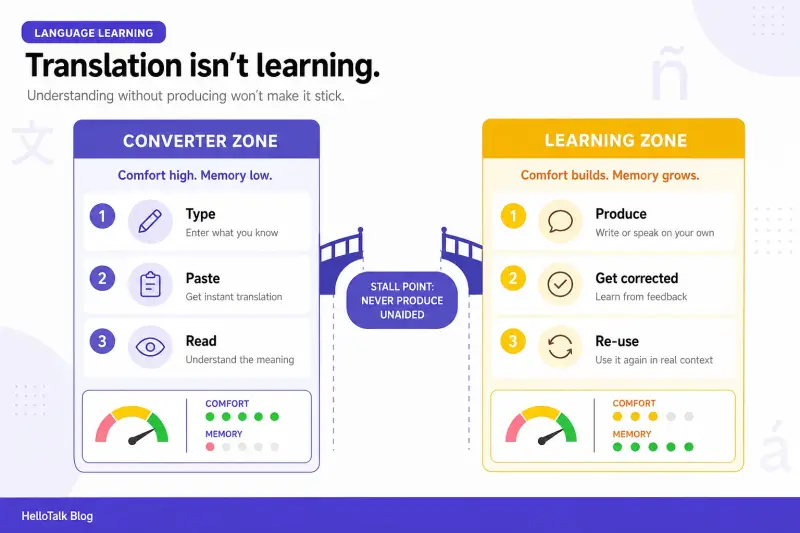
A conversion app removes the exact struggle that builds memory. When you look up a word instead of reaching for it, your brain files the moment as "solved" and forgets it immediately. The effort of trying to recall is what makes a word stick, and the app deletes that effort.
There is a second problem. Translation is literal, and Spanish is not. Ask a converter to translate "I'm looking forward to it" and you might get something no Spanish speaker would actually say. The app gives you grammatically valid Spanish that sounds like a robot in a way native ears catch instantly. Real Spanish is full of expressions that do not map word for word, and a converter cannot teach you those because it does not know you are trying to sound human.
Then there is speaking. A conversion app handles text. It does nothing for the moment when someone speaks fast, drops the ends of words, and mixes in slang from their region. That is the situation you actually need to survive, and no amount of typing into a translator prepares you for it.
Translation App vs Real Practice: An Honest Comparison for Spanish
The choice is not which app translates best. It is whether you want a temporary bridge or a permanent skill.
| Tool type | What it gives you | What it can't do | Best use |
|---|---|---|---|
| Translation / conversion app | Instant text conversion, survival communication | Retention, natural phrasing, listening, speaking | One-off travel moments, emergency backup |
| Flashcard apps (Anki, Memrise) | Vocabulary memory | Real conversation, regional variation | Building a word base |
| Scripted lesson apps (Duolingo, Busuu) | Grammar and structure foundations | Spontaneous speaking, real accents | Beginner groundwork |
| Tutoring platforms (italki) | Structured feedback from a teacher | Cost, casual daily practice | Focused weekly lessons |
| Language exchange with native speakers | Real timing, regional Spanish, phrasing that sounds human | Requires you to actually speak | Turning knowledge into fluency |
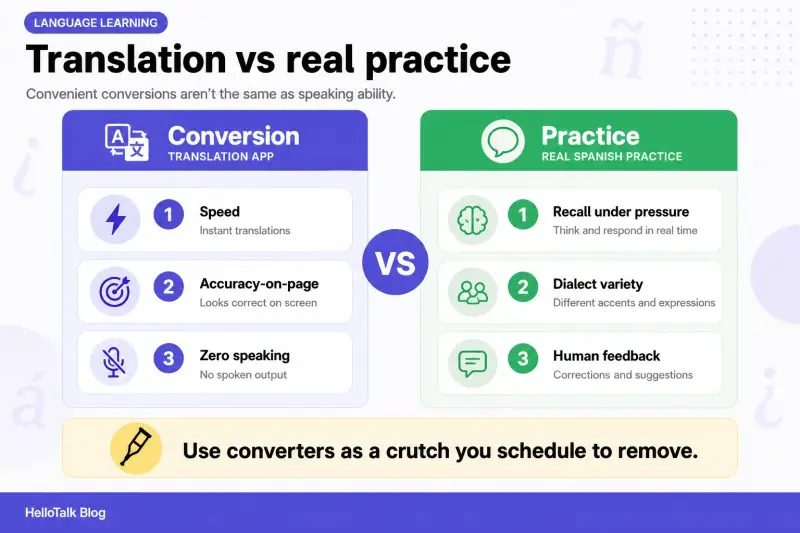
The translation app belongs in the emergency backup column. It is not where learning happens. Learning happens when a real person from a Spanish-speaking country talks back to you.
The Spanish Problem a Converter Can't Solve: There Isn't One Spanish
Here is the thing a conversion app completely hides. Spanish is spoken across more than 20 countries, and the differences are not small. The word for "you" plural changes between Spain and Latin America. "Coger" is a harmless everyday verb in Madrid and something you should not say casually in parts of Mexico or Argentina. A conversion app flattens all of that into one generic output and never tells you which region it picked.
If you are learning Spanish to talk to people in a specific place, whether that is Buenos Aires, Bogotá, or Barcelona, you need input from actual speakers there. A converter cannot give you the Argentine "sh" sound for "ll" and "y," or the Caribbean habit of dropping the "s" at the end of words. Those are the details that make you understood by real people, and they only come from hearing real people.
This is exactly why practicing with native speakers beats any converter for Spanish specifically. The language is too regional for a one-size output to serve you.
How HelloTalk Replaces the Crutch
Instead of turning your phone around at the market, imagine being the person who just asks. On HelloTalk, you connect with native Spanish speakers among 70M+ registered users across 200+ countries, so you can find partners from the exact region whose Spanish you want to learn.
Here is how the crutch gets replaced in practice. You want to ask "how much is this." Instead of translating it silently, you send a voice message to a partner in Mexico and ask how they would say it casually. They reply with the real phrasing, maybe with a "¿a cómo?" you never would have found in a translator. Now you have living Spanish, tied to a real voice, and it sticks because a person gave it to you.
When a word does trip you up mid-message, your partner can correct it inline and add a note about why. That is the layer a converter can never provide. It gives you the natural word, the one someone actually uses, from a person who talks that way every day. Over time, the app you reach for stops being a translator and starts being a place where you talk to people.
Drop into a Voiceroom with speakers from a Spanish-speaking country and just listen for ten minutes. You will hear the speed, the slang, and the regional sounds that a converter's flat text output erases. HelloTalk was recognized as the 2017 Google Play Best Social App and featured on Google Play's global homepage in 2024 for this kind of real exchange.
A Two-Week Plan to Stop Needing the Converter
You can wean yourself off a translation app faster than you think.
In week one, keep the converter, but change how you use it. Every time you look something up, do not just read the answer. Send that same phrase to a Spanish-speaking partner and ask, "is this how you'd really say it?" You will be surprised how often the honest answer is "sort of, but we'd say..."
In week two, flip the order. Before you translate anything, try to say it yourself in a voice message and let your partner correct you. Only use the converter to check afterward. By the end of the two weeks, you are producing Spanish first and verifying second, which is the opposite of leaning on the app.
The goal is not to ban the converter. It is to demote it from your primary tool to a backup you rarely open.
FAQ
Is an English to Spanish conversion app good for learning Spanish?
For learning, no. Conversion apps are built for instant translation, which removes the recall effort that builds memory and gives you literal phrasing that often sounds unnatural. They are fine as a travel backup, but real learning comes from practicing with native Spanish speakers.
What is the difference between a translation app and a language learning app?
A translation app converts your words so you can communicate right now. A language learning app aims to make you able to produce the language yourself, so you eventually need no tool at all. One is a crutch, the other builds the skill.
Why does my Spanish sound robotic even when the translation is correct?
Because translation is literal, and natural Spanish rarely maps word for word from English. Expressions, tone, and regional habits do not survive a converter. Hearing and copying real native speakers is what makes your Spanish sound human.
Which Spanish does a conversion app use?
Usually a generic, unspecified variety, and it rarely tells you which region it picked. Since Spanish varies a lot across 20+ countries, this is a real limitation. Practicing with speakers from your target country gives you the right vocabulary and accent.
Can I talk to native Spanish speakers for free?
Yes. Language exchange apps like HelloTalk let you message and voice-chat with native Spanish speakers for free, so you can practice real conversation without paying for a tutor.
I searched for an English to metric conversion app, is that the same thing?
No. Metric conversion apps convert units like kilometers and Celsius and have nothing to do with language. Any calculator or units app handles that. This guide is about converting between English and Spanish as languages.
To replace translation with real speaking, compare apps for talking to native speakers.
Want to stop translating and start speaking? Practice Spanish with native speakers on HelloTalk and turn every phrase you look up into one you actually own.