Best App to Talk to Native Speakers in 2026 (Free and Actually Usable)
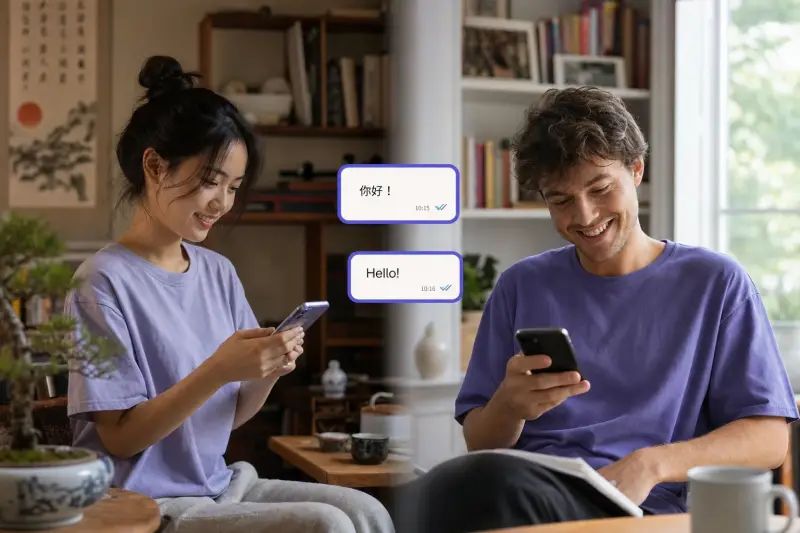
You have done the courses. You have the vocabulary, you can read a menu, you passed the quizzes. Then you get a chance to actually talk to a native speaker, and within thirty seconds you realize you cannot understand a word they say at normal speed. They are not speaking the clean, slow textbook version. They swallow syllables, use slang, and finish each other's sentences. That gap between "I studied the language" and "I can talk to a person who speaks it" is the whole reason you are searching for an app to talk to native speakers.
The good news is that these apps exist, many are free, and they work. The less good news is that most people download one, send a couple of awkward messages, get no reply, and quit. This guide fixes that. It covers what to look for in an app, how to actually get real conversations going, and how to avoid the common mistakes that make people give up in week one.
What You're Really Looking For in an App
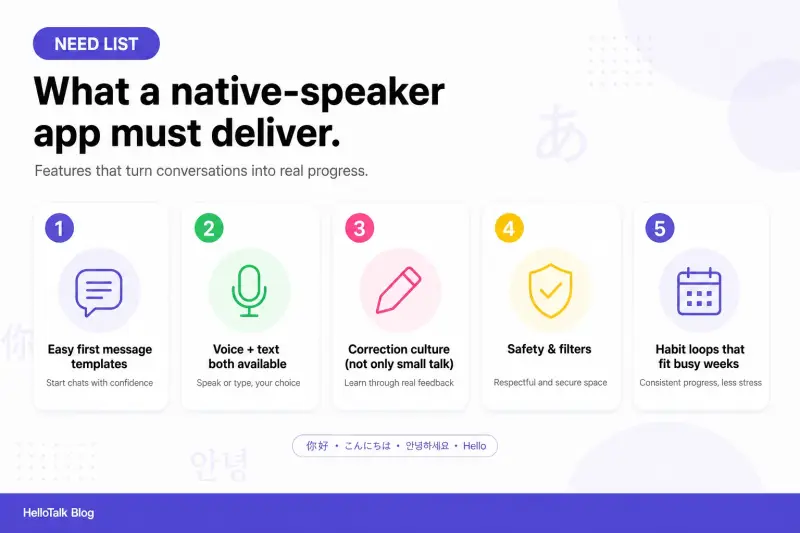
Not every app that claims to connect you with native speakers actually delivers real practice. Here is what separates a usable app from a dead one.
-
A large, active user base. If the app is small, you will find nobody who speaks your target language and is online when you are. Scale is not a vanity metric here, it is the difference between finding a partner and staring at an empty screen.
-
Voice and text both. Text lowers the barrier for beginners, but you need voice to actually train your ear and mouth. An app that is text-only leaves out the hardest and most important half.
-
Built-in correction tools. You want a partner to be able to fix your sentence and explain why, not just nod along politely while you make the same mistake forever.
-
Real people, not bots. Some apps quietly pad their experience with AI. You are here to talk to humans, so the app should connect you to actual native speakers.
Keep those four in mind and most of the "which app" question answers itself.
How the Main Options Compare
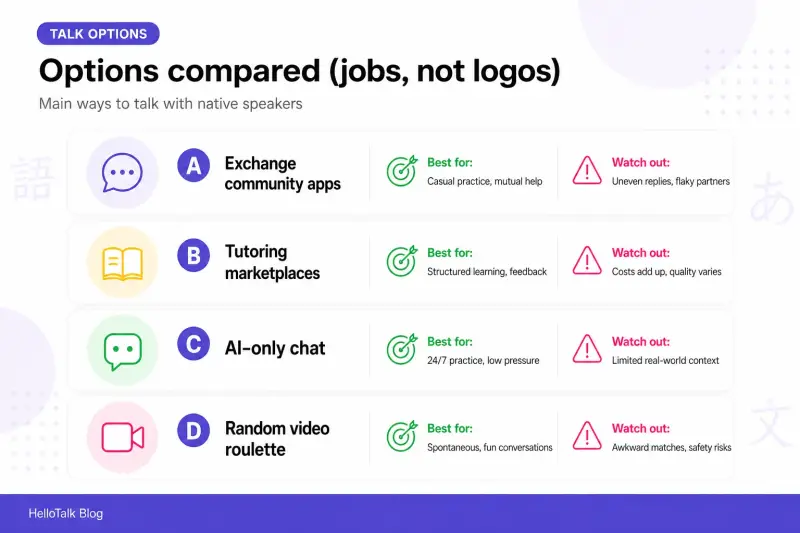
The apps people ask about fall into a few categories, and each solves a slightly different problem.
| App type | What it's for | Trade-off | Best for |
|---|---|---|---|
| Language exchange apps (HelloTalk, Speaky) | Free chat with native speakers who want to learn your language too | You give practice to get practice | Everyday real conversation |
| Paid tutoring (italki, Cambly) | Structured lessons with a paid teacher | Costs money, needs scheduling | Focused feedback before an exam |
| Scripted apps (Duolingo, Busuu) | Vocabulary and grammar foundations | Not real conversation | Building a base before you talk |
| Video chat roulette apps | Random spontaneous chats | Unpredictable, no learning tools | Bold learners who want raw practice |
For most people who want to talk to native speakers for free and actually improve, a language exchange app is the center of gravity. It costs nothing, it is built around mutual practice, and it gives you real humans instead of scripts.
Why HelloTalk Works for Real Conversation
The reason exchange works is simple: you are talking to someone who wants exactly what you have. On HelloTalk, you are connected with native speakers among 70M+ registered users across 200+ countries who speak 260+ languages, so whatever language you are learning, there are real people learning yours in return. That mutual need is what keeps conversations alive instead of one-sided.
Here is what talking to a native speaker actually looks like on the app. You send a short voice message instead of typing, because you want your mouth to do the work. Your partner replies at their natural speed, and yes, at first it is fast and confusing, which is the entire point. When you mangle a sentence, they tap it and correct it inline, then tell you why, so you learn the natural version and not just the technically correct one.
When you are too tired to compose sentences, drop into a Voiceroom and just listen. Ten minutes of real speakers talking to each other trains your ear for the speed and slang that made you freeze in the first place. You can also catch a Livestream and hear the language used naturally, no pressure to perform. HelloTalk was named the 2017 Google Play Best Social App and featured on Google Play's global homepage in 2024, largely because it connects real people rather than serving scripts.
How to Actually Get a Conversation Going (Most People Fail Here)
The number one reason people quit these apps is not the app. It is that their first message is "Hi, how are you?" and it goes nowhere. A stranger has no reason to invest in a generic greeting.
Do this instead. Open with something specific and easy to answer. Mention something from their profile, ask about a food from their city, or share one honest line about why you are learning their language. Give them a hook. "Hi, I'm learning Spanish to visit my partner's family in Colombia, what's one phrase locals use that I'd never learn from an app?" gets a reply almost every time, because it is personal and answerable.
Then lead with voice sooner than feels comfortable. Text is safe, but you are here to speak. A thirty-second voice message about your day does more for your fluency than fifty typed lines, and it signals to your partner that you are serious about real practice.
Finally, offer before you ask. These are exchanges. If someone helps you with English, help them with your native language in the same conversation. The partners who last are the ones who give, and giving is what turns a random contact into a regular practice buddy.
Staying Safe and Comfortable While You Practice
Talking to strangers online is easy to overthink, so here is the calm version. Keep your practice inside the app until you genuinely trust someone. There is no need to hand out your phone number or social profiles to have great conversations. If a chat drifts toward anything that feels off-topic or uncomfortable, it is completely fine to end it and move to another partner. There are millions of people to talk to, so you never have to tolerate a bad fit.
If you ever decide to meet a language partner in person, keep it in a public place and treat it like any first meeting with someone new. Protect your privacy, move at your own pace, and let trust build over real conversations first. Practicing a language should feel good, and the best partners make it feel that way.
FAQ
What is the best app to talk to native speakers in 2026?
For free, everyday conversation, a language exchange app is usually the best fit, because it connects you with native speakers who want to practice your language in return. HelloTalk is a strong choice thanks to its large, active community across 200+ countries.
Can I talk to native English speakers for free?
Yes. Language exchange apps let you message and voice-chat with native English speakers for free, since the exchange is mutual: you help them with your language while they help you with English.
How do I actually get someone to reply?
Skip generic greetings. Open with something specific from their profile or a real reason you are learning their language, and ask an easy, personal question. Offering to help with your native language in return dramatically increases replies.
Is it better to text or use voice with a native speaker?
Text is a comfortable starting point, but voice is where real progress happens. Speaking trains your mouth and your ear for natural speed and slang, which is exactly the gap most learners need to close.
Are the people on these apps real, or is it AI?
On genuine language exchange apps like HelloTalk, you are talking to real native speakers, not bots. That is the whole point, since only real people can teach you natural phrasing, culture, and how the language actually sounds.
How much practice do I need to see improvement?
Most learners notice they understand real speech better within a few weeks of regular voice practice. Fifteen to twenty minutes a day of talking to native speakers tends to move you faster than hours of solo study.
For the speaking habits to use once you find a partner, follow this plan for talking like a native English speaker.
Ready to close the gap between studying and speaking? Start talking to native speakers on HelloTalk and have your first real conversation today.