Best AI English Conversation App in 2026: What Works and What Doesn't

You open an AI English conversation app on your commute. You type a sentence, the bot replies instantly, and you feel productive for about four minutes. Then you get to work, someone asks you a casual question in English, and your mouth freezes. The words you rehearsed with the app do not come out. That gap between practicing with a machine and speaking with a person is the thing almost nobody warns you about.
This is not an argument that AI tools are useless. They are genuinely helpful for a specific set of problems. But if your goal is to actually hold a conversation in English, in a meeting, at a party, on a call, you need to know exactly what an AI app can do for you and where it quietly leaves you stuck. This guide walks through that, then shows how to combine daily AI practice with real conversation so the two reinforce each other.
What an AI English Conversation App Actually Does Well
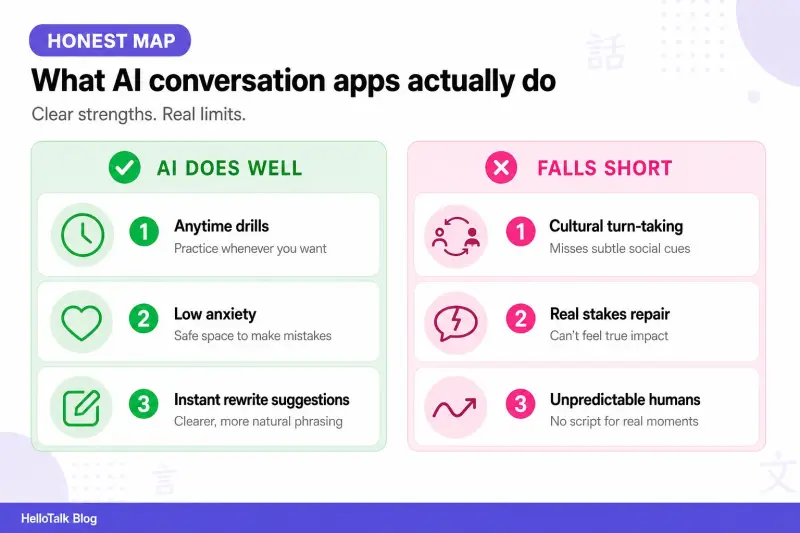
AI conversation apps have gotten good at a few things, and it helps to be honest about which ones.
-
They give you unlimited, judgment-free reps. You can say the same clumsy sentence ten times and nobody sighs at you.
-
They are available at 2 a.m. when no human wants to chat. Consistency is easier when the tool never sleeps.
-
They correct grammar and suggest phrasing fast, so you see your mistakes while the sentence is still fresh in your head.
-
They lower the fear. For a lot of learners, the hardest part of speaking is the first 30 seconds of embarrassment, and a bot removes that entirely.
Those four points are real value. If you have been avoiding speaking out of anxiety, an AI app is one of the gentlest on-ramps that exists. Use it to warm up.
Where AI Conversation Apps Quietly Fall Short
Here is the part the app store descriptions skip.
An AI does not misunderstand you the way a person does. When a real human loses the thread of what you are saying, they frown, they ask "sorry, what?", they wait. That friction is the exact skill you need in real life: repairing a conversation that went sideways. AI apps are trained to understand you even when your grammar is broken, so they never make you practice the recovery move.
AI also has no culture and no timing. It does not know that in English "how are you" is usually not a real question. It will not tease you, change the subject suddenly, or use slang your textbook never covered. Real fluency lives in those unscripted moments, and a language model smooths all of them away.
And AI feedback is generic. It tells you a sentence is "correct," but a native speaker tells you it is technically correct and nobody actually says it that way. That second layer of feedback is where natural English comes from.
So the honest verdict: AI is a great practice room, but it is not the game. You still have to play the game with people.
AI Tools vs Real Conversation: An Honest Comparison for English Learners
Most comparison charts pit one app against another. That is the wrong axis. The real choice is what kind of practice you are getting, and the strongest routine borrows from more than one column.
| Practice type | Best for | Weak spot | When to use it |
|---|---|---|---|
| AI chatbot apps | Grammar drills, low-pressure warm-up, instant correction | No real misunderstanding, no culture, generic feedback | Daily solo reps, building confidence before a real call |
| Pronunciation AI (ELSA and similar) | Isolated sound and stress accuracy | Sentence-level fluency, spontaneous speech | Fixing specific sounds you keep getting wrong |
| Scripted lesson apps (Duolingo, Busuu) | Vocabulary and structure foundations | Real-time conversation, listening to fast speech | Beginner base building |
| Tutoring platforms (italki, Cambly) | Structured feedback from a paid teacher | Cost, scheduling, less casual practice | Weekly deep-dive lessons |
| Language exchange with native speakers | Real timing, slang, culture, correction that matters | Requires showing up and speaking | The actual conversation practice AI can't replace |
The pattern that works for most learners: use an AI app or a daily English conversation app for reps on your own time, then bring what you practiced into a real exchange with a native speaker so it sticks.
How HelloTalk Fits: Practice Solo, Then Speak for Real
This is where a platform built around real people does the thing AI cannot. On HelloTalk, you are connected with native English speakers among 70M+ registered users across 200+ countries, so the person correcting you actually speaks the way you want to sound.
The flow looks like this. You warm up on your own, maybe with an AI tool, running through the phrases you want to use. Then you send a short voice message to a language partner instead of typing to a bot. They reply, and because they are human, they sometimes misunderstand you, which forces you to rephrase. That single move, rephrasing until a real person gets it, is the skill that transfers straight into meetings and phone calls.
When you have ten minutes and no energy to compose sentences, drop into a Voiceroom. You do not have to talk. You just let real spoken English, with its interruptions and laughter and half-finished sentences, land in your ear. That is the listening input AI conversation never gives you, because AI speaks in clean, complete turns.
The correction feature is the quiet workhorse. A partner can tap your message and fix it inline, then tell you why. That is the "technically right, but we'd actually say it this way" feedback that turns correct English into natural English. HelloTalk earned its 2017 Google Play Best Social App recognition and a 2024 Google Play global homepage feature for exactly this kind of person-to-person exchange.
A Simple Daily Routine That Combines AI and Real Speakers
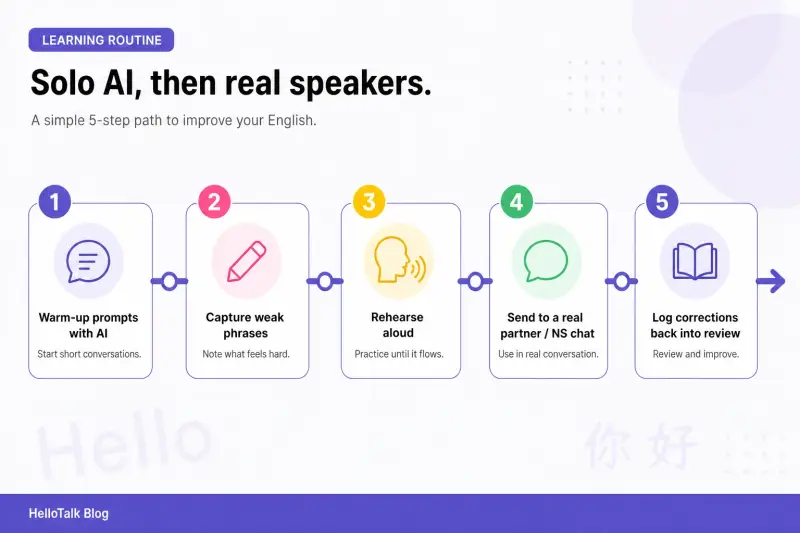
You do not have to choose one tool. Here is a routine you can run in about 25 minutes a day.
Start with 5 minutes of AI warm-up. Pick one situation, ordering food, introducing yourself, disagreeing politely, and run it with a chatbot until the words feel loose in your mouth.
Then spend 10 minutes with a real person. Send two or three voice messages to a language partner about that same situation. Ask them to correct the one thing that sounds most unnatural. You are transferring the AI-rehearsed phrases into a real exchange.
Finish with 10 minutes of listening. Sit in a Voiceroom or listen to a native speaker's replies again. You are not producing anything here. You are absorbing rhythm.
Do that five days a week and the frozen-mouth moment starts to disappear, because you have already had the conversation with a person, not just a machine.
Free vs Paid: What You Actually Need to Pay For
A lot of searches include "free" for a reason. You should not pay for the basics.
Free AI chat, free daily practice, and free access to real native speakers on an exchange app cover the core of what most learners need. You can build a serious routine without spending anything. Pay only when you hit a specific ceiling: a paid tutor for structured lessons before an exam, or a premium pronunciation tool if one sound is genuinely blocking you. Do not pay to unlock "more AI messages" when the real bottleneck is that you are not talking to humans yet.
The best free AI English conversation setup in 2026 is usually a free AI app for reps plus a free language exchange app for real speaking. Together they cover both halves of the problem.
FAQ
What is the best AI English conversation app in 2026?
There is no single winner, because AI tools and real conversation solve different problems. For grammar reps and low-pressure warm-up, an AI chatbot works well. For actual fluency, you need practice with native speakers, which an app like HelloTalk provides alongside your AI routine.
Can I learn to speak English with only an AI app?
You can build vocabulary, confidence, and grammar with AI alone, but you will hit a wall in real conversations. AI never truly misunderstands you, so it cannot teach you to repair a conversation, read tone, or handle slang. Pairing AI practice with real speakers fixes that.
Is there a good free AI English conversation app?
Yes. Many AI chat tools offer free daily practice, and language exchange apps let you talk to native English speakers for free. A strong free setup combines an AI app for solo reps with an exchange app for real conversation.
How is a daily English conversation app different from an AI tutor?
A daily English conversation app focuses on giving you short, repeatable speaking practice you can do every day. An AI tutor tends to structure lessons and corrections. Both are solo tools, and both work best when combined with talking to actual people.
How long until AI practice improves my speaking?
Most learners feel more confident within two to three weeks of daily practice. Real, measurable improvement in conversations tends to show up faster when you move your AI-rehearsed phrases into exchanges with native speakers, usually within a month or two.
Does AI pronunciation feedback actually work?
For isolated sounds and word stress, AI pronunciation tools are genuinely useful. For sentence-level rhythm and how you sound in a real back-and-forth, feedback from a native speaker is far more reliable.
When you are ready to move beyond solo practice, compare apps for talking to native speakers.
Ready to turn AI practice into real conversations? Connect with native English speakers on HelloTalk and put the phrases you rehearsed to work.