Spanish Learning Tool Priority: What to Spend Your Time on First

There are more Spanish tools than any of us could use in a lifetime, and that abundance is its own trap. The real question is not which tool is good, it is which tool to reach for first given what you are trying to fix. So let's rank them by the job they do.
The right order to prioritize Spanish tools is: first a tool that gives you real output and correction, then input tools, then drill and review apps, and only later formal structured courses. Most learners do this backwards, starting with drills and never reaching real output.
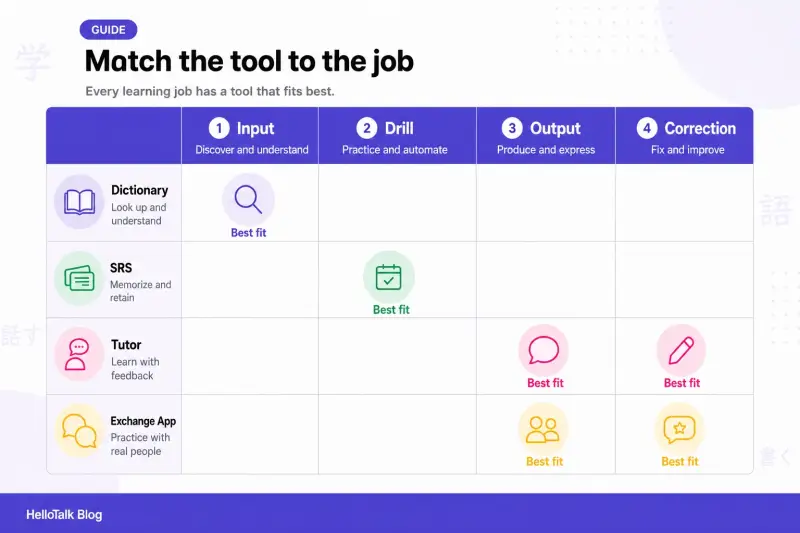
Match the tool to the job
No single tool does everything well. Each one is strong at a specific skill and weak elsewhere. The efficient move is to pick tools by the gap they fill, not by popularity.
| Tool type | Best for | Weak at | Priority |
|---|---|---|---|
| Language exchange community (HelloTalk) | Real output, correction, immersion | Rigid grammar syllabus | Use first, daily |
| One-on-one tutors (italki, Cambly) | Structured speaking, targeted feedback | Cost per hour adds up | Add when budget allows |
| Comprehensible input (podcasts, graded readers) | Listening, vocabulary in context | No output, no correction | Daily, in the background |
| Drill apps (Duolingo, Busuu) | Habit, basic vocabulary, review | Little real conversation | Supplement, cap the time |
| Structured courses | Grammar sequence, reference | Passive if used alone | Later, as a reference |
Why output tools come first
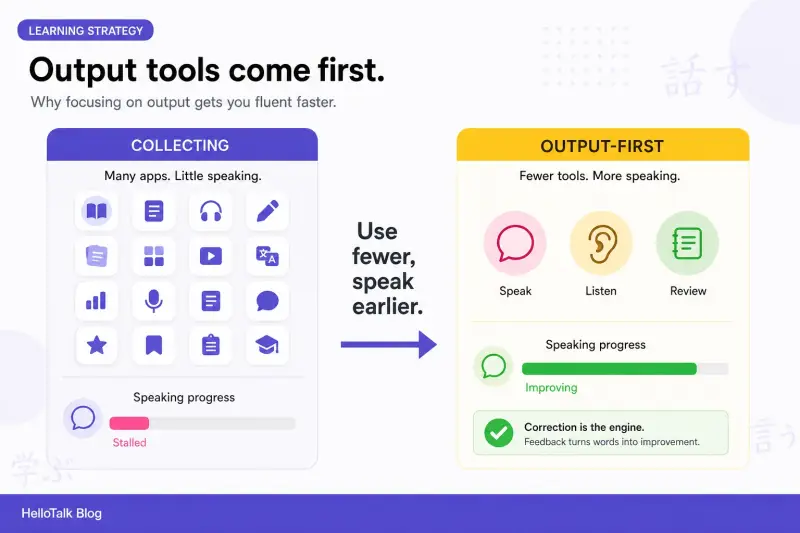
The skill that lags furthest behind for almost every learner is speaking. You can build a big passive vocabulary and still stall the moment you have to produce a sentence. The tool you use first should be the one that makes you produce Spanish and tells you what you got wrong, because that is the skill nothing else can fix. Everything else, from drills to courses, is easier to bolt on later.
How to choose without collecting ten apps
A simple rule keeps your toolkit lean:
-
Pick one output tool and use it every day.
-
Pick one input source you genuinely enjoy.
-
Pick one review or drill app and cap it at 10 minutes.
-
Add a tutor or course only once those three are habits.
Three consistent tools beat ten half-used ones. The efficient toolkit is small and used daily, not large and browsed occasionally.
Where HelloTalk sits in the priority order
Because the top priority is real output and correction, a language exchange community belongs at the front of the list. HelloTalk covers that role and doubles as an input source, which is why it earns the first slot. It connects you with native Spanish speakers among 70M+ registered users across 200+ countries and 260+ languages, and its community moves over 1 billion messages daily.
Each feature maps to a job in your toolkit:
-
Chat-based learning is your primary output tool. Message native speakers with built-in translation, transcription, read-aloud, and real-time grammar correction, so practice and feedback happen in one place.
-
Moments doubles as output and input. Post short Spanish text for correction from several native speakers, and scroll authentic posts as easy daily reading.
-
Voicerooms and Livestreams give you spoken immersion on demand. Join a 24-hour Spanish voice room as a listener first, then speak when you feel ready.
-
AI learning tools cover your review slot. AI pronunciation scoring flags the exact sound to fix, AI grammar correction explains each change, and image translation helps you read signs and menus on the go.
With most core features available for free, the highest-priority tool is also the one you can start with at no cost. HelloTalk was named the 2017 Google Play Best Social App and featured on the global Google Play homepage in 2024.
Common mistakes in choosing tools
-
Starting with drill apps and treating them as the whole plan.
-
Collecting resources instead of committing to a few.
-
Paying for structured courses before you have a speaking habit.
-
Ignoring free community tools that cover the hardest skill first.
FAQ
Which Spanish tool should a complete beginner start with? A language exchange community for real output, paired with easy comprehensible input. Drills and courses are useful later, but speaking practice is the skill that lags most.
Do I need to pay for a tutor? Not to start. Tutors are excellent for structured, targeted feedback, but you can build real speaking ability first through a free exchange community, then add a tutor when your budget allows.
Is Duolingo enough on its own? It is good for habit and basic vocabulary, but it provides little real conversation. Treat it as a supplement and cap the time, then spend the rest on output.
How many tools should I actually use? About three: one for output, one for input, one for review. More than that usually means less consistency, not more progress.
When should I add a structured course? Once daily output, input, and review are habits. A course then works as a grammar reference rather than a passive substitute for practice.
Where to go next
For the overall strategy behind this ordering, read how to learn Spanish efficiently and what to stop doing. To see why output and spaced review sit at the top, see the most efficient way to learn Spanish in 2026. And if your time is tight, how to learn Spanish efficiently in 15 minutes a day shows how to apply this priority order in a quarter hour.
For the research-backed method behind this order, read the most efficient way to learn Spanish.
Pick your first tool by the skill you most need to fix, then keep the toolkit small. You can put the top-priority tool to work today at HelloTalk.