How to Practice English Speaking with AI: The Best Apps and How to Use Them (2026)
The reason most learners can't speak English isn't grammar, it's fear. The fear of pausing, of sounding wrong, of a real person waiting on you. AI removes that fear completely. An AI English conversation partner never sighs, never judges your accent, never gets bored, and is awake at 2 a.m. when you finally feel brave enough to try.
But here's what the app stores won't tell you: just downloading an AI app doesn't work. Most people tap around for ten minutes and quit. The learners who actually get fluent use AI with a method. So this guide is two things, how to practice English speaking with AI so it actually moves the needle, and which apps to use for each goal.
How AI English speaking practice actually works
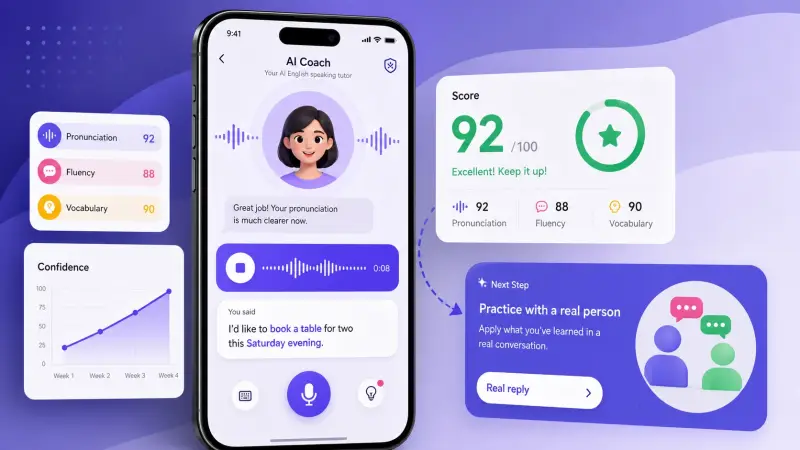
Modern AI speaking apps do three jobs at once, and understanding them helps you use them well:
- They listen (speech recognition), turning what you say into text the AI can analyze.
- They respond (conversational AI), replying like a real partner so you get back-and-forth practice, not just drills.
- They correct (feedback), flagging pronunciation, grammar, and word-choice issues, often with a "say it better" suggestion.
That combination means you can have a real spoken conversation, get instant feedback, and repeat it as many times as you want, the three things that build speaking skill, available on demand with no human required.
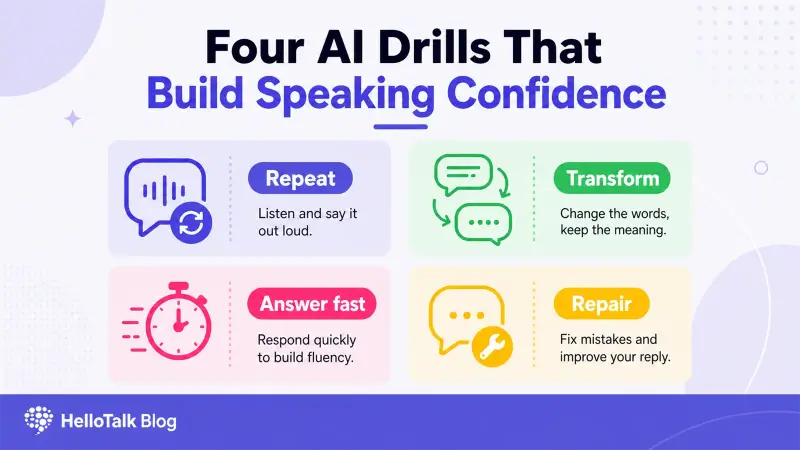
How to practice with an AI app (the drills that work)
Open any AI speaking app and try these four drills instead of aimless chatting. This is where the real gains come from.
1. Role-play a real situation
Give the AI a scenario you'll actually face and a job:
"Let's role-play. You're a barista and I'm ordering coffee. Keep it natural, and tell me my mistakes at the end."
Run it three or four times until it feels automatic, then change the scenario, a job interview, checking into a hotel, a work meeting. You're building ready-to-use conversations, not abstract knowledge.
2. Speak, get corrected, then redo
After you say something, ask:
"How could I have said that more naturally?"
Then say the improved version out loud yourself. This redo step is the part most people skip, and it's exactly where the learning sticks. Reading the correction does little; speaking it rewires the habit.
3. Push into the unscripted
Ask the AI to interview you with open questions:
"Ask me opinion questions and follow up on my answers."
Questions like "What's the best place you've ever traveled, and why?" force you to think on your feet, the messy, unplanned half of real conversation that scripted apps never train.
4. Drill pronunciation on repeat
When an app flags a sound you keep missing, repeat that word or sentence ten times in a row. AI gives you something a human tutor rarely can: infinite patience for the same correction.
Aim for 15-20 focused minutes a day. That's enough to feel measurably more fluent within a month, far more than an hour of silent study.
The best AI English speaking apps (and what each is for)
There's no single winner, the right app depends on your goal. Here's what we'd reach for in each case.
For all-round conversation: Speak
Speak is built specifically to give you conversational reps without a live human. Its AI holds genuine spoken conversations, adapts to your level, and gives feedback as you go, with some of the most accurate speech recognition we tested. Best for learners who want serious daily speaking volume and will pay for it. (Paid, free trial.)
For professional / business English: Loora
Loora positions itself as a personal AI coach leaning toward work contexts, interviews, meetings, presentations, with real-time feedback on grammar, pronunciation, and fluency. Best for working professionals who need English for their job. (Paid, free trial.)
For pronunciation precision: ELSA Speak
ELSA's specialty is pronunciation, it pinpoints exactly which sounds are off, down to the syllable. Less about open conversation, more about being understood. Best for learners whose accent gets in the way. (Free tier + Premium.)
For free, open-ended practice: ChatGPT (voice mode)
Don't overlook the obvious. ChatGPT's voice mode is an extraordinarily flexible partner, role-play anything, ask it to correct you, have it explain why. The free tier has limits, but the quality is hard to beat at the price. Best for self-directed learners who want a free, do-anything partner. (Free / Plus.) It also appears in our best free English speaking apps guide.
For quick, no-signup reps: Gliglish
About 10 free minutes of AI conversation a day with no account, the lowest-friction way to get a daily rep before committing to anything. Best for a fast daily warm-up. (Free / Premium.)
For lifelike avatars: Praktika
Praktika wraps its AI in animated avatars so practice feels like a video chat with a character. The "face" genuinely helps some learners talk more easily. Best for people who find a face easier than a faceless voice. (Paid, free trial.)
The honest truth: AI is practice, people are the point
Here's what no AI app's marketing will tell you: an AI partner is perfect for getting your reps in, killing the fear, and drilling pronunciation with zero stakes. But real fluency, reacting in real time to someone unpredictable, catching slang, reading tone, feeling the rhythm of a genuine exchange, only comes from talking to actual humans.
So use AI the smart way: as a bridge. Drill until the first sentence stops being terrifying, then take that confidence to a real conversation. The cleanest path from AI to humans is a language exchange like HelloTalk, home to 70M+ registered users across 200+ countries, where your partner is also a learner, so the jump from "talking to a machine" to "talking to a person" is gentle. Start in text, move to voice, then video. For the dialogue-focused options either side of that bridge, see our guide on how to practice English conversation.
If you want the bigger picture on combining AI with real practice across any language, including which tasks AI genuinely handles well and which it can't, our guide to AI language learning lays out the full AI-plus-human workflow.
Common mistakes when practicing English with AI
- Chatting aimlessly. Without a drill or a goal, you drift. Use the four drills above.
- Reading corrections but never re-speaking them. The fix only sticks when you say it out loud.
- Living in the AI forever. AI removes fear so you can face people, not so you can avoid them. Set a date to try a real conversation.
- Practicing in bursts. Fifteen minutes daily beats two hours once a week, every time.
- Chasing a perfect accent. Aim to be understood, not flawless. Clear and confident wins.
FAQ
Is an AI English speaking app as good as talking to a real person? For low-pressure reps, pronunciation drills, and building confidence, yes, sometimes better, because there's no judgment and unlimited patience. For true conversational fluency, no. Real people are unpredictable in ways that build the skill AI can't fully replicate. Use AI as a bridge to real conversation.
What is the best AI app to practice English conversation? Speak is the strongest purpose-built option for all-round conversation. For free, ChatGPT's voice mode is remarkably capable. For pronunciation specifically, ELSA leads. For business English, Loora.
How do I actually practice speaking with an AI app? Don't just chat, run structured drills: role-play real scenarios, ask "how could I say that more naturally?" and re-speak the better version, have it ask you open questions, and repeat flagged pronunciation. Aim for 15-20 focused minutes a day.
Are there free AI English speaking apps? Yes, ChatGPT's voice mode and Gliglish let you practice for free (with limits), and ELSA offers a small daily free allowance. See them all in our best free English speaking apps round-up.
Can AI fix my pronunciation? Yes, this is where AI genuinely excels. ELSA in particular gives syllable-level feedback that's hard to get even from a human tutor in real time.
When should I switch from AI to real people? As soon as you can hold a basic role-play without panicking, usually a few weeks of daily practice. AI's whole purpose is to get you ready for humans, so don't wait until you feel "perfect." You never will.
Start practicing today
AI English speaking apps are the best tool ever invented for the learner who's too scared to say the first word, unlimited, judgment-free practice on demand. Use one with the drills above to get talking. Then, when the fear has faded, take that voice to a real person on HelloTalk and discover the difference between practicing English and actually speaking it. Want to see how AI fits into a complete routine? Start with our pillar guide: how to practice English speaking without a teacher, or compare every type of app in our best English speaking apps round-up.