
Daily English Speaking Practice: A 30-Minute Routine for Non-Native Professionals
Most advice on English speaking practice assumes you have an hour a day or a weekend course. You don't. You have 30 minutes, and that's actually enough.
The problem isn't time. It's structure. Thirty unstructured minutes of "watching English YouTube" and "reading English news" produces almost no speaking improvement. Thirty structured minutes split into the right three blocks compounds into real fluency over 8–12 weeks. How to learn a language fast makes the point clearly: consistency and structure beat volume every time.
This routine is built for non-native professionals with full workdays, not language students with 4-hour afternoon schedules. It fits in a commute, a lunch break, and 10 minutes before bed.
Why 30 Minutes of Daily English Speaking Practice Beats 3 Hours on Weekends
The spacing effect is one of the most robust findings in cognitive science: small amounts of practice distributed over time produce stronger retention than the same total time in one block.
For language speaking specifically, the mechanism matters. When you produce English speech daily, your brain automates the retrieval pathways, and reaching for a word becomes faster with each repetition. Three hours on a Sunday activates those pathways once. Consistency beats intensity.
Thirty minutes a day also prevents the skill decay that happens between weekly sessions. If you only practice speaking on weekends, you spend the first 20 minutes of each session just getting back to where you were. Daily practice means you start every session already warm.
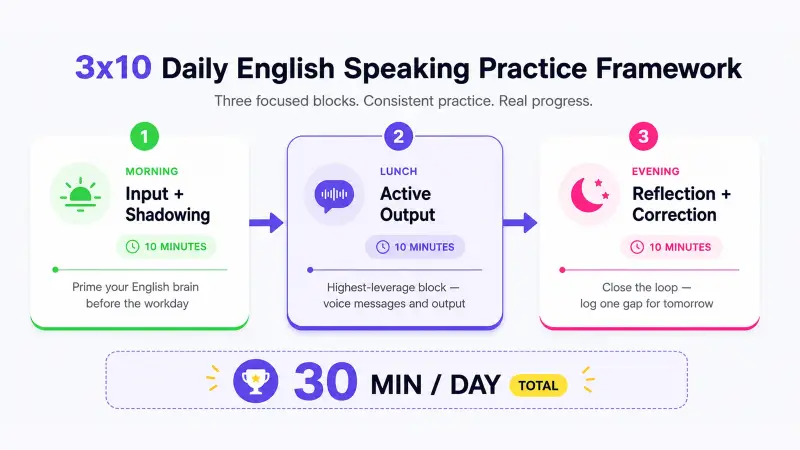
The 3×10 Method: Your Daily English Speaking Practice Framework
| Block | Time | Focus |
|---|---|---|
| Morning | 10 min | Input + shadowing |
| Lunch | 10 min | Active output |
| Evening | 10 min | Reflection + correction |
Three blocks of 10 minutes each, targeting three distinct skills. None of the three alone is enough. Together, they cover the input-output-feedback loop that produces real fluency.
Morning Block: 10 Minutes of Input and Shadowing
The morning block primes your English-speaking brain before the workday starts. It's most effective during a commute, but works anywhere.
Three steps:
- Pick a 2-minute native speaker clip: A podcast excerpt, a news clip, a meeting recording, anything where the speaker uses real English at normal speed, not "learning English" pace.
- Listen once: Just absorb. Note two or three phrases that catch your attention.
- Shadow it twice: Play it again and speak along, matching rhythm, stress, and intonation. Don't worry about keeping up perfectly — the goal is getting your mouth producing English early in the day.
The morning block is not where you produce original English. It's where you absorb patterns and warm up. Think of it as stretching before the workout.
Lunch Block: 10 Minutes of Active English Speaking Practice 🎯
This is the highest-leverage block of your day. The morning block prepared you, and now you produce.
Apps like HelloTalk make voice messages the primary practice mode here: asynchronous, schedule-flexible, and lower social pressure than live calls. You send a voice message, your partner replies when they can. It's real conversation without the scheduling friction of coordinating time zones.
Three prompt types for the lunch block:
- Today's topic: Describe one thing that happened at work this morning, in English, 60–90 seconds. No script.
- Opinion question: Answer a question your language partner sent you. "What's the best advice you've ever received?" Opinion questions force you to generate sentences you've never used before.
- Error replay: Take one sentence you struggled with yesterday (from your evening review) and use it naturally in today's message.
For variety, the best English learning apps for daily practice lists tools worth pairing with your lunch block — some specialize in exercises that fit exactly this time frame.
Evening Block: 10 Minutes of Reflection and Correction
The evening block closes the loop. It's where you process what you produced, identify the gaps, and absorb corrections.
Three steps:
- Listen back to today's voice messages: You'll immediately notice things you missed while speaking, a word you reached for and couldn't find, a sentence that came out awkward, a pronunciation habit you didn't know you had.
- Review your partner's corrections: Apps like HelloTalk offer native speaker corrections directly in the chat. Don't just read them — say the corrected sentence out loud, twice. The correction only transfers to speaking if you produce it after receiving it.
- Log one gap: One word, phrase, or grammar pattern you want to use correctly tomorrow. Just one. Write it down. Tomorrow's morning block starts with it.
Five corrections a week, reviewed properly, is 250 corrections in a year, which is how people actually close the gap between "understands English" and "speaks English naturally."
A Sample Day: Walking Through Real English Speaking Practice
Maria works as a senior accountant at an international firm. Her English is solid for reading and writing. Spoken meetings? She usually follows but rarely volunteers to speak.
Her routine unfolds like this:
- 7:15am (commute): Listens to a 2-minute business English podcast clip. Shadows it twice. Notes the phrase "I'd push back on that" — she's never said it but knows she needs it.
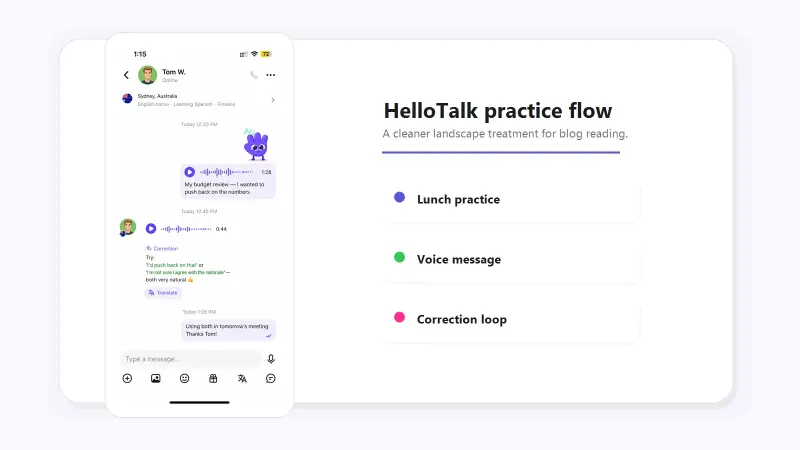
- 12:30pm (lunch): Records a 90-second voice message to her language partner (a native English speaker in Australia learning Spanish): "We had a budget review. I wanted to push back on some numbers but didn't. I need to learn how to do that naturally in English."
- 10:15pm (before sleep): Listens to his reply. He said "push back" is natural and offered two alternatives: "I'd question that" and "I'm not sure I agree with the rationale." She says all three out loud. Logs "I'd question that" for tomorrow.
Three months later, Maria speaks in team meetings. Not perfect, but present. Contributing to the conversation rather than waiting for it to end.
How to Stay Consistent with Your Daily English Speaking Practice
The 30-minute routine only works if you actually show up daily. Three habits that make consistency sustainable:
- Habit stacking: Attach each block to something you already do, morning block to your commute, lunch block to eating, evening block to brushing your teeth. The existing habit carries the new one.
- Public commitment: Tell your language partner you'll send a voice message every weekday. Social accountability, not wanting to disappoint a real person, is more reliable than personal discipline alone.
- Recovery rule: If you miss a day, send one voice message the same evening, just 30 seconds. The goal isn't perfection. It's not letting one missed day become a week off.
When You Need More Than Voice Messages: Try Voicerooms
Once the voice message habit is solid, usually around Week 3–4, try voicerooms: real-time group voice conversations open around the clock.
Apps like HelloTalk run voicerooms on topics from everyday conversation to professional English, 24 hours a day. You can listen first, then raise your hand to speak when you're ready. The real-time format introduces the element that voice messages can't: live pressure, where someone responds before you've had time to rehearse.
Live voicerooms are the bridge between "I can send prepared voice messages" and "I can hold a real-time conversation." Most learners are ready for them around 3–4 weeks into the daily routine.
Whether you use HelloTalk or another platform, the progression is the same: text, then voice messages, then live conversation. Each step is a meaningful jump in difficulty, and each one is worth the effort.
When You Want to Level Up English Speaking Practice
The 30-minute routine builds a speaking floor. Once you're consistently conversational, the next level is professional register, the kind of English that holds up in client meetings, presentations, and negotiations.
Why studying English for years doesn't lead to fluency addresses the gap between "studied English" and "speaks English" in detail. The short version: fluency requires output under pressure, with feedback, in context — exactly what the daily routine builds, but at higher stakes.
At that stage, the routine might evolve to include weekly sessions with a native speaker in your specific field. The 30-minute structure stays. What changes is the level of conversational challenge.
What to Do When You Don't Have 30 Minutes
Some days, 30 minutes is genuinely not possible. Three emergency plans:
- 5-minute version: Send one voice message. Anything, describe what you had for lunch. The maintenance value of one daily production rep is significant — it keeps the habit alive through hard weeks.
- Commute-only version: Do just the morning block. 10 minutes of shadowing on the way to work counts as practice even if the output blocks don't happen.
- Consolidated version: If you missed both output blocks, spend 5 minutes listening to an English clip and 5 minutes speaking a summary of it out loud. Not ideal, but it keeps the streak going.
FAQ
Q1: Can I really improve my English speaking with only 30 minutes a day?
Yes, provided the 30 minutes includes real spoken output, not just input. Thirty minutes of reading English articles produces almost no speaking improvement. Thirty structured minutes split between shadowing, voice messaging, and reviewing corrections produces measurable improvement within 4–6 weeks. Real timelines for daily English practice gives the research behind what different practice types actually produce.
Q2: What if I miss a day of English speaking practice?
Use the recovery rule: send one 30-second voice message the same evening. Don't try to catch up or double up — just don't let one missed day turn into a week off. Consistency over perfection is the only principle that matters for building a speaking habit.
Q3: Do I need an English speaking practice app or can I do this on my own?
You can do the solo parts, shadowing, self-talk, voice journaling, entirely without an app. The part that benefits most from an app is finding a consistent native speaker partner for the lunch block exchanges. Without that, you're practicing production without getting the real-world feedback that closes the loop.
Q4: Is it better to do 30 minutes of English practice in one block or split it up?
Split it up. The 3×10 structure in this routine is not arbitrary — it's designed around how language retention actually works. One continuous 30-minute block produces a single activation of your speaking pathways. Three separate blocks across morning, midday, and evening produce three activations with gaps in between. Those gaps are where consolidation happens. Your brain rehearses the patterns during the intervals, which is why spaced practice outperforms massed practice for language learning. There's also a practical reason: spreading the 30 minutes across the day means you're never far from your last practice rep. You start each block already partially warm rather than spending the first few minutes just getting back into English mode.
Q5: What kind of improvement can I realistically expect after 30 days of this routine?
Three concrete changes most people notice. First, your speaking startup time drops — sentences begin forming faster, with less internal searching for words. Second, you start catching your own mistakes mid-sentence and correcting without stopping, which is a sign your monitoring ability has caught up to your production speed. Third, you develop a smaller set of "anchor phrases" — a few dozen constructions you produce automatically that hold your speech together while your brain works on the harder parts. What you won't have after 30 days is fluency. You'll have a reliable foundation and measurable momentum. The difference between 30 days in and day zero is significant. The difference between 30 days and 90 days is even larger, because the habit compounds.
Q6: Can I practice English speaking effectively during my commute, or only at home?
A commute is one of the highest-leverage windows in the routine. The morning shadowing block is specifically designed for it: put in earbuds, pick a 2-minute native speaker clip, listen once, then shadow twice while walking or riding. No phone screen needed after you've started the clip. The lunch block can also work partially on a commute — the voice message format is built for exactly this situation. Apps like HelloTalk let you record and send voice messages from anywhere, and your partner replies asynchronously, so there's no need to be at a desk. The only block that benefits from being home is the evening review, where listening back and reading corrections attentively is easier without background noise. Two of the three daily blocks work as well in transit as anywhere else.
Start tonight: record a 60-second voice message about your day. If you don't have a language partner yet, open HelloTalk, match with an English-speaking professional, and introduce yourself. One message. That's Day 1 of the routine.