
Japanese Speaking Practice: How to Stop Being Afraid to Open Your Mouth (Even at N2)
If you're searching for Japanese speaking practice advice after years of studying, you've probably noticed the gap. Reading? Fine. Listening? Mostly fine. But the moment you need to speak, to a Japanese native, to a colleague, to anyone who expects a real-time response, something freezes.
This isn't a vocabulary problem. Most people who struggle with Japanese speaking have thousands of words stored. The problem is a specific barrier that Japanese learners face more acutely than learners of most other languages. Understanding real timelines for learning Japanese helps put it in context: Japanese is genuinely harder to reach speaking fluency in than European languages, but the freeze isn't about grammar. It's about silence.
This guide breaks down why the silence barrier exists for Japanese specifically, and maps out a 4-stage method for getting past it, whether you're at N5 or N2.
The Japanese Silence Barrier: Why N2 Learners Still Need Speaking Practice
The JLPT N2 tests reading comprehension, grammar, and listening. It does not test speaking. Someone can pass N2 and still be completely unable to hold a 5-minute spoken conversation, and this is extremely common among learners outside Japan.
The barrier isn't random. Three things specific to Japanese language and culture create it:
Keigo (敬語) Anxiety
Japanese has three distinct politeness registers: teineigo (丁寧語 — standard polite), sonkeigo (尊敬語 — respectful), and kenjougo (謙譲語 — humble). The fear of accidentally using the wrong level, particularly using casual form when polite form is expected, paralyzes many learners before they even begin.
The reality: In 90% of everyday situations, teineigo is appropriate and sufficient. Even native Japanese speakers default to teineigo with new acquaintances. Worrying about sonkeigo before you can hold a basic conversation is like worrying about wine pairing before learning to cook.
The "Meiwaku" Culture
Japanese cultural norms around not causing inconvenience to others (meiwaku, 迷惑) creates a specific hesitation in language learners: the feeling that your broken Japanese is an imposition on the native speaker. You suffer in silence rather than attempt a sentence that might waste their time or cause confusion.
This is a cultural projection, not a reality. Most Japanese native speakers are genuinely delighted when someone attempts the language — the effort is noticed and appreciated, not judged.
The Perfectionism Trap
Japanese learners tend to be detail-oriented by the nature of the learning process: kanji study, particle rules, verb conjugation patterns all reward precision. That precision orientation becomes a liability in conversation, where waiting for the perfect sentence means saying nothing.
The perfectionism trap is a loop: you don't speak because you're not ready, so you never get the practice that would make you ready.
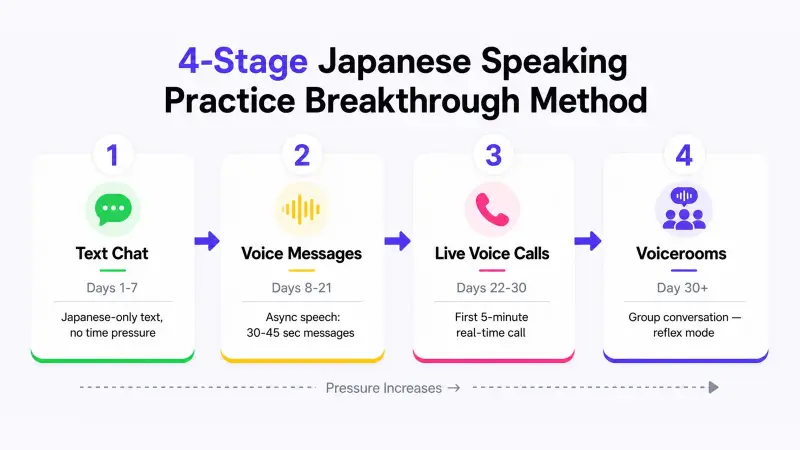
The 4-Stage Japanese Speaking Practice Breakthrough Method
Getting past the silence barrier requires a graduated approach. Each stage lowers the pressure of the next. Completing each one unlocks the following. Don't skip stages.
Stage 1: Text Chat (Days 1–7, Lowest Pressure)
Text chat is the entry point because it removes time pressure entirely. You have as long as you need to compose a sentence, look something up, and edit before sending.
Three things to do in Stage 1:
- Write in Japanese only: No English in the chat. Even if you're slow and need a dictionary three times per message, Japanese-only keeps the practice real.
- Talk about your actual life: What did you eat today? What are you working on? Real topics produce vocabulary you'll actually reuse, unlike textbook scenarios.
- Don't self-correct before sending: Send the message with the imperfect sentence. Let your partner correct it. The correction is the lesson.
Stage 2: Voice Messages (Days 8–21, Async Practice)
Voice messages add what text can't train: real-time speech production. But the async format means you can record, review, and optionally re-record before sending, lower pressure than live calls.
Three things to do in Stage 2:
- Record before reviewing: Say the message once without stopping. Then listen. Then decide whether to re-record. This trains the ability to complete sentences under mild pressure.
- Keep messages short: 30–45 seconds per message. The goal is daily reps, not performance. Volume of attempts matters more than length.
- Ask follow-up questions: End every voice message with a question to your partner. This keeps the exchange moving and gives you more natural Japanese input to learn from.
Stage 3: Real-Time Voice Calls (Days 22–30)
The first live call is terrifying. That's expected and normal. The goal of Stage 3 is not fluency. It's completing a 5-minute call without going completely silent.
Three things to do in Stage 3:
- Tell your partner beforehand: 「緊張しています。ゆっくり話してください。」 ("I'm nervous. Please speak slowly.") This is a practical request that makes the call work for both people, not a sign of weakness.
- Prepare 3 topics: Before each call, decide on three things you'll talk about. Having a topic available when conversation stalls removes most of the panic.
- Don't translate in your head: When you catch yourself trying to construct Japanese from an English sentence, stop. Say what you can in Japanese, even if it's simpler than what you meant.
Stage 4: Voicerooms and Group Conversations (Day 30+)
Once you've had five or six 5-minute live calls, extend the format. Join a Japanese-language voiceroom, a group voice conversation with multiple speakers. The difference from one-on-one: you follow multiple people simultaneously, decide when to enter, and keep up with natural speech speed.
This is the stage where Japanese speaking becomes reflexive rather than deliberate. It takes months to fully develop, but Stage 4 is where the real breakthrough happens.
Finding the Right Japanese Practice Partner
The partner matters as much as the method. Three principles for finding the right Japanese practice partners:
- Avoid perfectionist corrections: Some native speakers will stop and correct every particle error mid-sentence. This is discouraging at Stage 1–2. Look for partners who let you finish sentences and correct at natural pause points.
- Look for Japanese speakers learning your language: The mutual exchange format removes the inequality dynamic. They need your help as much as you need theirs, and they viscerally understand the speaking fear you're experiencing.
- Filter by shared interests: A conversation about something you both genuinely care about, manga, music, travel, gaming, food, runs significantly longer than a generic language exchange.
Apps like HelloTalk are particularly useful here because they let you find Japanese learners of English or other languages — the mutual exchange means they're as motivated as you are, and they understand the speaking fear firsthand. The interest-based matching feature connects you with people who share actual topics to talk about, not just mutual language goals.
Language exchange through platforms like HelloTalk also means the practice is free and sustainable — the relationship continues for months rather than ending after one awkward session.
Whether you use HelloTalk or another language exchange platform, the principle is the same: find a partner in a mutual exchange, with at least one shared interest, who's patient enough for the early stages.
30-Day Japanese Speaking Practice Action Plan
| Week | Daily Time | Focus | Output Goal |
|---|---|---|---|
| 1 | 15 min | Text chat only | 10 messages/day |
| 2 | 20 min | Voice messages | 3 voice messages/day |
| 3 | 30 min | First voice call | 1 live call this week |
| 4 | 30 min | Extended conversations | 3 live calls this week |
Daily time increases gradually. Week 1 is shorter because text chat is lower intensity — you spend time thinking, not producing speech. By Week 4, 30 minutes of live Japanese conversation is genuinely tiring. That tiredness is the production muscle being built.
4 Common Mistakes to Avoid in Japanese Speaking Practice
Four things that stall progress or extend the silence barrier longer than necessary:
- Waiting until grammar is "good enough": Grammar improves fastest through corrected speaking, not more study. The threshold for starting speaking practice is much lower than most learners think.
- Only practicing with patient, teacher-type partners: You need some partners who speak at natural speed and don't slow down to accommodate you. Accommodation feels kind but doesn't build real comprehension speed.
- Focusing on keigo before it's necessary: Teineigo handles nearly every interaction you'll have for the first year of speaking practice. Worrying about sonkeigo at N4–N5 is premature and paralyzing.
- Treating corrections as failure: Every correction in a language exchange is data, not judgment. Each one is a specific improvement your next conversation will reflect.
A Real Learner's Story
Julia had studied Japanese for five years in Amsterdam. She could read manga in Japanese without a dictionary. She'd passed JLPT N2.
She had never had a complete spoken conversation in Japanese.
She started Stage 1 — text chat only — with a Japanese university student learning English. Day 1 took 40 minutes to compose 8 messages. Day 7 took 15 minutes for the same volume. The production muscle was already adapting.
At Day 10, she sent her first voice message. Thirty seconds. She said it was the most nervous she'd been while learning a language in five years.
Day 25 was the turning point. Her Japanese partner said something she didn't understand, and instead of going silent, she said: 「もう一度言ってください。ゆっくりと。」 ("Please say that again. Slowly.") She had only ever written this phrase before — it came out without thinking.
By Day 30, they were doing 15-minute voice calls. Not fluent, but present — a real conversation with a real person, in Japanese, from a city where almost nobody speaks it.
Resources Beyond Japanese Speaking Practice
Speaking is the output side of Japanese learning. If you want to strengthen the input and structural foundation alongside your speaking practice, these resources cover the other dimensions:
- For a curated set of online learning tools: the best online resources for Japanese beginners
- For a complete beginner's roadmap including timelines and approach: how to learn Japanese fast as a beginner
- For app recommendations tested against real learner outcomes: the top Japanese learning apps tested for beginners
The speaking practice in this guide works best in parallel with structured input, not instead of it. Both sides of the skill need development.
FAQ
Q1: Why can I read Japanese but still need speaking practice?
Reading and speaking are distinct skills trained by different cognitive processes. Reading is recognition — your brain identifies patterns. Speaking is production under time pressure — your brain retrieves vocabulary, applies grammar, forms sentences, and delivers them in seconds. You can be excellent at one and poor at the other. Many N2 passers are. Speaking practice specifically trains production, not recognition.
Q2: How do I learn Japanese language speaking faster?
The fastest route is daily speaking output with real-time or near-real-time feedback from native speakers. The 4-stage method in this article is structured around this: text, then voice messages, then live calls, then voicerooms. Frequency matters more than session length — 15 minutes daily beats 2 hours weekly.
Q3: How long until I can hold a basic Japanese conversation?
For learners starting from JLPT N4–N5 vocabulary, a basic 5-minute spoken conversation with a patient native speaker is achievable within 30 days of the method above. Real timelines for harder languages provides broader context — Japanese speaking takes significantly longer to reach full fluency than European languages, but basic conversational function comes faster than most learners expect once they start practicing output.
Q4: Is HelloTalk good for finding Japanese practice partners?
Apps like HelloTalk are well-suited for Japanese practice specifically because they have a large community of Japanese speakers learning English and other languages. The mutual exchange format, interest-based matching, and graduated practice modes — text, then voice messages, then live calls — map directly onto the 4-stage method in this article.
Q5: Should I focus on keigo or casual Japanese first for speaking practice?
Start with casual Japanese (plain form / dictionary form) in most learning contexts, but use teineigo — the standard polite form ending in ます/です — as your default when speaking with new partners. The practical reason: teineigo is appropriate in virtually every real-world situation you'll encounter as a learner. It's what strangers use with each other, what you use with shop staff, and what you use in most professional settings. Keigo — the full system of sonkeigo and kenjougo — is required in formal business environments, but attempting it before your teineigo is solid is almost always counterproductive. Native speakers can tell when keigo is being used mechanically rather than naturally, and incorrect keigo draws more attention than correct teineigo. Master teineigo to a point of automaticity first. By the time that's solid, you'll have absorbed enough context to learn keigo as a meaningful layer rather than a confusing wall.
Q6: Can a complete beginner start Japanese speaking practice right away, or should they study first?
Day one is not too early to start practicing speaking. The common instinct is to wait — to accumulate enough grammar and vocabulary before "risking" a real conversation — but that instinct reliably extends the silence phase by months without improving outcomes. Beginners have one thing that intermediate learners sometimes lack: nothing to protect. You don't have a half-built speaking habit that might be wrong. Starting with text-first exchanges removes the time pressure of live conversation while still producing real output. Apps like HelloTalk are designed for this entry point — you can take as long as you need to compose a message, look up words, and edit before sending. The skills you build in those first halting text exchanges transfer directly to spoken Japanese faster than any amount of solo study without output practice.
Open HelloTalk, find a Japanese learner of your language today, and send your first text message. Day 1 starts now. The first sentence doesn't have to be good — it just has to exist.