
Russian Verbs of Motion: Say How and When You Go Somewhere
Published on

If your sentence has to say how you travel and whether this is one trip or a regular one, pick between идти, ходить, ехать and ездить first. "I go to work" is one English sentence and at least two Russian ones, and a list of endings will not tell you which version a reader took from your message. Most of that you can check alone against four verbs. When you want to know how your wording landed, a short message on HelloTalk lets a willing partner say what they understood.
Choose by How You Travel and Whether It Is One Trip or a Regular One
Two questions decide the verb, and both are answerable before you look at a single form. Are you on foot or in some kind of vehicle? And are you talking about one trip in one direction, or about movement that repeats or goes there and back?
In Russian, how you travel is part of the verb, so идти and ехать are a choice you make before you think about time at all. English hides that choice inside "go" and leaves it to context. Russian puts it in the word you pick, which is why a sentence can be grammatically fine and still describe the wrong journey.
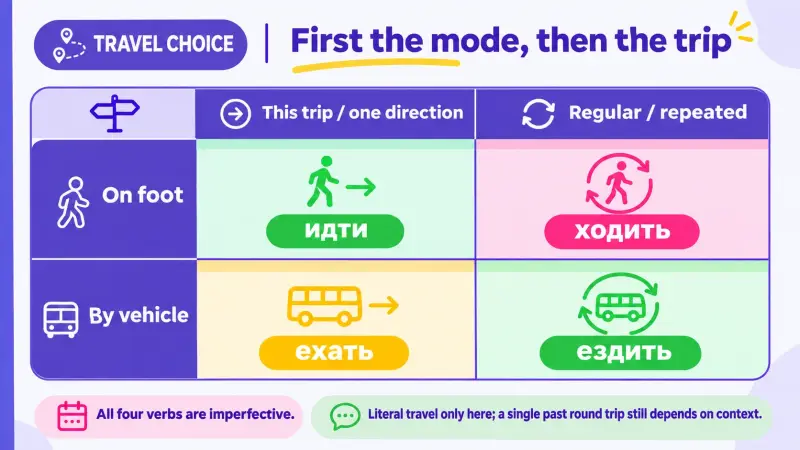
The grid below is the whole scope of this article. Find your row by travel mode, then use the trip column to decide between the one-direction verb and the repeating one.
| Verb | How you travel | Which kind of trip | Example | English |
|---|---|---|---|---|
| идти | on foot | one trip, in progress or in one direction | Я иду в магазин. | I am walking to the store. |
| ходить | on foot | regular, repeated, or there and back | Я хожу в магазин каждый день. | I go to the store every day. |
| ехать | by vehicle | one trip, in progress or in one direction | Я еду на работу. | I am on my way to work. |
| ездить | by vehicle | regular or repeated trips | Я езжу на работу на автобусе. | I go to work by bus. |
The present forms you need most are иду and идёшь, хожу and ходишь, еду and едешь, езжу and ездишь. That is enough to write about your own week without working through a full table of persons and tenses.
All four of these unprefixed verbs are imperfective, so moving from идти to ходить changes the shape of the trip rather than marking it as finished. If your real question is about completed versus ongoing versus repeated events, that belongs to another part of the verb system, covered in the walkthrough of beginner Russian resources that explain verb aspect through real situations.
Where a contextual lesson helps more than a chart
Among free explanations, Russian for Free handles this topic in its Lesson 14. The useful part for this task is that it splits walking from vehicle travel and shows each verb inside a present-tense situation rather than as a paradigm.
A full reference table gives you every form at once. That is good for checking an ending you already half remember, and poor for deciding which of two correct verbs fits your Tuesday. Lesson 14 then moves on to prefixes such as по-, and for the narrow job here that part is better left aside than applied as a general shortcut. A chart dropping out of usefulness at exactly this point is a familiar pattern, traced in where Russian learning resources break down.
идти and ходить: On Foot, This Trip or Regularly
Starting with the walking pair keeps the examples short, since you can describe most of your own week without naming any transport. Use идти when you are on the way right now or heading in one direction, and ходить when the trip is part of your routine.
Asked on the street, Куда ты идёшь? means where are you going at this moment, and Я иду домой answers it for this one walk. A routine sounds different: Я хожу на работу пешком says that walking to work is what you normally do, with no claim about where you are standing as you type it.
One caution so the on-foot label does not get overextended. Russian also uses ходить for transport running on a route, as in Автобусы ходят каждые десять минут, which describes a service rather than anyone's feet. The on-foot reading is the literal travel case this article covers, not a rule about every expression containing ходить.
ехать and ездить: The Same Split for Vehicle Travel
The same two questions run through the vehicle pair. Swap the travel mode and the logic carries over unchanged.
Я еду в Москву describes one trip you are making or about to make in one direction, and Мы едем на машине adds the vehicle to that same single journey. For something that repeats, Я езжу в Москву два раза в год and Каждое лето мы ездим на море put the movement on a schedule instead of on today.
ехать and ездить cover bus, car, train and similar travel without you having to name the vehicle. In the examples here, the walking verb already carries on foot by itself; adding пешком, as in Я хожу на работу пешком, makes that explicit when a listener might otherwise picture a bus.
ходили and a Past Round Trip You Made Once
The present tense makes the split look tidy. The past tense is where a common beginner shortcut breaks, the one that reads single-direction as one time and multidirectional as often.
In the past you will meet шёл and шла for a walk in progress, as in Я шёл домой for I was on my way home. Alongside that, Вчера мы ходили в кино reports one visit to the cinema and the return from it, and Вчера мы ездили в Москву does the same for a vehicle trip there and back.
Past-tense ходили can describe one completed there-and-back visit, which is why "multidirectional means often" is an incomplete rule. What carries that reading is the whole sentence and the situation around it, not a time word acting as a switch: Вчера мы ходили в кино is one evening out, while Мы ходим в кино каждый месяц is a habit. None of this is a statement about aspect, so resist reading ходили as a finished-action marker.
Describe Your Own Route and Check What a HelloTalk Partner Understood
Reading about four verbs is not the same as finding out which trip your own sentence described. That gap is where another person becomes useful, and the sequence below keeps the solo work first.
Write three sentences about this week, one trip in progress, one routine and one past outing, then check each against the grid above for travel mode and trip type. That pass removes most of the obvious mix-ups before you use anyone's attention.
The table turns the rest into concrete actions, including where each one happens and what it is good for.
| What you prepare | Where it happens | Finite question to attach | Why this step helps |
|---|---|---|---|
| Three sentences about this week's trips | Your own notes, checked against the four-verb grid | "Did I pick on foot or vehicle for each one?" | Solo checking catches the mode and routine slips you can already see for yourself |
| One of those sentences as a text or voice message | A HelloTalk chat, using its text and voice messages | "Did you understand this as today's trip or something I do every week?" | HelloTalk carries the sentence to someone who reads Russian, and only another person can report a reading you did not intend |
| A question back about the other person's own commute | The same HelloTalk chat | "Ты ездишь на работу или ходишь пешком?" (do you go to work by transport, or walk?) | It makes the message an exchange about routes rather than a marking request, and their answer shows which verb a real route gets |
| Wording from a reply you want to keep | HelloTalk's in-chat correction and translation tools, plus your own note file | "Is по вторникам what you would say here?" | HelloTalk shows corrected wording inside the message, and copying it into personal notes is what makes it reusable next week |
A reply tells you which reading your sentence carried, something a conjugation list cannot show you on its own. A message such as Я еду в центр, потом иду домой пешком. А ты как ездишь на работу? means "I am riding into the center, then walking home. And how do you get to work?", so it gives a partner two verbs and one stated mode to react to, and asks about theirs.
A possible answer like "я езжу на метро, минут двадцать, так ты обратно идёшь пешком?" would mean "I take the metro, about twenty minutes, so you walk back?", and it would show that the contrast arrived.
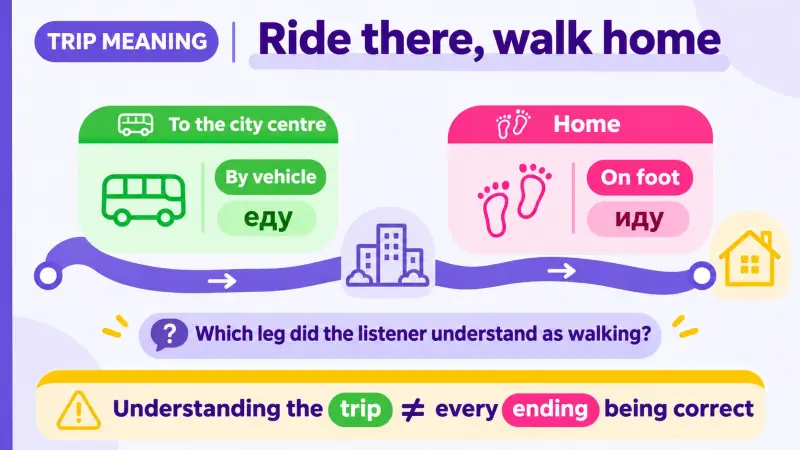
If a reply instead has you walking the whole way, your sentence is not automatically the problem. Say plainly that the first leg is by transport and the way home is on foot, ask which part was unclear, and change your wording from what that particular answer points to.
If a reply contains a word you cannot find in a dictionary because of its ending, the lookup side of the same messages is handled in looking up an inflected Russian word without losing the message.
Two limits are worth holding onto. Someone who guesses your meaning correctly has not confirmed that every ending in the sentence is right, and the people you write to are participants with their own reasons for answering, not teachers on call. One short answerable question per message tells them exactly what to respond to. If finding someone to write to is the open problem, the practical routes are laid out in the guide to Russian language exchange and how to actually practice.
A photo of your street or bus stop, shared in the same chat, can add optional context, but it does not say whether you are on your way now or describing a weekly habit. The sentence still has to carry that part.
For reuse, keep the saving small and personal. A short list of the exact phrases you want again, such as на машине, пешком and по вторникам, is easier to pull from next week than a scroll back through old chats.
If motion verbs turned out not to be your real sticking point, the broader map of options lives in the overview of the best online resources to learn Russian as a beginner and stay motivated.
FAQ: Talking About Everyday Trips in Russian
Is идти perfective and ходить imperfective?
No. идти, ходить, ехать and ездить are all imperfective. The difference between them is direction and repetition, not whether an action is presented as complete.
Which verb do I use for "I go to work"?
It depends on two answers. On foot and right now gives Я иду на работу; on foot as a routine gives Я хожу на работу пешком; by transport right now gives Я еду на работу; by transport as a routine gives Я езжу на работу.
Does ходить always mean on foot?
In the literal travel sentences covered here, yes. Russian also uses ходить for transport running on a route, as in Автобусы ходят каждые десять минут, so treat the on-foot reading as this article's case rather than a rule for every expression.
Can ходили describe a single trip?
Yes. Вчера мы ходили в кино can report one visit and the return from it. The whole sentence and the situation around it carry that reading; a time word on its own does not decide it.
What about prefixes like по-?
They change the picture in ways this article does not cover, and the broad version of that rule is not safe to apply as a shortcut. Stay with the four unprefixed verbs until your everyday trips come out the way you mean them.
What should I ask a HelloTalk partner so the question can actually be answered?
Send one sentence and one closed question with two options, such as whether you sounded like you were on the way now or describing a weekly routine. A narrow question tells the other person exactly what to respond to, and leaves them room to add their own route.
Do I need a partner to check every sentence?
No. Travel mode and routine versus one trip are things you can check yourself against the grid above. Bring in another person when the open question is what your wording communicated, not when it is which form to write.
When your three sentences about this week are ready, send one of them on HelloTalk and ask which trip the other person pictured.