
How to Look Up an Inflected Russian Word Without Losing the Message
Published on
If a Russian message contains a word your vocabulary list never showed you, paste that exact form into a dictionary before you ask anyone; the sender is mainly needed when the sentence itself leaves the meaning open. The snag is concrete: в городе carries an ending the headword го́род does not, and the written string города matches more than one form in the same table. HelloTalk keeps the original sentence in the chat, so one short question to the person who wrote it can settle what an entry cannot.
Start From the Message You Received, Not a Word List
Here is an invented practice message, the kind a Russian-speaking partner might send: «Я сейчас в городе, вернусь вечером.» That reads as "I'm in town right now, I'll be back in the evening." You recognise сейчас and вечером, then stall on городе, which is not the shape your word list taught you.
The ending on a Russian word carries information, so copy the whole sentence before you start searching rather than reducing it to one unknown item. The preposition в in front of городе points you toward the right row of the dictionary entry, and вернусь вечером tells you when the person is coming back. Neither part names a city.
Word lists print nouns in the nominative singular, which is the one form a running sentence often avoids. That mismatch is where a routine built on lists and flashcards stops helping, something also covered in where Russian learning resources break down, and it sits inside the wider question of which online resources work for a Russian beginner.
Type the Exact Form You Were Sent Into OpenRussian
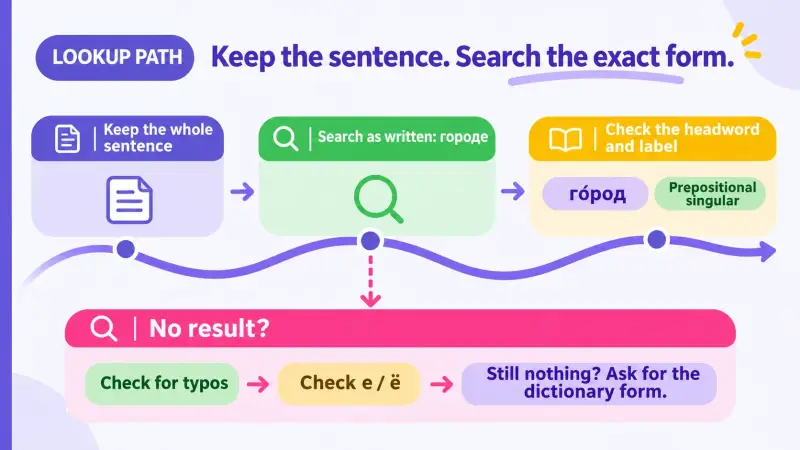
So the search starts with the string from the message, not with a guess at the dictionary form. Copy городе out of the chat and paste it into the OpenRussian search box exactly as written, ending included.
Searching городе in OpenRussian's public search box returns го́род and labels го́роде as prepositional singular. The result line for that query also shows the meaning city, town, a noun masculine tag and an A2 marker, which is enough to stop guessing and open the entry.
Other endings are worth pasting in the same way, though a dictionary that handles one form is not a guarantee for every inflection or every typo. If a search comes back empty, check the message for a slip, mind е written where ё is spoken, and if it still fails, ask the sender for the dictionary form of the word.
The search box and entry pages used in this path are publicly viewable, while some sections of the site sit behind a paid tier. It is worth building the habit on the parts you can reliably open.
Read the Entry: Headword, Case Label, and Example
Opening the entry turns a search result into something you can use in the sentence, and the first pass needs only three things: the headword, the label attached to your form, and one example sentence.
The го́род entry gives the headword with its stress mark, the meaning city or town, the masculine noun category, example sentences, and a declension table carrying a notice about a stress change. Your form го́роде is listed as prepositional singular, which fits the в in front of it, so в городе reads as in town or in the city.
The preposition by itself does not decide the case, since в also appears with other endings and other meanings. Here the entry's label and the sentence agree, and that agreement is what makes the reading safe.
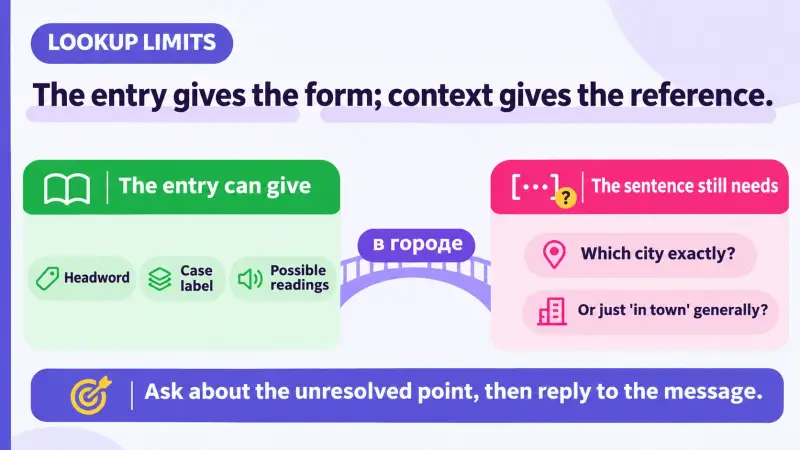
A dictionary entry can tell you which form you are looking at, but not which city the sender meant or why they brought it up. The A2 tag describes that word, not your level, and reading one message does not require memorising the table; the row matching your form does today's work.
When Written города Can Be Read Two Ways
The declension table is also where the comfortable one-form-one-meaning picture stops holding. The forms around this entry are го́род, го́роде, го́рода and the plural города́, and the entry flags the stress change outright.
In ordinary written Russian the stress marks are not printed, so the single written string города can match the genitive singular го́рода or the plural города́, which the table lists for both the nominative and the accusative. Spelling does not separate them; the words around them do.
Take a clean pair, invented for practice. «Я приехал из города.» means "I came from the city", with из governing the genitive singular. «Эти города очень красивые.» means "These cities are very beautiful", where эти and красивые are plural and settle the reading. The singular form is grammatically one city, but which city, or whether the writer means a city in general, still comes from the sentence.
Hearing and producing that stress difference yourself is a separate routine, handled in checking Russian word stress with audio, recording, and a listener.
It helps to keep the three written forms apart in one place, since each one needs a different amount of outside help. The table below sorts the form you might receive, what the entry settles for you, and what the sentence or the sender still has to settle.
| Written form in the message | What the го́род entry gives you | What the sentence or sender still has to settle |
|---|---|---|
| городе | The headword го́род, and this form labelled prepositional singular | Which city, and whether в городе means a named city or simply in town |
| города | The declension table lists го́рода and the plural города́, with a stress-change notice | Which reading fits, read from the word it depends on and from plural agreement |
| город | The headword form itself, city or town, masculine noun | Whether it is the subject or the object here, and which place is meant |
The third column is the part the entry leaves open, and in a chat the person who wrote the sentence is right there to answer it.
Check the Sentence With the Sender on HelloTalk and Reply to the Content
In the example above the lookup settles the grammar and leaves one thing open: в городе can point to a specific city or simply mean in town, and the message never names a place. Paste that original sentence back into the same HelloTalk chat with one narrow question attached, because the writer is the person who knows which place they had in mind.
HelloTalk's chat supports text and voice messages, translation and correction tools in the same thread, so the sentence you are asking about and your question go out together. Keep the question answerable in a line: «В каком городе ты сейчас?» for "Which city are you in right now?", or a short English version if you would rather not build the Russian yet.
A narrow question tells the other person exactly what to answer, which is easier to respond to than "is my Russian correct?". Whether and when someone replies is still up to them; partners choose what they feel like answering rather than working as on-call teachers.
Then answer what the message was actually about. «Хорошо, тогда напиши вечером. Я тоже был в городе утром.» reads as "Okay, write to me in the evening then. I was in town in the morning too", and it reuses the form you just looked up. These are suggested lines rather than a transcript, and a partner following them means the message got through, not that your endings were right.
Afterwards keep the record small: in your own notes, save the original sentence, the headword го́род, the label that applied, and anything the sender clarified. When the same ending turns up next week, you read it instead of searching again, and the saved wording goes into your next message. That loop of asking and reusing is what finding a Russian language exchange partner and actually practising runs on.
Messages are also easier to work through when the rest of your input sits at a level you can follow, which is the question behind choosing beginner Russian listening resources.
FAQ: Russian Word Lookups in Context
Does OpenRussian recognise every inflected Russian form?
The form городе returns го́род with a prepositional singular label. Other endings are worth pasting in the same way rather than assumed to work, especially if the message contains a typo.
What should I do if the search returns nothing?
Check the message for a slip and for е written where ё is spoken. If you can guess the headword, open its entry and look for your form in the declension table. If nothing matches, ask the sender for the dictionary form.
How do I tell whether города is genitive singular or plural?
The spoken forms differ in stress, го́рода against города́, but written Russian usually leaves the marks out. Read what the word depends on and what agrees with it: из города is genitive singular after that preposition, while эти города очень красивые has plural agreement. The entry lists города́ for both nominative and accusative plural.
Do I need to learn all six cases before I can look words up?
No. To read one message you need the label the entry attaches to your form plus the words around it. The full system can come later.
Should I ask a partner about every unknown word?
No, that is slower for both of you. Do the lookup yourself and bring only what the entry could not settle, such as which place or which time the sentence refers to.
Does a partner understanding my reply prove my grammar was right?
It does not. A successful guess means the message got through; it is not evidence that the ending, the stress or the word choice was correct.
What is worth saving from one lookup?
The original sentence, the headword, the case label that applied, and any clarification you received. Personal notes are enough; nothing more elaborate is needed.
Next time an unfamiliar ending shows up in your inbox, run the lookup first, then bring the one leftover question back to the sentence on HelloTalk and answer what the person was telling you.