
Beginner Russian Listening Resources: Choose Material You Can Actually Follow
Published on

If you can follow what happens in a short clip without translating every word, that material fits you now; if you are decoding single words and lose the thread, it sits above you today. The awkward part is that Comprehensible Russian and Russian with Max can both look beginner friendly from outside. Trying one sample is a solo job. A human reply matters later: once the material hands you a topic, one short question on HelloTalk can bring back wording nobody scripted for you.
Compare Comprehensible Russian and Russian with Max Before You Start a Series
Both series put something in public view, so the useful question is not which one is better but which job each one does. Comprehensible Russian's homepage runs a DEMO VIDEOS section where Beginner 0 is one of the selectable levels. Russian with Max publishes individual episode pages, including a Transcript tab.
At the Beginner 0 end, Comprehensible Russian's job is to make meaning arrive through what you can see. Its starting level FAQ describes zero beginner videos as relying on visual scaffolding and gestures, so a learner who is still slow with Cyrillic can follow a sequence of actions.
Russian with Max's job is a different one. The membership FAQ recommends its podcast materials from roughly A2-B1 upward, and membership transcripts are written in Russian with difficult vocabulary explained in English. The help there is aimed at hard words, not at every sentence.
Comprehensible Russian and Russian with Max are not two versions of the same beginner track: one builds meaning out of what you can see, the other sits above a zero start and supports you through a Russian transcript. For the wider menu of starting points before you narrow down, the overview of online resources for beginner Russian learners covers the categories this article chooses inside.
What the Beginner 0 Demo Shows a Complete Beginner
Beginner 0 is the lower of the two entry points, so it is the sensible place to see what a genuine zero beginner clip looks like. On Comprehensible Russian's current homepage, selecting Beginner 0 in the demo section loads an embedded player titled "Your First Russian Conversation | Introduce Yourself in 1 Minute", and that player opened without a login request.
The announced topic tells you what language to expect: self introduction. Two examples of that kind of sentence are Меня зовут Анна (my name is Anna) and Как тебя зовут? (what is your name?), written out here as examples of the family. Which sentences the clip actually uses is worth checking in the clip.
While it plays, watch two things: whether you can tell who is speaking to whom, and whether a gesture or object on screen tells you what a sentence is about before any translation reaches you. Comprehensible Russian's starting level FAQ describes its zero beginner videos as carrying meaning through visual scaffolding and gestures, which is why an exchange can be followable before you can read a Cyrillic sentence at speed.
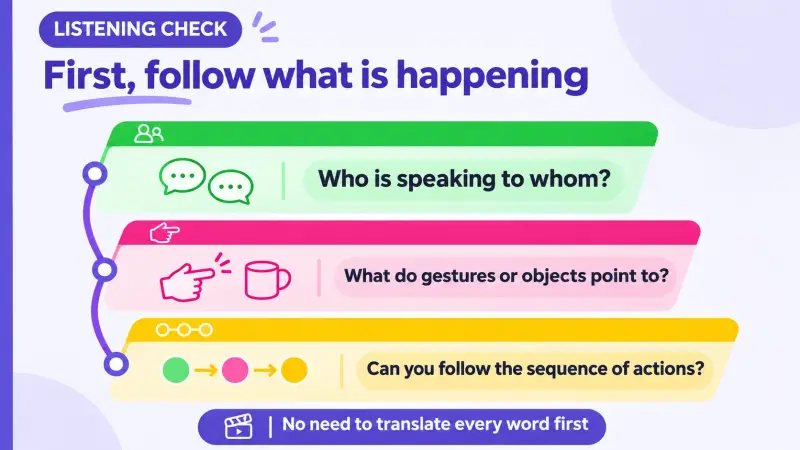
One limitation is worth stating plainly. The demo player is what the homepage shows publicly, while full downloadable transcripts belong to the library, where access conditions vary. If the alphabet is still your slow point, you can lean on the visuals here and work on the letters separately, and the guide on matching Russian apps to a specific practice job sorts those drill tools out.
Is Russian with Max Too Hard for You Right Now?
A clip you can follow says nothing about where a different series starts, and an unhurried delivery does not by itself make an episode a beginner episode. Russian with Max's membership FAQ recommends its podcast materials from roughly A2-B1 upward, and the public sample episode 247 carries its own B1-B2 label, so neither description points at a zero beginner starting point.
That does not make the page useless today. Episode 247 is about a familiar domestic habit, taking off your shoes and wearing slippers at home, and its page carries a public Transcript tab with timestamped Russian text plus PDF and audio links, visible without a login. A beginner can open that tab and read a short everyday segment along with the audio instead of attempting the whole episode.
A few topic words the title points to are worth having ready before you read: дома (at home), обувь (footwear), тапочки (slippers), снимать (to take off). Expect them in forms that do not match the dictionary entry you memorised, which is normal this early, and the companion piece on looking up an inflected Russian word without losing the message deals with that problem directly.
Check the Entry Requirements and Text Support of Each Series
Impressions of two samples are easy to remember and easy to mix up, so it helps to read the conditions side by side: the level each one states, what carries the meaning, what text you can reach and under what conditions, and what to do when a sample does not fit you yet.
| Sample you can open | Stated level | What carries the meaning | Text support and how to reach it | What to do when it does not fit you yet |
|---|---|---|---|---|
| Comprehensible Russian, Beginner 0 demo on the homepage | Beginner 0, one of the selectable demo levels | Visuals and gestures, described in its starting level FAQ as scaffolding for zero beginner videos | The demo player itself opened without a login; library transcripts are a separate feature with varying access conditions | If introductions and simple demonstrations are already easy, move to a new topic or a longer segment at a similar level |
| Russian with Max, sample episode 247 | Labeled B1-B2 on the episode | Connected speech on an everyday topic, supported by reading along | Public Transcript tab with timestamped Russian text, PDF and audio links, no login requested | If a full episode leaves you without a thread even with the transcript open, use one short segment with the transcript instead |
| Russian with Max, podcast materials in general | Membership FAQ recommends roughly A2-B1 or above | Spoken Russian with transcripts written in Russian | Membership transcripts, written in Russian with difficult vocabulary explained in English; this is a member feature rather than public text | If you are starting from zero and need the meaning itself before vocabulary notes, start with visual material instead |
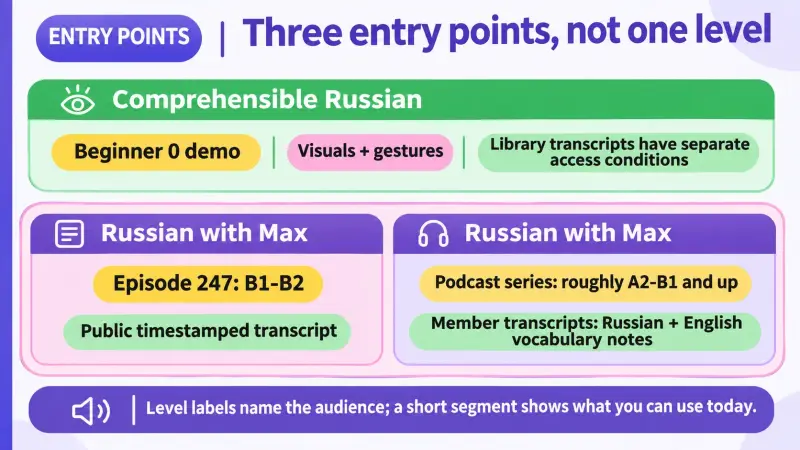
With the conditions visible, the choice still comes down to one short segment of the real thing. Take about a minute from the sample you are considering and notice three things, as prompts rather than as a score.
- Before any translation, can you say what is being shown or talked about?
- If text is visible, does reading along help you hold the segment, or does it pull your attention off the audio?
- After one pass, can you say in one English sentence what the segment was about?
A level label tells you who the material was made for, while one short segment tells you which parts of it you can use today. None of this is a test with a pass mark. When a prompt is hard to answer, it usually points at the thing to change next: the length of the segment, the topic, or the kind of support you lean on.
Decide to Keep, Go Easier, or Switch, Then Ask One Question on HelloTalk
A decision you can look back at next week beats a vague feeling about difficulty, so write one line in your notes about what the segment was actually like. The table below pairs the common difficulties with a next move.
| What the segment was like | Reasonable next move | Concrete action |
|---|---|---|
| You followed the events and the support was a backup, not a lifeline | Keep this series | Try a longer segment of the same series and notice the same three things |
| You followed the picture but could not state the main idea | Keep it, in smaller units | Stay on one minute segments and replay before adding new material |
| You lost the thread even with the visuals or the transcript open | Go easier | Move to Beginner 0 style visual material until introductions and simple actions are followable |
| It felt easy and repetitive after two passes | Change the topic or the length first | Stay near the same level with a new topic or a slightly longer segment, and judge a harder sample like episode 247 on its own terms |
Whatever you decide, the material has handed you a topic, and that is where a person adds something a recording cannot. Send one short question about that same topic to a Russian speaker on HelloTalk, by text or voice message, because the answer comes out of their own experience instead of a prepared exercise. After the slippers episode, a message like "Ты дома носишь тапочки?" (do you wear slippers at home?) is small enough to ask in passing.
Replies, when they come, run from one word to several sentences, and people answer as people rather than as teachers on call, so keep it to one question per topic. If you want to check listening rather than reading, you can ask whether they would mind answering with a short voice message, adding "Можешь ответить голосом?" (can you answer by voice?). A text reply is still useful; it just puts your reading to work instead of your ear.
When something comes back, write down what you understood before you translate the rest.
Then keep the one phrase you had to look up in your own notes. It is easy to reuse the next time you return to that segment or write to the same person, and the walkthrough on preparing your first short Russian voice exchange, including the reply covers what to do when the answer runs longer.
A recorded lesson repeats identically, while a person answers out of their own experience, which is what a fixed series cannot supply on its own.
FAQ: Picking Russian Listening Material
Can a complete beginner start with Russian with Max?
Its membership FAQ recommends the podcast materials from roughly A2-B1 upward, and the public sample episode 247 is labeled B1-B2, so it is not presented as a zero beginner entry point. A beginner can still open the public episode page, read a short everyday segment with the timestamped transcript and audio, and leave the rest for later.
Do I need an account to see either sample?
The Beginner 0 demo player on Comprehensible Russian's homepage opened without a login request, and episode 247's Transcript tab with timestamped Russian text, PDF and audio links is publicly visible. Full library transcripts are a separate feature whose access conditions vary, so do not count on one for the demo clip.
What if the Beginner 0 demo feels easy?
Treat it as a sign to change one thing, not to jump levels. A new topic or a slightly longer segment at a similar level is the smaller step, and a sample labeled B1-B2 stays a separate decision you make by opening it, not a reward for following an introduction.
Should I read the transcript before or after listening?
If you are checking what you catch by ear, listen once, then read, then listen again. If reading Cyrillic is still slow for you, a transcript may do little on a first pass, and visual material is worth trying instead.
How many series should I follow at once?
One main series plus one harder sample as a preview is plenty, because collecting material is easier than finishing a segment. The point is to repeat the same short check whenever the material changes, not to build a permanent list.
What should I ask a HelloTalk partner about the material?
One short question on the same topic that the person can answer from their own experience, such as whether they wear slippers at home after that episode. Keeping it to one question makes the scope clear rather than controlling how much the other person writes, and if the reply runs long you can work through one part of it. A willing partner is answering out of interest rather than running a lesson.
Does a correct answer to my voice message prove my pronunciation is right?
No. It shows that one question was understandable in that context, with the topic already known, and it says nothing general about your sounds or grammar elsewhere.
Pick one segment today, notice those three things, and if the topic is worth a real reply, take one short question about it to HelloTalk.