
Arabic Connected Letters: Move from Alphabet Charts to Real Words
Published on

If you can name ا, د and ب on a chart but freeze at شَرِبَ, the missing piece is usually joining, not memory. Most of that is solo decoding: positional shapes, the letters that break the chain, and a few short words you read slowly. A human reply helps at a narrower point, when you want to hear one word spoken or check that you read the word you think you read, and HelloTalk's chat is where the whole word can sit in one message while you ask about it.
Position and Joining Change the Shape, Not the Letter
In a word, an Arabic letter keeps its identity and changes its written shape according to its position and whether it can join the letter next to it. ب is written بـ at the start of a joined group, ـبـ in the middle, ـب at the end, and ب standing alone. The single dot below stays put in all four.
This is why a chart can feel useless the moment you open a real line of text. Charts usually show the isolated form, so the shape you practiced most is often the one that appears least once letters start connecting.
Vowel marks are a separate question. The small marks in كَتَبَ are a teaching aid for beginners, and most everyday Arabic text leaves them out, which is a different reading problem from joining. If that is where you are stuck, the shape of the word still comes first, then reading when Arabic vowel marks disappear.
Once the four position shapes stop surprising you, the next thing that breaks a word in half is the gap.
The Six Letters That Do Not Join the Letter After Them: ا د ذ ر ز و
The six letters ا د ذ ر ز و do not join the letter that follows them, although they can join the letter before them. A gap in the middle of a word is therefore not a space between words, and the letter after the gap is not starting a new word.
Direction is the part that gets lost when this rule is summarized too fast, so the table below separates the two sides of each letter. Read it as one rule applied six times, not six separate exceptions to memorize.
| Letter | Joins the letter before it | Joins the letter after it | What that looks like in a word |
|---|---|---|---|
| ا | can | no | A gap opens right after it, and the next letter begins a new joined group. |
| د | can | no | The following letter starts a fresh group in the middle of the word. |
| ذ | can | no | The same break as د, with the dot above kept. |
| ر | can | no | In شَرِبَ the break falls after ر, and the final ب stands on its own. |
| ز | can | no | The same break as ر, with one dot added above. |
| و | can | no | A gap follows و, so the rest of the word can look like a separate piece. |

The letter after a gap begins a new joined group, and its shape depends on what follows it: the initial form if it joins the next letter, the isolated form if nothing joins onto it. A practical habit comes out of that: before sounding anything out, scan the word for these six letters and decide where the gaps belong. That takes a few seconds and keeps a three-letter word from looking like two words.
Gaps are one source of misreading. The other is letters that carry the same outline.
Same Skeleton, Different Dots: ب ت ث
Inside a word, ب, ت and ث share one skeleton, and only the dots separate them: one dot below for ب, two above for ت, three above for ث. The outline you see in a joined group tells you almost nothing on its own.
In شَرِبَ, the ب at the left end stands on its own and keeps its single dot below, which is the only visible difference between that word and a shape with dots above. Handwriting, small screens and low-contrast print all blur dots, so reading the skeleton and guessing from context happens to everyone at this stage.
One useful habit while you are still slow: say the dot count and position to yourself before you name the letter. It is a way of slowing down the guess, not a measure of how well you read.
With breaks and dots both accounted for, short complete words are where you use the two together.
Read Short Complete Words Right to Left: كَتَبَ, جَلَسَ, شَرِبَ
Arabic is read right to left, so the first sound in كَتَبَ comes from the ك on the right-hand side of the word. English-trained eyes drift leftward first, which quietly reverses a three-letter word.
Take the three words one at a time. كَتَبَ, he wrote, is ك then ت then ب, with ك joined to ت and ت joined to ب, so the word is one unbroken shape. جَلَسَ, he sat, is ج then ل then س, joined the same way. شَرِبَ, he drank, is ش then ر then ب, and because ر does not join forward, the final ب attaches to nothing on either side and is written in its isolated form ب.
Those words and their meanings come from Madinah Arabic's free reading lessons, which continue with خَرَجَ, فَتَحَ and فَهِمَ. The same lesson states the right-to-left direction and offers separate audio controls for individual letters and for the complete word, which is the pairing you want when a word is readable but not yet sayable.
Two named resources do different jobs here, and it is worth seeing what each one settles before you build a routine around it. Kaleela lists an Arabic Alphabet entry alongside its language courses, so it sits in the same beginner territory from a different direction.
| Resource | What it gives for joined-letter reading | What it leaves open |
|---|---|---|
| Madinah Arabic free reading lessons | The joining rule with the six non-joining letters, plus short complete words with meanings and per-letter and whole-word audio controls | A fixed syllabus, so it will not respond to the particular word that stopped you today |
| Kaleela | A separate Arabic Alphabet entry next to its courses, with lessons and exercises described as using audio and video | Whether that path drills joined shapes inside words, and which Arabic variety it uses, is worth checking on the site before planning a routine around it |
| HelloTalk chat | A complete word or sentence stays intact in one message, and a reply can come back as text or as a voice message | Who answers and how much they say depends on who is available and willing |
While you read, three questions are enough to keep yourself honest: does this word contain any of ا د ذ ر ز و, where does each gap fall and which letter starts after it, and do the dots match the letter I just named. They are prompts for slowing down, not a score.
If you are still deciding whether your reading material should be Modern Standard Arabic or a dialect, that choice belongs further upstream and is handled in Arabic resources by variety and learning task.
Solo decoding settles the shapes, and lesson audio covers the words that a lesson happens to include. The word or sentence you met somewhere else is the one worth bringing to a person, for a reading or a meaning in context.
Keep the Whole Word in a HelloTalk Message and Ask About the Reading
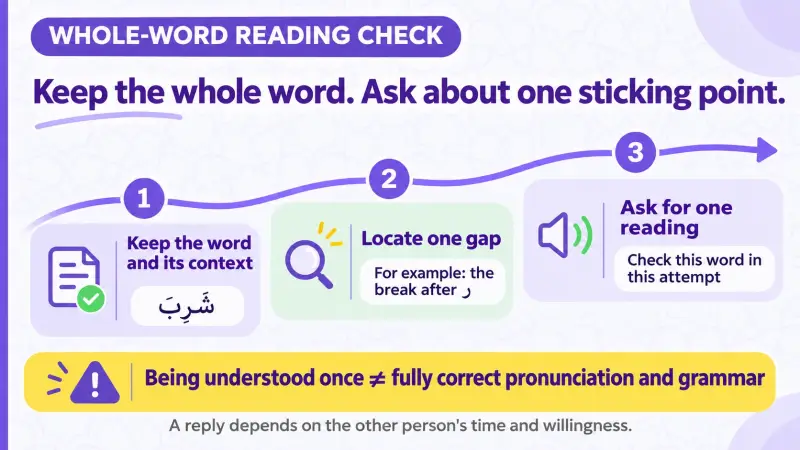
This is the point where a person is worth asking. On HelloTalk, paste the complete word, or better, the whole sentence you met it in, and ask one specific question, because the reader can then see the joined shape in its context instead of a letter you retyped from memory. HelloTalk's chat supports text and voice messages along with media sharing, so the word, a photo of the line you are reading, and a short voice reply can stay in the same conversation.
A message you could adapt, written as a draft rather than a transcript: "I'm reading شَرِبَ and I stop at the gap after ر. Could you send a short voice message of the whole word?" A second, narrower ask works too: "Does this sentence mean 'he drank'?" Keep it to one or two questions; someone is choosing to reply, not teaching a scheduled lesson.
It also helps to know what a reply does and does not settle. If the person understands your attempt, that tells you something useful about this word in this exchange, and not that your pronunciation or grammar is generally correct. If the answer confuses you, narrow it to one letter or one gap rather than asking for a full explanation of the alphabet.
Reuse takes a minute afterwards. Keep the voice message or the wording in your own notes with the word, the gap that tripped you and the meaning you were given, so the next word with a break after ر has a reference you already trust. When you look the word up afterwards, keep the original sentence next to the dictionary entry instead of the bare root, since the chat translation gives you a gloss and not the form you actually saw.
If the real difficulty turns out to be the sound rather than the shape, that is a different drill, and Arabic pronunciation tools for English speakers covers the sounds that most often go missing.
FAQ: Reading Joined Arabic Letters
Do Arabic letters become different letters when they connect?
No. The letter is the same; its written shape changes with its position in the joined group and with whether it can join the letter next to it. ب keeps its single dot below whether it appears at the start, the middle, the end, or on its own.
Which Arabic letters do not join the letter after them?
ا, د, ذ, ر, ز and و do not join the letter that follows them. They can still join the letter before them, which is why they often appear attached on one side and open on the other.
Why is there a gap inside شَرِبَ?
Because ر does not join forward. ش joins to ر, then the chain stops, so the final ب has nothing attached on either side and is written in its isolated form. The gap is not a space between two words.
How do I tell ب, ت and ث apart inside a word?
By the dots only: one below for ب, two above for ت, three above for ث. Their skeleton in a joined group is the same, so when the dots are blurred by handwriting or a small screen, context is what is left.
Do I have to finish the whole alphabet before reading words?
No. Short complete words such as كَتَبَ, جَلَسَ and شَرِبَ use a small set of letters and already exercise joining, direction and dots. Recognizing a letter on a chart and recognizing it inside a joined word are two different tasks, and the second one needs real words.
Are the vowel marks in كَتَبَ always printed?
No. They are common in teaching material for beginners and usually absent from everyday text, which is a separate reading skill from letter joining.
Can someone on HelloTalk confirm how a word is read?
Someone willing to reply can send a voice message or tell you what the word means to them, and HelloTalk's chat keeps the text, the voice message and any photo of the line together. There is no set reply time or depth, and a partner is not an on-demand teacher, so keep it to one specific question about one word rather than a request to explain the script.
When the shape of the word has stopped being the problem and you want to hear it from a person, bring the whole word into a chat on HelloTalk and ask one question about it.