
Arabic Dictionary Lookup: Keep the Dialect and the Original Sentence
Published on

If an Arabic word in a message has more than one reasonable reading, a dictionary and the surrounding messages often settle it, and when they do not, the person who wrote the sentence can. Say a friend writes عايزين نجري شوية in a HelloTalk chat. You can look up every word and still not know whether that is an invitation to go running or a push to hurry. The chat holds both the sentence and its writer; the dictionary is a reference you bring back to it.
Decide What This Lookup Has to Answer
One unknown word usually raises three separate questions: what the word can mean, which variety of Arabic it belongs to, and which of those meanings fits the sentence in front of you. A dictionary answers the first, and gives you labels for the second. For the third, its glosses and examples let you compare the options, which is often enough to pick the sense that fits the context; when the sentence and the messages around it still read two ways, that is when the writer is worth asking.
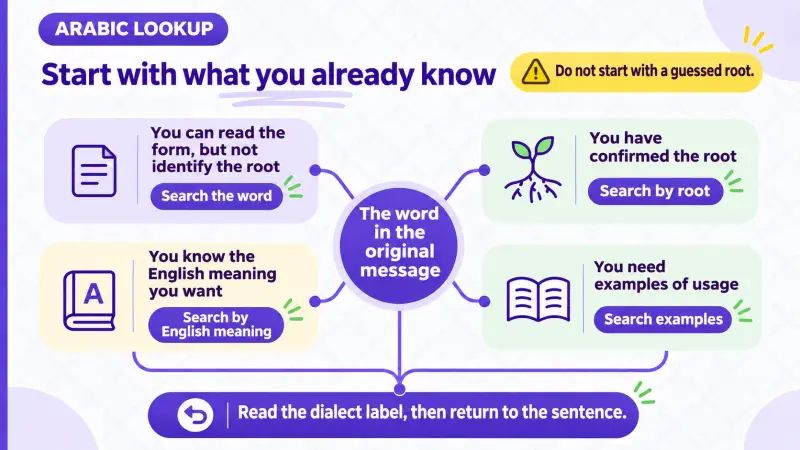
Which search you run depends on what you can already tell from the message. The table below sorts the common starting points, with a last column for what each search leaves unsettled.
| What you can tell from the message | Reasonable search | What it settles | What it leaves open |
|---|---|---|---|
| You can read the letters but do not recognise the word, and cannot identify a root | Search the word as written | Whether that form is listed, and in which dictionary | Which listed sense applies here |
| You know the writer's variety, or the chat is clearly in one dialect | Read the dictionary group on each result | Which entries come from the variety you are reading | Whether this speaker uses that form the same way |
| You already have the root from an entry or a teacher | Search by root | Related words grouped under the same root | Which derived form the message actually uses |
| You know the English meaning you expect but not the Arabic word | Search by English meaning | Candidate Arabic words for that meaning | Register and dialect fit in your sentence |
| You want usage rather than a short gloss | Search examples | Sentences where the word appears | Whether your sentence matches those patterns |
LivingArabic's public search form shows checkboxes for dictionaries and for search types, so you can leave one mode on and switch later. Not every chat word will have an entry, and a mode that works for one word may return nothing for the next.
Search the Word Itself in LivingArabic When You Cannot See the Root
Arabic dictionaries are often organised by consonantal roots, with several related words sitting under the same three-letter root. That is useful once you know the root, and unhelpful when the word in front of you carries extra letters you cannot classify yet.
On LivingArabic's search page, the search types include Word, Root, English meaning and Examples, each with its own checkbox, next to the list of dictionaries. For a word you simply cannot parse, deselect Root, English meaning and Examples, and leave Word on.
When you cannot identify the root with confidence, searching the word exactly as it is written is the safer first query, because a guessed root sends you to an unrelated entry. عايز shows why. The written form holds ع، ا، ي، ز, while the dictionary files it under ع و ز, so two of the letters you can see are not the ones organising the entry.
If the word search returns nothing, check the spelling in the message: chat writing can drop letters, double them for emphasis, or use a local spelling. Try the most standard spelling you can manage, try an English meaning search for what you think it means, and keep the question for the chat if neither works.
Narrow the Results to the Dialect You Are Reading
LivingArabic's help separates Classical and Modern Standard Arabic from dialect groups, and describes its Egyptian dictionary as based mainly on the speech of Cairo. That matters before you copy a meaning out of a result list, because one search can return entries from more than one group at a time.
So read the group label on a result before the gloss. If your chat partner writes in Egyptian, an entry from a Classical source can still be worth reading, but do not carry its sense into the Egyptian sentence without checking an entry from the dialect group or asking the writer. If you are unsure which variety your own study material uses, recognising the variety an Arabic course teaches is a separate check worth doing once.
Labels have limits in both directions. A Cairo-based entry does not describe every Egyptian speaker, and a word listed under one dialect is not automatically wrong in another. For the wider picture of how standard and everyday varieties sit beside each other, these Arabic resources for MSA and everyday dialects cover the split in more detail.
عايز in One Entry: Root ع و ز, Wanting, and Needing
A word search for عايز reaches an entry in LivingArabic's Egyptian group that lists عاوِز / عايِز under the root ع و ز. That answers two of the three questions at once: the form belongs to the Egyptian group, and the root is not the one the surface letters suggest.
The entry keeps a wanting or desiring sense apart from a needing sense. المدير عايز يكلمك is given for wanting: the manager wants to speak to you. العربية عاوزة تتصلّح sits on the other side, a car that needs repairing.
The examples also show the word agreeing with its subject, عاوزة with a feminine noun and عايزين in the plural. That is worth noticing when the form in your chat does not match the headword letter for letter.
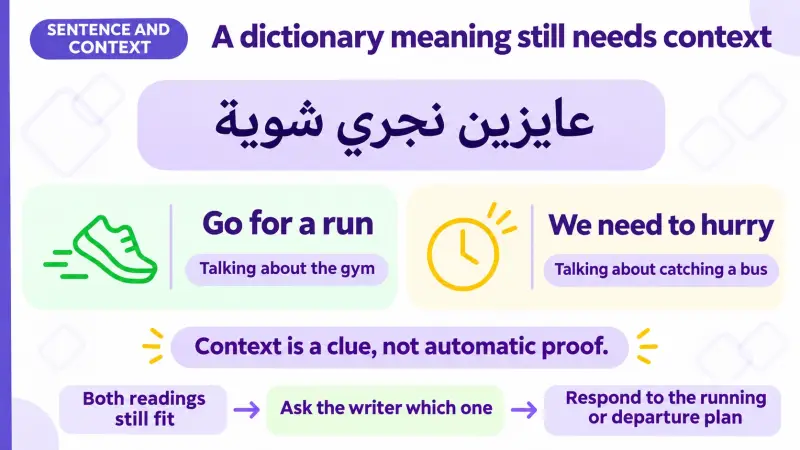
Which brings back عايزين نجري شوية, the sentence the entry uses to show the same form read both ways: wanting to run, or needing to hurry, depending on the situation around it. A dictionary entry narrows what a word can mean; when the surrounding messages still leave two readings open, the person who wrote the sentence can say which one was meant.
One more gap between entry and chat: the entry lists عاوِز / عايِز as two spellings, both written with short vowel marks, while the message gives you عايز bare.
For the marks, compare عايِز with عايز, which are the same letters with and without them. عاوِز is the other spelling the entry records, with و where the chat form has ي, so that difference is not about marks at all. Reading around missing marks is its own habit, and working without every Arabic vowel mark deals with that side of it.
Confirm the Sense in the Sentence, Then Send a Real Reply on HelloTalk
Before you ask anything, write the sentence down with your reading next to it. Often the surrounding messages are enough: a line about catching a bus points to hurrying, a line about the gym points to running. Those are clues rather than proof, so the question is worth asking only when the thread still reads both ways.
When both readings still fit, ask the writer on HelloTalk, in the same chat where the sentence appeared, because at that point they are the one who can settle it. Quote the line back and offer two options, so the question can be answered in one short message.
عايزين نجري شوية
Do you mean we should actually run, or just that we need to hurry?
A possible answer is one line picking an option, or a short voice message repeating the phrase the way they would say it. HelloTalk's chat includes text and voice messages along with translation, which helps when the reply comes back in Arabic and you want a rough reading before working through it yourself.
Once a reading is settled, reply to what the message said rather than stopping at the word. If it was an invitation to run, answer the invitation: whether you can go, and when. If it was hurry up, say how long you need.
A follow-up question on the same topic works too, in whichever language that chat normally uses: where they usually run, or what time they want to leave. That keeps the exchange on the plan instead of on your lookup.
Keep it to one question per sentence. A chat partner is someone having a conversation rather than a tutor on call, and a question with two named options is easier to answer than an open request to explain a word.
Keep the result small: the original sentence, the dialect label, the root, and the sense that turned out to be meant. Those notes live in your own file or notebook, since a gloss copied without its sentence loses the part that made it useful.
Then reuse the word the next time you want something in that chat, in a sentence of your own rather than as a quoted gloss. If you would like that line looked at, HelloTalk's chat includes correction tools alongside the ordinary message, and getting feedback on an Arabic sentence goes further into what to ask for.
FAQ: Arabic Dictionary Searches
Do I need to know the root before I can use an Arabic dictionary?
No. LivingArabic's search form offers a word search next to root, English meaning and example searches, so you can start from the form you see in the message. The root is often something the entry hands back to you.
What should I do when the word search returns nothing?
Check the spelling first, since chat writing can drop or double letters. Then try an English meaning search for the sense you expect, and if that fails, ask in the chat with the whole sentence attached.
How do I tell which dialect an entry belongs to?
Read the dictionary group attached to the result. LivingArabic's help separates Classical and Modern Standard Arabic from dialect groups and describes its Egyptian dictionary as based mainly on Cairo speech, which is a starting point rather than a description of every speaker.
Does عايز mean want or need?
The entry lists both: a wanting or desiring sense and a needing sense. المدير عايز يكلمك is given for wanting to speak, العربية عاوزة تتصلّح for a car needing repair, and عايزين نجري شوية can be read either way depending on context.
Should I ask my chat partner about every unknown word?
No. Look it up first, and save the question for cases where two listed senses both fit the sentence. One focused question with two options is easier to answer than a list of words.
Can I just run the message through a translation feature instead?
Translation gives you one reading quickly, which is often enough. For a word with two plausible senses in that sentence, a dictionary shows you the alternatives and the writer can settle which one was active.
How should I save what I find?
Keep a short personal note with the sentence, the word, the root, the dialect label and the sense that was meant. That means your own notes or document, since a saved gloss without its sentence is hard to reuse later.
Next time an Arabic word in a chat has two readings, run the lookup first, then bring your sentence and one clear question back to HelloTalk.