
Finnish Questions and Short Answers: Keep a Simple Exchange Going
Published on

If you can already build a Finnish question, the next step is mostly solo sorting: decide whether the question asks for information or for confirmation, then answer with the matching verb form. The concrete difficulty shows up in the answer: one natural reply to Puhutko suomea? (Do you speak Finnish?) is Puhun, I speak, which takes the verb from the question and changes the person.
A real reply helps once you want to see which option someone actually picks and then say something back to it. HelloTalk is where you can send that one question as text or as a voice message and work from the answer you get.
Tell an Information Question From a -ko/-kö Question
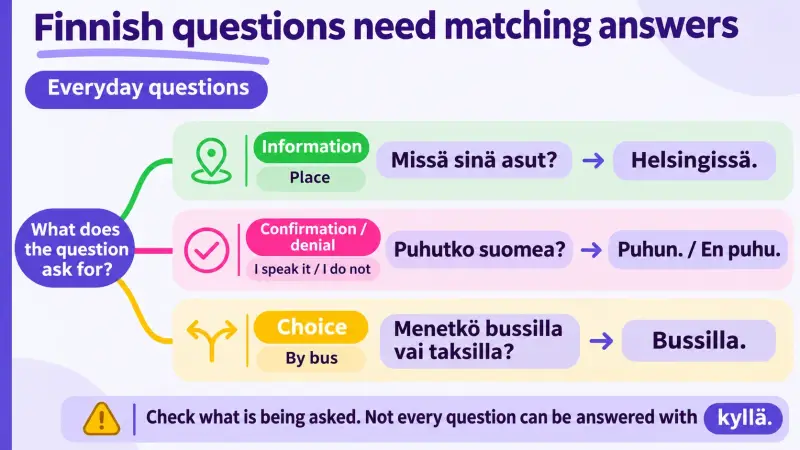
Finnish gives you two starting patterns, and they ask for different things. A question word such as missä, milloin, kuka or mitä marks the gap the asker wants filled: Missä sinä asut? asks for a place, and Milloin juna lähtee? (When does the train leave?) asks for a time.
The suffix -ko/-kö works the other way round, because the sentence already contains the content and the question is whether it holds: Puhutko sinä suomea?
A Finnish question word asks for the missing information, while an ordinary -ko/-kö question asks you to confirm or deny something the sentence already states. Mixing the two is what produces unusable replies, such as answering Missä sinä asut? with kyllä. One group of -ko/-kö questions behaves differently: when the sentence names two alternatives with vai, it is asking you to choose, and that case has its own section below.
If you are still picking study material at this stage, the overview of Finnish courses and resources by learning goal sorts options by what you are trying to do.
Before going pattern by pattern, it is worth lining up what each question actually requests, since that decides which reply lands. The table below is a quick check, and the sections after it take the suffix, the verb answer, negation and choices one at a time.
| Question type | Example | What the asker wants | A short reply that answers it | A reply that leaves it open |
|---|---|---|---|---|
| Question word | Missä sinä asut? (Where do you live?) | the missing information, here a place | Helsingissä. (In Helsinki.) | Kyllä. (Yes.) |
| -ko/-kö on the verb | Puhutko suomea? (Do you speak Finnish?) | confirmation or denial of the verb | Puhun. (I speak.) or En puhu. (I do not speak.) | Suomi. (Finnish.) |
| -ko/-kö with vai | Menetkö bussilla vai taksilla? (Are you going by bus or by taxi?) | one of the two named alternatives | Bussilla. (By bus.) | Kyllä. (Yes.) |
| Negative -ko/-kö | Etkö pidä kahvista? (Do you not like coffee?) | which side is actually true | Pidän. (I do like it.) or En pidä. (I do not.) | Joo. (Yeah.) |
Two of those rows need more than one line, so choice questions and negative questions have their own sections further down.
Where the Suffix Attaches, and What It Puts in Focus
The table put -ko/-kö on the verb, which is where it sits in ordinary questions. In a statement the order is sinä puhut suomea (you speak Finnish); to ask, the conjugated verb takes the suffix and moves to the front: Puhutko sinä suomea? The pronoun can then be dropped, because the verb ending already carries the person: Puhutko suomea?
In these everyday questions the suffix -ko/-kö goes on the conjugated verb, and Finnish adds no helper verb of the English do kind. The choice between -ko and -kö follows the vowels of the word the suffix joins: if that word contains a, o or u, you get -ko, as in asutko, puhutko, oletko and onko. The words here with none of those vowels take -kö: menetkö, tiedätkö, etkö. Longer words and compounds need more care than this short list can show.
The suffix can also attach to a different word, and then that word is what the question is about. Puhutko sinä suomea? asks about the speaking, Sinäkö puhut suomea? asks whether it is you, and Kahviako sinä juot? asks whether coffee is the thing you are drinking.
Finnish also has focus constructions where the suffix lands on something other than a conjugated verb, including non-finite forms, so it is not accurate to say it only ever attaches to a finite verb. For ordinary exchanges, though, the conjugated verb version stays the safer default.
Everyday speech also shortens these forms, and spoken questions do not always look like the standard examples above. The comparison of spoken Finnish and standard Finnish covers which register to lean on first; the examples here stay with standard written forms so the endings remain visible.
One Common Answer: Repeat the Verb With the Person Changed
Once you can read a -ko/-kö question, the reply is often built from the same verb. A common short answer repeats the verb from the question with the person changed, so Tiedätkö? (Do you know?) is answered Tiedän (I know) and Puhutko suomea? is answered Puhun. The question is about sinä and the answer is about minä, so the ending moves with it.
The same switch works across the verbs you meet early:
- Oletko suomalainen? (Are you Finnish?) Olen. (I am.)
- Asutko Helsingissä? (Do you live in Helsinki?) Asun. (I do.)
Not every short answer involves that second-to-first person switch. Onko sinulla aikaa? (Do you have time?) is built around sinulla, so the verb on is already third person and stays that way in the reply: On. (There is.) The person you are asking about is inside sinulla, not in the verb ending.
This is one usual pattern rather than the only acceptable one, and the answer does not have to stop at one word. Puhun vähän (I speak a little) and Asun Tampereella (I live in Tampere) both answer the question and hand the other person something to pick up.
Information questions pull the same point in a different direction. Missä sinä asut? is answered Asun Helsingissä or simply Helsingissä, keeping the ending that means in rather than the dictionary form Helsinki. Which endings carry which everyday meanings is the subject of the guide to Finnish case endings for everyday meanings.
Negative Answers With en, et, ei, and When kyllä or joo Works
Denial needs its own forms, because Finnish does not negate by adding one fixed word to the sentence. Finnish negation is person-marked: in these present-tense examples en, et, ei, emme, ette and eivät carry the person, while the main verb stays in a short form such as puhu or pidä. The negative answer to Puhutko suomea? is En puhu, or just En.
These forms are regular enough to learn as one block, which saves you from guessing in the middle of a message. Read the table as person first, then the negative verb, then the short main verb that stays unchanged down the column. The rows cover the present tense only, which is what the questions in this article use.
| Person | Negative verb | With puhua, to speak | With pitää, to like |
|---|---|---|---|
| minä (I) | en | en puhu | en pidä |
| sinä (you) | et | et puhu | et pidä |
| hän (he, she) | ei | ei puhu | ei pidä |
| me (we) | emme | emme puhu | emme pidä |
| te (you, plural) | ette | ette puhu | ette pidä |
| he (they) | eivät | eivät puhu | eivät pidä |
Finnish does have words for yes and no. Kyllä (yes) and ei (no) are both in use, and joo and juu (yeah) are common in speech, so Haluatko kahvia? (Do you want coffee?) can be answered Kyllä or Joo without anything being wrong. Kyllä also combines with the verb, as in Kyllä puhun (Yes, I speak it), which confirms and keeps the verb visible at the same time.
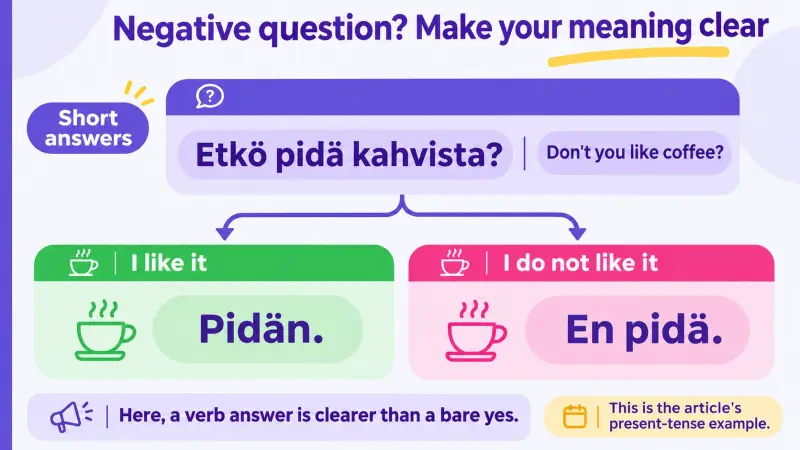
Negative questions are where a bare yes becomes hard to read. Etkö pidä kahvista? can be answered Pidän if you do like coffee and En pidä if you do not, and that short predicate answer leaves less room for doubt than one word that might be agreeing with either part of the question.
vai Questions Ask for a Choice, So a Yes Does Not Answer Them
A choice question looks like a -ko/-kö question but is not asking whether. In these alternative questions, vai asks you to pick one of the named options, so kyllä leaves the question unanswered. Menetkö bussilla vai taksilla? wants Bussilla (by bus) or Taksilla (by taxi), and Juotko kahvia vai teetä? (Do you drink coffee or tea?) wants Kahvia (coffee) or Teetä (tea).
Notice that the chosen word keeps the form it had in the question: bussilla and not bussi, teetä and not tee. Lifting the alternative straight out of the question is a cheap way to stay accurate while the endings are still new to you.
You can also answer with something that was not offered, since this kind of question asks which and not whether, so Kävelen (I walk) is a reasonable reply if you walk. Catching these questions at speaking speed is a separate job, and the roundup of Finnish listening materials by the task they support covers where short dialogues fit in.
Ask One Real Question on HelloTalk and Reply to the Answer You Get
Everything above can be checked on paper, which is exactly why it belongs before you write to anyone. What you cannot produce alone is an answer you did not choose, and that is the part that makes you read somebody else's person form and respond to it. Send one question on HelloTalk, as text or as a voice message, because the reply comes back as that person's own choice rather than as the sentence you were predicting, and HelloTalk chat keeps translation and correction tools next to the message if a word in the answer is unclear.
Before sending, check your own question. If it is about the person you are writing to, conjugate the verb for sinä; questions built differently, such as Milloin juna lähtee? or Onko sinulla aikaa?, keep their own form. Then check that the suffix vowel matches the word it joins, and decide whether you are asking for information, for confirmation or for a choice. A choice question makes a good first one, because you already know the two shapes the answer can take.
A question you could send is Juotko aamulla kahvia vai teetä? (In the morning, do you drink coffee or tea?) One possible answer is Juon teetä. Entä sinä? (I drink tea. And you?), and a short Teetä. is another. Those are shapes worth preparing for rather than an exchange that has already happened.
Your own turn then uses the pattern from the verb-answer section: Minä juon kahvia aamulla. Juotko teetä myös illalla? (I drink coffee in the morning. Do you drink tea in the evening too?) That keeps the exchange moving on the content of the reply instead of restarting with a fresh unrelated question.
If you want feedback, keep it to one thing the other person can answer in a line. Note first that Juotko mieluummin kahvia vai teetä? is not a politer version of the same sentence: mieluummin means rather or preferably, so that question asks about preference instead of about what you actually drink in the morning. Decide which of the two you meant, then ask something bounded, such as whether Juotko aamulla kahvia vai teetä? sounds like a question they would put that way to a friend.
People answer when they feel like it and from their own usage, not as an on-demand teacher, and a reply that understood you is not proof that every ending was right. Keep the useful lines in your own notes, by hand or in a notes file: the question you sent, the answer you received, and one phrase worth repeating such as Entä sinä? (And you?)
When an answer contains a word form you cannot find in a dictionary, the method for looking up a Finnish word form without losing its sentence gets you from the ending back to the base word.
FAQ: Finnish Questions and Replies
Does Finnish have words for yes and no?
Yes. Kyllä and ei are both used, and joo and juu are common in speech. Repeating the verb from the question, as in Puhun or En puhu, is another usual way to answer and often gives the other person more to work with.
Can I attach -ko/-kö to an infinitive?
Not in the ordinary questions taught here, where the suffix goes on the conjugated verb, which then stands at the front: Puhutko suomea? Finnish does have separate focus constructions in which the suffix marks another word, including some non-finite forms, but those are not the everyday pattern, and no English-style helper verb is added in either case.
How do I choose between -ko and -kö?
Look at the vowels of the word the suffix joins. If it contains a, o or u, use -ko, as in asutko, puhutko and onko. The other words used here, with none of those vowels, take -kö: tiedätkö, menetkö, etkö.
How should I answer a negative question such as Etkö pidä kahvista?
Answer with the predicate: Pidän if you do like coffee, En pidä if you do not. A single yes word can read as agreement with either part of the question, so the verb answer is clearer here.
What answers a question with vai?
Name one of the alternatives, keeping the form it had in the question, for example Bussilla to Menetkö bussilla vai taksilla? A plain kyllä does not answer that kind of choice question. You can also name a third option, such as Kävelen.
Is a one-word answer rude in Finnish?
No. Short answers like Olen or En are normal. Adding a little information, as in Puhun vähän, mainly helps the current exchange continue rather than fixing anything impolite.
Will someone correct my question if I send it on HelloTalk?
HelloTalk chat includes correction tools, translation, voice messages and media sharing, so a partner can mark up your sentence if they choose to. Nobody is obliged to reply or correct, so send one short question rather than a list, and keep your own notes of the wording that worked.
When your next question is ready, send it to one person on HelloTalk and build your next sentence out of the answer you get.