
Egyptian Arabic Listening Resources: Lessons, Real Clips, and Personal Replies
Published on

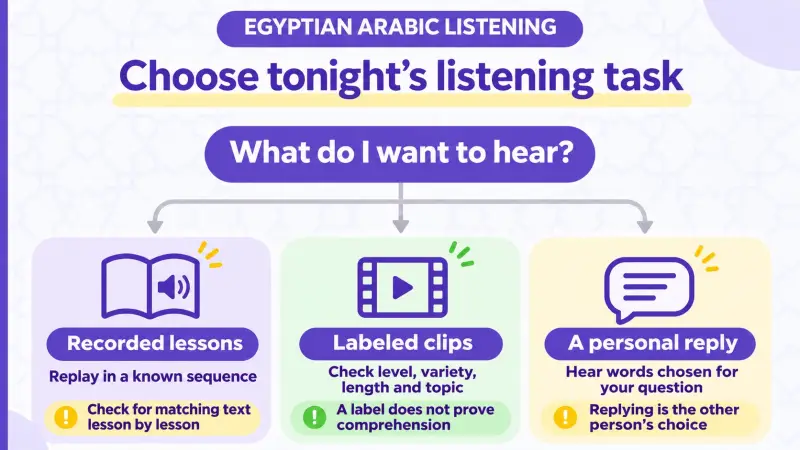
If you have already chosen Egyptian Arabic, pick listening material by what you will be able to check afterwards: a course recording for fixed phrases in a known order, a labeled clip when you want material graded before you press play. A human reply fits a different moment, when you want a sentence nobody wrote in advance; on HelloTalk you can send one short question by text or voice and ask about a single phrase you heard. أهلًا وسهلًا (welcome) is clear inside a lesson and gone in the first seconds of a clip.
Kaleela, Playaling, or a HelloTalk Exchange: Match Each One to a Listening Task
These three options are not competing for the same slot in your week. A course gives you repeatable audio in a known order, a clip library gives you material whose level and variety are stated before you press play, and a conversation gives you one sentence that exists because you asked for it.
Sorting them by job is more useful than ranking them. The table below lines up the listening task each one fits, the text support you can plan on, and the limit worth knowing before you spend an evening on it.
| Option | The listening task it fits | Text support you can plan on | Limit to work around |
|---|---|---|---|
| Kaleela Egyptian Dialect course | When you want the same phrases in a fixed order you can return to | Course activities built around audio and video; whether a given lesson also shows text matching that recording is something to check when you open it | The public course page shows that the Egyptian entry exists, not how replay, display or lesson pacing work inside the app |
| Playaling sample clips | When you want speech whose level and variety are labeled before you press play | Caption segments, loop and speed controls are visible in the player; the full transcript sat behind a premium prompt in a signed-out view | One clip can carry a Beginner label and both Modern Standard and Egyptian tags at the same time |
| A HelloTalk exchange | When you want one unscripted answer to your own question, plus a check on one phrase | Text and voice in the same chat, with translation and correction tools next to the message | A reply depends on another person's time and interest, and a region tag on a profile is not a teaching credential |
If you are still weighing Arabic study material more broadly, the wider Arabic resource comparison covers the full set of options. This article stays with the narrower question: which recording do you press play on tonight.
Kaleela: Egyptian Dialect Lessons With a Set Structure
Kaleela lists an Egyptian Dialect course as its own entry, separate from Modern Standard Arabic and from its other named dialect courses, so the variety is settled before you start a lesson. Its course activities are described around audio and video rather than reading alone. For someone who has already chosen Egyptian, that labeling matters: it keeps you from spending listening time in a variety you did not intend to study.
The value of a course recording is repetition without awkwardness. You can play the same ten-second line six times, say it back, and play it again, which is normal with a file and strange to ask of a person. Start with one short lesson block rather than a whole unit.
A sensible routine is to listen once without looking and write down what you think you heard, in English or in Arabic script. If that lesson also gives you text matching the recording, listen again alongside it and compare; the gap between the two versions is the useful part. If no matching text comes with it, mark the line as unconfirmed and settle it later against something you can read or one person's answer.
What the public course page settles is that the Egyptian entry exists and that activities are built around audio and video. Whether a particular lesson shows text you can line up with the recording, and how replay works, is worth noticing in your first session and adjusting around. If you are unsure whether a course is actually giving you Egyptian, the practical signals are covered in checking whether an Arabic course teaches your variety.
Playaling Clips: Real Speech, and How to Read the Level and Dialect Tags
A course labels material by unit. A clip library labels it by level and variety, and those tags are most of what you have to go on before you press play.
Playaling's public sample 616, titled Welcome! and أهلًا وسهلًا!, carries a Beginner level label and is tagged both Modern Standard (MSA) and Egyptian, which shows that one clip can sit in two varieties at once. It is a greetings clip of about thirteen seconds, and the page embeds a publicly viewable video from UNM Arabic.
A double tag like that is not a flaw. Greetings often travel across varieties, so an overlapping clip still gives your ear something to work on, as long as you do not treat it as a sample of purely Egyptian speech when you are listening for dialect features.
A level label describes the material, not your comprehension on a given day. Reading the tags well means checking four things: the level, the variety tags, the length, and the description of what the clip is about. A thirteen-second greeting and a three-minute interview both labeled Beginner ask very different things of you.
A workable approach is to pick one short clip, play it through once, then loop a single segment while you try to write the first phrase down. Slowing playback is fine. If a clip turns out to be mostly past you, a shorter one or a more familiar topic is a reasonable next pick.
Can You Get the Text You Need for Checking?
Everything above assumes you can confirm what you heard, and that is where access limits differ by resource.
On the Playaling sample, the embedded public video played in a signed-out session, while the transcript and learning overlay sat behind a premium prompt. Caption segments, loop and speed controls were visible in the player interface, but the text itself was covered.
When text is in front of you, checking is direct: write what you heard, compare, mark the two or three words that were wrong. Without it you are working with a guess. Replaying one segment can firm up what you think you heard, and looking up an isolated word can test whether it is a word at all, but neither step tells you that your version is the version that was said.
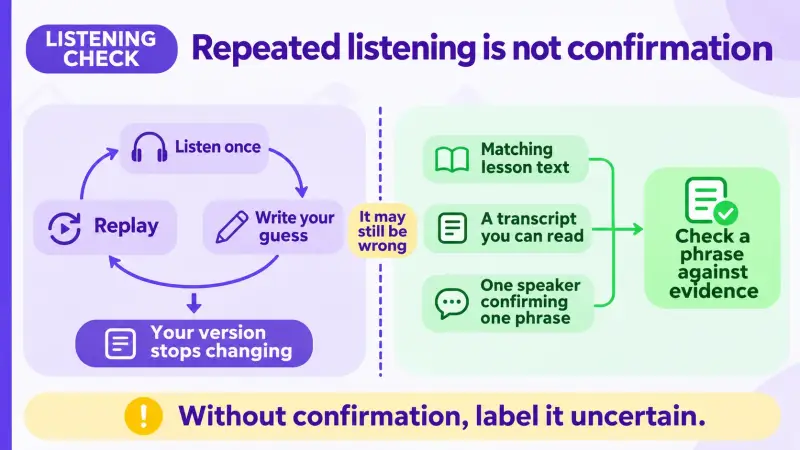
A guess that stops changing is not the same as a guess that has been confirmed. So keep the uncertainty labeled in your notes, and save it for the places that can settle it: a lesson text, a transcript you can read, or one person confirming one phrase.
Looking up a heard word has its own traps in Arabic, since dialect spelling and root-based entries do not always line up with what reached your ear. The approach of keeping the dialect and the original sentence in your lookup matters more than landing on any entry at all.
Add One Personal Listening Exchange on HelloTalk
A recording says the same thing every time. At some point you want to understand a sentence that someone chose the words for, in the moment, because you asked a question.
HelloTalk's chat includes text and voice messages, translation, correction tools and media sharing, which keeps a listening question, the reply and your follow-up check inside one conversation. A concrete version: send a short text message to an Egyptian Arabic speaker on HelloTalk asking a bounded question, because only a person can tell you which greeting they personally use and say it in their own voice.
A message you could write:
I'm learning Egyptian Arabic. With friends, do you say إزيك or عامل إيه? If you have a minute, could you send a short voice note with the one you actually use, and how you usually answer it?
إزيك is another way of saying "how are you"; عامل إيه asks a man how he is doing, and عاملة إيه is the form used to a woman. Asking which one a person reaches for is a question they can answer from habit. A voice reply might be a few seconds long and contain the greeting plus whatever answer that person picked, such as الحمد لله (thank God), used the way "fine, thanks" is used in English.
Replay it, write what you think you heard, then send one narrow check rather than a general request for feedback, for example: "I think the greeting was عامل إيه. Is that what you said?" A yes or no about one phrase is something a busy person can give, and it settles more than a vague "how was my listening".
Two honest limits belong here. Someone recognising your meaning is not proof that your pronunciation or grammar was correct, and a region label on a profile is not evidence of teaching ability or of one uniform Cairo accent. Whether a reply comes at all depends on that person's interest and time.
When a phrase turns out to be useful, keep it in your own notes with the date, the question you asked and the form you heard. The next exchange is the place to reuse it: put the phrase into a message you write yourself and see how it lands. For choosing who to approach, see finding a partner for your Arabic dialect, and for asking about a whole sentence rather than a single word, see feedback on a full Arabic sentence.
FAQ: Egyptian Arabic Listening Material
Should I start with a course recording or a real clip?
Either, depending on what you can check tonight. A course recording comes in a fixed order you can return to, and if that lesson also shows matching text, self-checking is simpler; a labeled clip is a fine starting point too when its level, length and topic suit you and you have a way to confirm a phrase later.
What does a Beginner label on a clip actually tell me?
It describes how the material was graded, not how much you will catch. A Beginner clip can still be quick, and an unfamiliar topic can make a short clip harder than its label suggests.
A clip is tagged both Modern Standard and Egyptian. Is it still useful?
Yes, for shared material like greetings, which often appear in both. Just do not treat such a clip as an example of purely Egyptian everyday speech when you are listening for dialect features.
Can I practise listening without a transcript?
Yes, as long as you keep practice and confirmation apart. Replaying a short segment and looking up the words you isolate builds a guess; a lesson text, a transcript or a person confirming one phrase is what turns that guess into something you can rely on.
How many times should I replay one clip?
No fixed number is worth promising. Pausing when your written version stops changing is a reasonable stopping point, though a stable version can still be wrong, which is why returning to the same clip later or checking one phrase with someone is worth the extra step.
What should I ask an Egyptian Arabic speaker about listening?
Ask something answerable in one line, such as which of two greetings they use, or whether a specific phrase you wrote down is what they said. Keeping the question narrow makes it realistic for someone replying between other things.
Pick one short Egyptian Arabic clip tonight, write down what you caught, and bring the one phrase you are unsure about to a conversation on HelloTalk.