
Look Up a Finnish Word Form Without Losing Its Sentence
Published on

When a Finnish word from a message is missing from the dictionary, the ending is one of the first things worth checking, and you can often reach the headword on your own. A human reply earns its place a step later: you have a candidate entry, but the line still says more than the entry explains. That sentence came from a HelloTalk chat, so the person who wrote it is the one to ask about it. The snag here is specific: searching kukan returns a compound you did not ask about, and deleting the n leaves kuka, not kukka.
Keep the Whole Sentence Before You Search Anything
Before opening a dictionary tab, copy the whole line the word came from. A Finnish ending tells you more in company: which words sit next to the form, whether another noun follows it, where the sentence stops. If your note says only kukan, you can still look for a headword, but you have nothing left to check a meaning against.
Here is the kind of line this article works with. It is an example written for this article, not a message from a private chat:
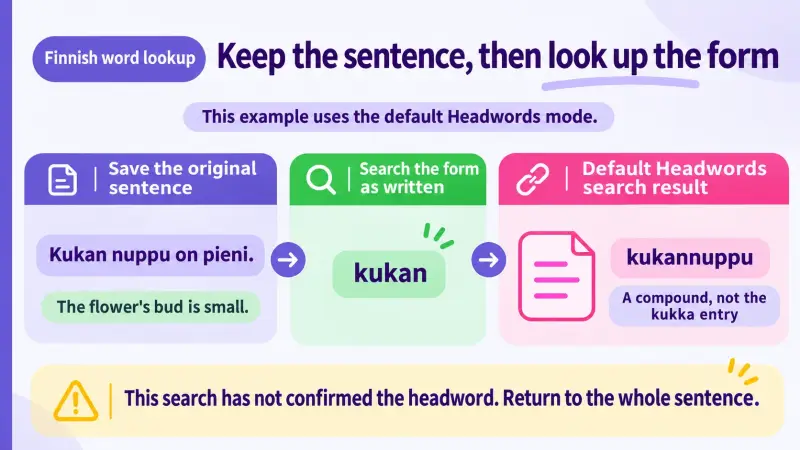
Kukan nuppu on pieni.
That says the flower's bud is small. Kukan is the form that sends you to the dictionary, and Kukan nuppu, a flower's bud, is also the short example the dictionary's own entry uses.
In HelloTalk chat you can scroll back to the message a word like this appeared in, which is a good reason to leave it where it is rather than retyping fragments. Copying the line into your own notes keeps it usable after the conversation has moved on to other things.
Here is what is worth keeping, and what each piece answers later in the lookup.
| What you keep | Where you keep it | What it answers later |
|---|---|---|
| The complete line, not just the word | The chat itself, plus a copy in your notes | Which words surround kukan, and where the sentence ends |
| The exact spelling, letter by letter | Your notes | Whether a search failed because of one wrong letter |
| The word that follows the form | Your notes | Whether the form leads into another noun, as nuppu does here |
| Your own first guess at the meaning | Your notes | Whether the entry supports your reading or replaces it |
The last row is the one people skip. Writing your guess down before the dictionary influences it gives you something concrete to ask about afterwards.
Try the Form You Saw First: Does kukan Lead to kukka?
Start by searching the form exactly as it appeared. Sometimes the string you copied is a headword, and that first attempt costs almost nothing.
With kukan it comes back only partly useful. Searching kukan in Kielitoimiston sanakirja's default Headwords mode returns a single result, the compound kukannuppu, rather than opening the kukka entry. That result on its own does not prove your word is inflected; it tells you that this exact string is not an entry name in this mode, and that the entry you want may sit under a different spelling.
Kielitoimiston sanakirja is a dictionary of standard Finnish covering word meanings, use and inflection information, and setting its interface to English does not turn its Finnish definitions into English ones. The English interface makes labels such as Headwords and INFLECTION readable, which is enough to navigate an entry. The site also offers more than one search mode; the route described here stays with the default one.
Other Finnish lookup sites are organised around different jobs. Omasanakirja presents dictionary entries together with inflection tables, and the Voikko-based page is a word analysis lookup rather than a reading dictionary, so a second stop there answers a different question when a first search stalls. Which dictionary, course, app or tutor fits your wider plan is a separate decision, covered in Finnish resources by learning goal.
One more possibility is worth noting early. If the chat spelling reflects how people speak rather than how the standard language is written, a standard-language dictionary may not list that spelling, which is a different problem from an ending. The gap between spoken and standard Finnish is the reason a perfectly normal chat word can be absent from a dictionary of the written standard.
Dropping the n Gives kuka: Check the kk and k Inside the Word
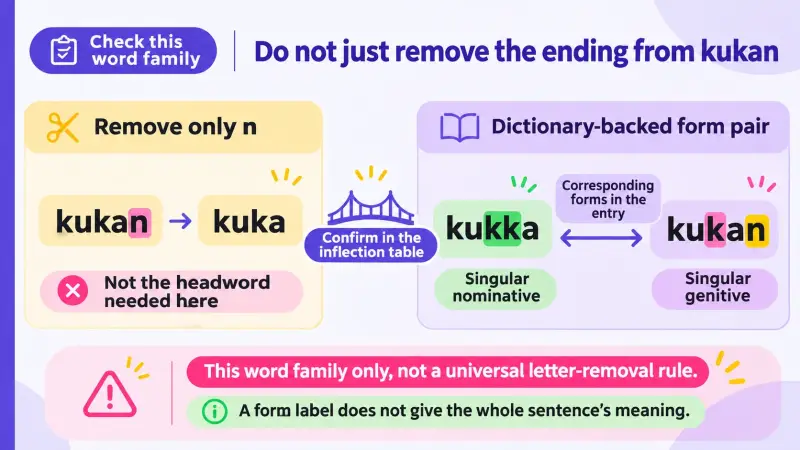
The obvious repair is to cut the ending and search again. Try that on kukan and you get kuka, which is not the spelling you are looking for. Removing only the final n from kukan leaves kuka rather than kukka, so the consonants inside a Finnish word can change along with the ending.
In this word family the difference is visible in the dictionary itself. The kukka entry displays kukka and kukan together, and the two spellings differ by that one k in the middle plus the ending. So the attempt that works here does more than drop the final n, it also carries the double k back into the word.
That observable correspondence is what makes kukka the candidate behind kukan. It is not a general recipe for deleting letters and doubling consonants in any unknown word, since stems and endings combine differently from word to word. Deciding which Finnish case endings to learn first in everyday conversation is a more useful starting point than memorising a full table, and if changes like this keep arriving before you feel ready for them, that early grammar load is worth weighing when choosing resources for Finnish.
Confirm the Match in the Inflection Table, and Read the Finnish Definition
Searching kukka in Headwords opens an entry headed kukka 10*A. Expanding INFLECTION shows forms with their labels, and that list is where your candidate is either supported or left unproven.
Read the list looking for the exact string you started with. Finding it there supports kukka as the headword behind kukan; it does not yet settle what the word is doing in the line you saved, because the entry describes forms rather than your sentence.
| Form shown in the entry | Label |
|---|---|
| kukka | singular nominative |
| kukan | singular genitive |
| kukkaa | singular partitive |
| kukkaan | singular illative |
| kukat | plural nominative |
| kukkien (kukkain) | plural genitive |
| kukkia | plural partitive |
| kukkiin | plural illative |
The current kukka entry lists kukan as the singular genitive, which is what links the form in the message back to the headword. The entry shows a selection of forms rather than every case and suffix combination, so a form that is absent from the list is not evidence that it belongs to some other word.
The definition itself stays in Finnish. The first sense of this entry includes the short example Kukan nuppu, a flower's bud, so the form you met appears in the entry's own example, which is often the quickest way to see the word in use. Working through a Finnish definition slowly, or looking up its main content words, is normal at beginner level and does not mean the dictionary is the wrong tool.
One limit is worth holding on to. The label tells you which slot a form fills in the table, not what the word is doing in your sentence, because the same spelling can serve more than one construction. That is why the line you saved in the first step should still be open in another tab.
Ask the Writer on HelloTalk Whether Your Reading Fits
By now you have an entry, a label and a line you can only partly account for. The example message says a bud is small, but not which flower it belongs to. That remainder is a good question for the person who wrote it: in the HelloTalk chat where the message appeared, reply to that message and ask, because the writer can say what they had in mind instead of leaving you to infer it from a dictionary table.
A dictionary entry tells you what a word can mean, while only the person who wrote the sentence can confirm what they meant by it.
Keep the question narrow enough to answer in a line. Illustrative wording, written for this article:
- "I looked up kukan and found kukka. Is that the same word in your message?"
- "Which flower is it? One you are growing?"
The first can come back as yes, no, or a quick rewrite of the line. The second asks for a word or two about what they were looking at, which is the kind of request a chat partner can handle between other things. HelloTalk's chat description includes text and voice messages, translation, correction tools and media sharing, so attaching a screenshot of the entry is easier than describing in words which sense you landed on.
A short voice message naming the word is sometimes quicker than typing an explanation, though a partner recognising the word you said does not settle whether you pronounced it well. What comes back is one person's account of their own sentence, offered when they feel like answering, not a full grammatical analysis.
Save the pieces that held up in your own notes: the form as it appeared, the headword, the label, and whatever the writer said the line was about. Then reuse the word in the form your own sentence needs. If their answer is about a plant on a windowsill and you want to say you have a flower too, the word you write is kukka, not the kukan you first copied; the genitive comes back when something belongs to the flower, as in Kukan nuppu.
A reply that arrives without a correction is not proof your grammar was right, though it may mean the message was clear enough to answer. Short questions with short answers give that reuse somewhere to happen, which is the habit behind keeping a simple Finnish exchange going.
FAQ: Finnish Word Form Lookups
Why does searching the exact form I saw sometimes fail?
Because dictionaries are organised by headwords. A search for kukan in Kielitoimiston sanakirja's default Headwords mode returned one result, the compound kukannuppu, and did not open kukka. The form exists in the language; it just was not the entry name there.
Does Kielitoimiston sanakirja give English translations?
No. It is a dictionary of standard Finnish with meanings, usage and inflection information. Switching the interface to English changes labels such as Headwords and INFLECTION, while the definitions and examples stay in Finnish.
Is deleting the ending enough to find the headword?
Not in this case. Deleting the n from kukan leaves kuka, not kukka, because the consonants inside the word differ between the two spellings. Here the version with the double k is what matches the entry, and the entry itself shows the pair.
Does the inflection list show every form of the word?
No. The kukka entry displays a selection, including singular nominative, genitive, partitive and illative plus the matching plural forms. A form that is not in that list is not proof that it belongs to a different word.
Do I need a native speaker for every word I look up?
No. Most single-word lookups end at the entry, and checking a form against the inflection list is something you do alone. A question to another person is useful when the entry fits but the sentence still does not.
What if the word in the chat is spelled the way people say it?
Then a standard-language dictionary may not list that spelling, which is a register question rather than an inflection one. The two can overlap, since spoken forms carry endings as well, so it is worth looking at both the spelling and the ending.
How do I ask without treating my partner as a teacher?
Ask about one word, in one or two lines, with an answer they can give in a few words. Attaching the entry screenshot and your own guess means they are confirming or correcting a reading rather than explaining Finnish grammar from scratch.
Next time an ending stops you mid-message, keep the line, work the entry, and bring the one question that is left to the person who wrote it on HelloTalk.