
French Nasal Vowels: Hear a Contrast and Check What a Listener Heard
Published on

If you can already play pain and peine back to back and hear two different words, the next useful step is finding out what someone else hears in your voice. Solo listening and repeating covers most of this work. What it cannot do is tell you which word actually landed, since your own vowel never reaches your ears the way it reaches a listener. On HelloTalk you can send one short voice message to a French speaker who is open to replying and ask which of the two words they heard.
Start With One Contrast, Not the Whole Chart
Most nasal vowel pages open with a chart of symbols. That chart is a fine reference and a poor first drill, because four unfamiliar vowels give you nothing specific to check against.
A nasal vowel in French is a single vowel sound, not a vowel followed by a separate n or m consonant. That one idea is enough to start, and it is easier to test with two words than with a full inventory.
Pick a pair that a resource has already labelled with audio, so you are comparing a documented example rather than your own guess. Lawless French's nasal vowels page places pain next to peine with separate audio links, which gives you one labelled nasal example and one labelled oral example in the same place. The same comparison on that page also sets un next to une.
The loop itself is short: play the source audio, repeat it, record yourself saying each word inside a sentence, then ask one person one question about the recording. If you are fitting pronunciation into a longer schedule, planning French practice with weekly checkpoints shows where a small sound block belongs.
pain and peine: Two Words, Two Meanings
This pair is worth the attention because the difference is not decorative. The two words carry different meanings, so a listener's answer tells you something about the sound rather than about their patience with spelling.
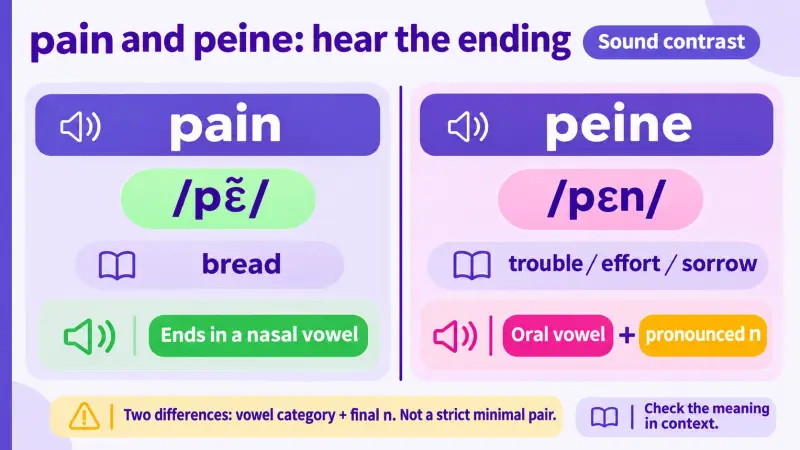
Pain means bread. The creator's IN lesson gives the nasal vowel symbol [ɛ̃], lists ain among the spellings that produce it, and uses le pain as its example word.
Larousse lists peine as [pɛn] with senses including sorrow, difficulty and punishment, so peine is not the French spelling of English pain. When you build your own sentence, choose one sense and check that entry first instead of assuming the translation.
Two short frames are enough to practise with:
- Je voudrais du pain, s'il vous plaît. (I would like some bread, please.)
- Ce n'est pas la peine. (No need, or it is not worth the trouble.)
The second one is a common set phrase, which makes it easy to say and easy for a listener to recognise. If you prefer a sentence of your own, confirm the sense of peine you want in a dictionary entry before you record it.
Nasal Vowel or a Pronounced n or m: Hear the Difference
Once you have two words, the real question is what happens to the letter n. In pain the n is part of the spelling of a vowel; in peine there is a consonant you can actually hear.
Here it helps to keep written letters and pronounced sounds apart. As a working cue rather than an exception-free rule: when written n or m is followed by another consonant letter or ends the word, the letters in front of it often spell a nasal vowel, and when n or m is followed by a vowel letter or is doubled, the consonant is usually pronounced.
A written final e complicates that cue, because it is frequently silent. In peine the pronounced form given by Larousse, [pɛn], ends on the n even though an e follows in writing. For any new word, the dictionary entry with its phonetic form stays the safer check.
The short table below is the set worth keeping open while you practise. Read the middle columns as what to listen for, not as a complete description of French spelling.
| Written form | Reference form | Is n or m pronounced as a consonant | What to listen for | Meaning used here |
|---|---|---|---|---|
| pain | /pɛ̃/, with [ɛ̃] the vowel symbol given in the creator's IN lesson | No | the word ends on the vowel itself | bread |
| peine | [pɛn] in Larousse | Yes | a clear n right after the vowel | trouble, effort or sorrow, depending on the sentence |
| un | nasal vowel, traditionally written [œ̃] | No | one nasal vowel, nothing after it | a, one (masculine) |
| une | [yn] in Larousse, the oral vowel [y] plus [n] | Yes | the vowel is not nasal and an n follows it | a, one (feminine) |
One caution on the last two rows: in a phrase such as un ami, the n does become audible because of linking between words. That is a different mechanism from the contrast above, and French liaison rather than word-internal vowel contrasts deals with it properly.
Say It Inside One Short Sentence and Ask a HelloTalk Listener Which Word They Heard
Isolated words are hard to judge for both sides. A sentence gives the listener enough context to answer, and it is closer to how you will use the word anyway.
Record your two sentences in one voice message on HelloTalk and send it to a French speaker you already chat with, then write one short text question underneath asking which word they heard in each sentence. HelloTalk's chat keeps the voice message, your written question and their reply in the same thread, with translation and correction tools available there, so the whole exchange stays in one place instead of across separate files.
A message you could write, kept short on purpose:
Dans ce message vocal, j'ai dit deux phrases. Est-ce que tu entends « pain » ou « peine » dans chacune ?
(In this voice message I said two sentences. Do you hear pain or peine in each one?)
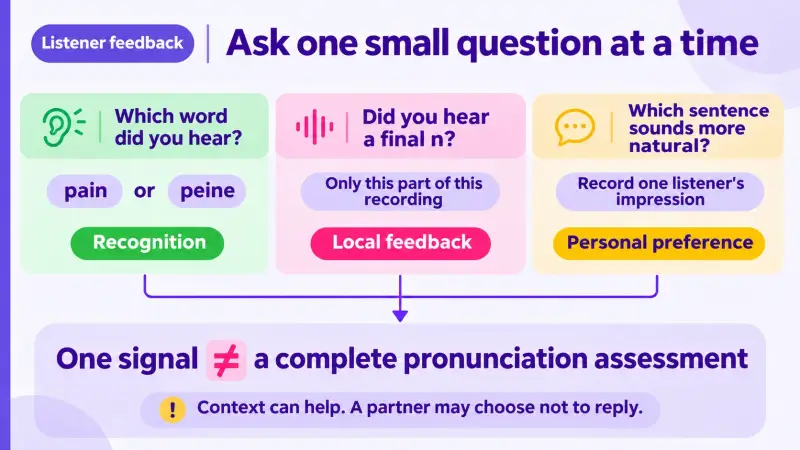
A listener telling you which word they heard answers a recognition question, not a full pronunciation assessment. A correct identification can also come from the sentence context, so treat it as one signal rather than a verdict on the vowel.
The questions below stay narrow on purpose: each one asks for a single choice or impression, and answering is entirely up to the other person. Keep the request bounded and let the conversation return to whatever you were discussing.
| Question you send | Why the request stays small | What you do with the answer |
|---|---|---|
| Which word did you hear, pain or peine? | one choice, no explanation needed | if it matches what you said, keep that sentence; if not, return to the source audio for that word |
| Did you hear an n sound immediately after pain? | yes or no about one sound | take it as one listener's report on that spot in your recording, then replay the source audio for pain |
| Which of my two sentences sounded more natural to you? | personal impression, no analysis | note it as one speaker's preference, not a rule |
When a reply is useful, copy the wording into your own notes with the date and the word it concerned, then reuse that same sentence in a later conversation so the practice turns into something you actually say. Replies depend on who is free, so keep the solo loop running regardless and ask a different partner another day.
Regional Variation in How Many Nasal Vowels You Hear
The number of nasal vowels is often presented as settled, which matters once you start comparing your recording against a real person's answer.
The same Lawless French page that lists four nasal symbols also notes [œ̃] merging into [ɛ̃] across much of France, so four distinct nasal vowels is a reference inventory rather than a promise about every speaker. Individual habits differ on top of that.
The practical consequence is small but worth knowing. If a partner treats un and brin as the same vowel, that reflects their own system, and one person's pronunciation does not change the reference contrast you chose for this exercise. Keep the pair you are drilling stable and let variation be information rather than a reason to restart.
The pain and peine contrast holds up well here, because it compares a nasal vowel with an oral vowel plus a pronounced n rather than two nasal vowels that may have merged. If your difficulty shows up mainly when writing what you hear, separating spelling slips from genuinely missed sounds is a different diagnosis, covered in French dictation practice. For how much room pronunciation deserves inside a wider plan, a broader French learning method compares the main approaches.
FAQ: Practicing French Nasal Vowels
Do I need to learn all four nasal vowels before practising?
No. One documented contrast with audio gives you something checkable today, and the chart stays available as a reference when you add the next pair.
Is pain and peine a perfect minimal pair?
Not strictly. The whole-word reference forms are /pɛ̃/ for pain and /pɛn/ for peine, so the two differ in the vowel category and in the final pronounced n, which makes them a useful teaching contrast rather than a one-sound minimal pair. Realisation also varies between speakers, so use the pair as a reference contrast rather than a universal test of your accent.
How do I know whether the n or m is pronounced in a new word?
Use the written cue first: n or m before another consonant letter or at the end of a word often goes with a nasal vowel, while n or m before a vowel letter or doubled is usually pronounced. Letters and sounds do not line up perfectly, and a written final e is often silent, so the dictionary entry with its phonetic form is the safer check.
Does peine always translate as pain in English?
No. Larousse gives senses including sorrow, difficulty, punishment and effort, and the common phrase ce n'est pas la peine is closer to no need than to anything painful.
What if my HelloTalk partner guesses the word correctly?
It means they understood that word in that sentence, with context helping. That is encouraging, and it is still not proof that every sound in the message was accurate.
Can I practise nasal vowels without talking to anyone?
Yes, for most of it. Playing labelled audio, repeating, recording yourself and comparing are all solo steps. A human reply is useful for the part you cannot judge, which is what your own version sounds like from the outside.
What should I do if nobody answers my question?
Keep the solo loop going and ask someone else later with the same short question. A bounded request, one recording and one either-or choice, is easy for the other person to answer or to skip, and skipping it is a normal outcome.
If you want to try the check itself, record one sentence with pain and one with peine and ask a French speaker on HelloTalk which word they heard.