
How Should You Practice French Liaison Without Overusing It?

Somewhere in your first months of French, you learn the trick: a final consonant that is normally silent comes back to life before a vowel. Les amis suddenly makes sense, with that [z] gluing the two words together. So you do the reasonable thing and start linking every boundary that looks the same.
Then you say et Alice with a [t], and something is clearly off. The spelling looks identical to les amis: a final consonant, then a vowel. Yet one link is required and the other is banned, and the simple rule you memorized has stopped helping.
Here is the real shape of the problem. Liaison is not a command to pronounce every silent consonant before a vowel. A normally silent final consonant joins the opening vowel of the next word only in licensed grammatical contexts, not everywhere two words happen to meet. The question is never just "can I link here?" but "does this specific boundary allow it?"
The fix is an order of operations. Make the common mandatory liaisons automatic first, protect the main forbidden boundaries second, and only then experiment with optional links. This article walks that order, shows you how to train your ear with contrasts, and helps you decide how many optional links a given conversation actually wants.
If most of your study time currently lives in courses and apps, this daily French practice guide covers where the audio, review, and conversation time come from. This piece covers the liaison decisions themselves.
Practice Mandatory Liaisons First, Forbidden Boundaries Second, and Optional Liaisons Last
The Office québécois de la langue française sorts liaison into three classes: mandatory, forbidden, and optional. That sounds like grammar-book housekeeping, but it is the most practical thing you will read about liaison, because each class asks you for a different move. One link you always make, one you always block, and one you choose.
Liaison practice is a three-way decision at every boundary: produce the link, block it, or choose it according to context.
The table below is a starter set worth drilling before anything else. The bracketed letters show the liaison consonant, not a complete phonetic transcription.
| Decision | High-value context | Example | What to practice |
|---|---|---|---|
| Mandatory | Determiner before a noun | les [z] amis, un [n] intérêt | Make the consonant part of the following syllable |
| Mandatory | Personal pronoun with a verb | nous [z] avons, on [n] arrive | Learn the pair as one spoken unit |
| Mandatory | Adjective before a noun | un grand [t] arbre, de bons [z] amis | Keep the word order attached to the sound |
| Forbidden | After et | un garçon et une fille | Keep a clean boundary after et |
| Forbidden | After a singular noun | un repas infect | Do not release the noun's silent final consonant |
| Forbidden | Before an aspirated h | les haricots | Check the word in a reliable dictionary when unsure |
| Optional | Auxiliary before a past participle | nous avons aimé | Record both linked and unlinked versions |
| Optional | Plural noun before a following adjective or verb | mes amis étaient là | Compare casual and careful speech rather than forcing one answer |
The OQLF guide to mandatory liaison treats these frequent links as systematic across registers. Its forbidden-liaison guide lists boundaries where a link normally sounds wrong. Pick five phrases from each of those two groups and drill them until they feel like single words. Add only two optional examples at first.
Resist the urge to collect every exception on day one. A short set you can actually produce at speed beats a long rule sheet that evaporates the moment someone talks to you at normal pace.
Liaison Depends on Grammar and Phrase Boundaries, Not Just the Next Vowel
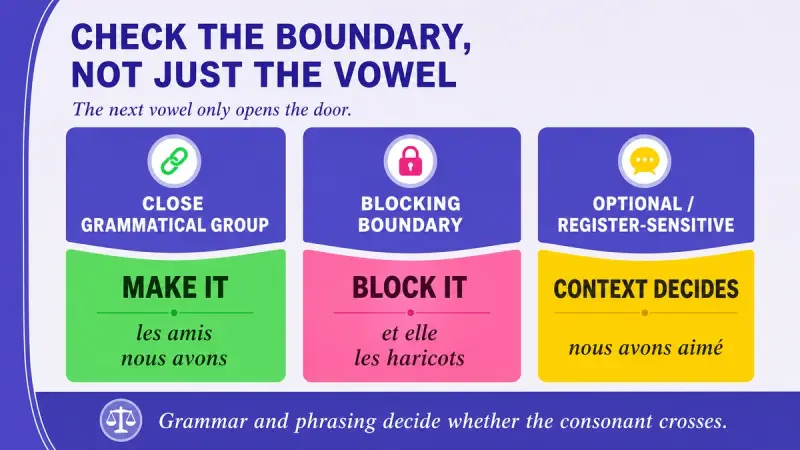
Now for the mental shift that would have saved you the et Alice moment: stop reading liaison off the spelling. A vowel or silent h at the start of the second word only opens the door. Grammar and phrasing decide whether anything walks through it.
A following vowel does not by itself authorize liaison; the relationship between the two words controls the result.
Line up these boundaries and the pattern gets clearer:
| First phrase | Decision | Why |
|---|---|---|
| les amis | Mandatory [z] | Determiner and noun form a close grammatical group |
| nous avons | Mandatory [z] | Subject pronoun and verb are linked |
| Vincent arrive | No liaison | A proper noun before a verb does not license the same link |
| et elle | No liaison | Liaison is forbidden after the conjunction et |
| très intéressant | Mandatory [z] in the cited OQLF pattern | A short adverb is closely attached to the following word |
| un repas infect | No liaison | Liaison is forbidden after a singular noun |
Pauses matter too. The OQLF notes that punctuation or an oral break blocks liaison across that boundary. So when you listen, ask a structural question: are these two words one tight phrase, or did the speaker finish a unit and start a new one?
The aspirated h deserves its own warning label. Haricot begins with a written h, but its dictionary classification blocks liaison and elision. The Académie française's liaison guidance uses les haricots as a clear no-liaison example. You cannot guess this from the letter alone, so look the word up when in doubt.
Train Your Ear With Liaison and No-Liaison Contrasts Before Shadowing Full Sentences
Rules only become usable when your ear catches both the consonant and the boundary that blocks it. That is why jumping straight into full-sentence shadowing backfires as a first step: rhythm, unfamiliar vocabulary, and several sound changes hit at once, and you cannot tell which part you got wrong.
A liaison contrast teaches more than repeating one correct phrase, because it trains both the sound and the boundary that blocks it.
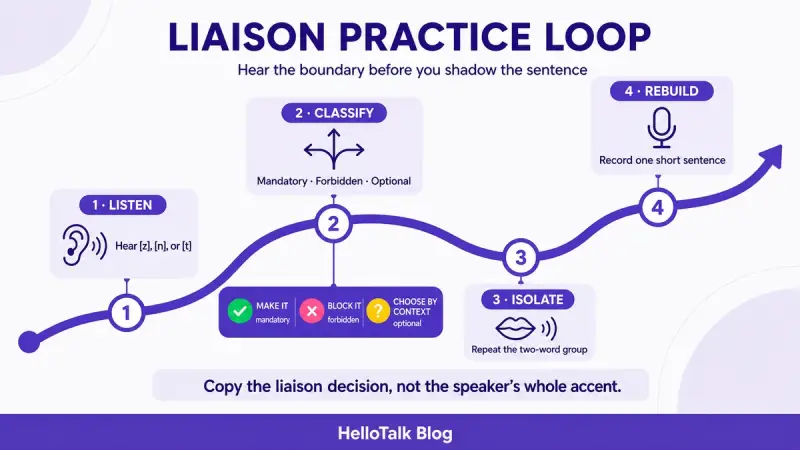
Work through four passes with a small set of recorded phrases:
- Listen without reading and mark whether you hear an added [z], [n], or [t].
- Read the phrase and classify the boundary as mandatory, forbidden, or optional.
- Repeat only the two-word group until the consonant lands inside the next syllable.
- Put the group back into one short sentence and record it once.
This contrast set covers all three decisions without a long script:
| Linked target | Contrasting boundary | Listening question |
|---|---|---|
| les amis | les haricots | Does the [z] appear, or does the second word begin cleanly? |
| nous avons | Vincent arrive | Is the first word a pronoun attached to a verb, or a name before a verb? |
| très intéressant | un repas infect | Is the first word a short adverb or a singular noun? |
| nous avons aimé with liaison | nous avons aimé without liaison | Do both versions stay understandable and natural in context? |
For model audio, pick a source that labels the target instead of a random pronunciation clip. TV5MONDE's meal lesson includes a pronunciation exercise on liaison, and the University of Texas Français interactif liaison lesson has recorded mandatory, forbidden, and optional examples.
Once the short pairs feel easy to classify, shadow one complete sentence. Keep the goal narrow: copy the liaison decision and the syllable connection, not the speaker's entire accent.
Match Optional Liaisons to Register Instead of Treating More as More Correct
Optional liaison is where overuse actually happens, so this is the stage to slow down. If you copy every link from a carefully read sentence into a relaxed chat, each individual link can be technically possible and the whole thing can still sound stiff.
Optional liaison expresses register and speaking style; producing more optional links is not a higher score for correctness.
The OQLF guide to optional liaison describes the pattern plainly: optional links become more frequent as the style becomes more careful. Familiar speech uses very few, neutral speech uses some, and sustained formal speech may use more. Your job is not to find the "right" number but to build a range.
| Optional context | Casual practice | Careful-speech practice | What to ask a listener |
|---|---|---|---|
| Auxiliary plus past participle: nous avons aimé | Record without the link | Record with [z] | Which version fits a conversation with friends? |
| Plural subject plus verb: mes amis étaient là | Keep the boundary light | Test the [z] link | Does the linked version sound formal here? |
| After mais: mais elle | Leave it unlinked | Test the possible [z] | Would you use it in a presentation or ordinary chat? |
| After trop: trop important | Listen for variation | Compare with a careful reading | Is the final [p] natural in this sentence? |
One caution about feedback: treat a single speaker's reaction as information about that speaker and that context, not a universal vote. Build a reliable neutral version first, then a more careful version you can pull out when the setting calls for it.
Use HelloTalk to Run a Listen, Record, and Context-Check Liaison Loop
At some point a rule chart stops being able to answer your question, because the question becomes: which version fits this exchange, with this person, right now? That is a job for real interaction, and HelloTalk gives you four places to run the loop: chat, public posts, live audio, and solo review.
The loop works best when your question is narrow. Instead of asking "Is my French pronunciation good?", send one phrase and name the context: Dans une conversation entre amis, est-ce que vous faites la liaison dans « nous avons aimé » ?
| HelloTalk module | Liaison task | Evidence to save |
|---|---|---|
| Chat-based learning | Exchange a short voice message containing one target phrase; use built-in translation, transcription, read-aloud, and grammar correction to keep the surrounding sentence clear | The partner's recorded model and their context note |
| Moments | Post two versions of one optional liaison and ask which fits casual speech or a presentation | Several individual judgments, kept separate rather than treated as a formal rule |
| Voicerooms and Livestreams | Join first as a listener and tally one mandatory and one optional environment in spontaneous speech | The complete phrase and the situation in which it occurred |
| AI learning tools | Use pronunciation scoring for a repeatable solo attempt and image translation to turn a printed example into a practice prompt | A before-and-after recording, not a promised learning result |
For context on the platform itself, HelloTalk reports 70M+ registered users across 200+ countries and support for 260+ languages. That is registered reach, not a promise about who will see or answer your question. If you do hear back from more than one partner, keep the question specific so the answers stay interpretable instead of contradictory.
For a longer live-practice format, borrow the session structure in this French language exchange guide. And if you are pairing these drills with a course, this course-and-exchange plan shows how to carry a course example into conversation and bring the correction back for review.
Know Where Liaison Ends: Keep Enchaînement and Broader French Rhythm as the Next Step
One last boundary remains, and it protects you from a different overcorrection. Not every run-together consonant in French is liaison.
Liaison activates a consonant that is normally silent, while enchaînement carries an already pronounced final consonant into the next syllable.
The OQLF explanation of liaison and enchaînement contrasts examples like un bel étalon and partir avec elle. The final consonants of bel and partir are pronounced anyway, vowel or no vowel. In connected speech they slide into the next syllable, but no dormant consonant woke up.
| Phenomenon | What happens | Example | Your practice cue |
|---|---|---|---|
| Liaison | A normally silent final consonant becomes audible before the next word | les [z] amis | Decide whether the grammatical context licenses it |
| Enchaînement | A consonant that is already pronounced joins the opening vowel of the next syllable | bel étalon, partir avec elle | Keep the consonant, then smooth the syllable boundary |
| Phrase rhythm | Words group into spoken units with pauses, prominence, and reductions | A complete clause or short turn | Copy the whole group only after the local sound decision is stable |
This is also where the current drill stops. Liaison practice answers one question: when does a silent final consonant appear? It does not cover vowel quality, elision, intonation, or phrase-level rhythm. When you are ready for those, they fit inside the listening and speaking blocks of a three-month French method stack.
Frequently Asked Questions
Is French liaison always required before a vowel?
No. A following vowel or silent h creates a possible phonetic environment, but grammar and phrase boundaries determine whether liaison is mandatory, forbidden, or optional.
Why is there liaison in les amis but not after et?
Les amis contains a determiner directly attached to a noun, which is a mandatory context. Liaison after the conjunction et is forbidden, so et Alice keeps a clear boundary.
Should beginners practice optional liaison?
Yes, but only after the frequent mandatory and forbidden patterns are stable. Start by recognizing both optional versions, then use listener feedback to learn which version fits casual or careful speech.
Is the h in every French word treated the same way?
No. A mute h can permit liaison or elision, while an aspirated h blocks them. Check a reliable dictionary instead of guessing from the spelling.
Are liaison and enchaînement the same thing?
No. Liaison makes a normally silent consonant audible. Enchaînement moves an already pronounced final consonant into the next syllable without creating a new consonant sound.
Start small tonight: choose four contrast pairs, record them, and check one optional example in a real context. Use HelloTalk when you want text, voice messages, community posts, and live audio inside the same practice loop.