
How Can You Hear and Practice Russian Hard and Soft Consonants?

Record угол and уголь back to back, then play the file to yourself. If they sound identical, the fix that feels obvious is to make the soft consonant quieter and the hard one louder, so you try exactly that. The recording changes. The contrast a Russian listener expects still does not appear.
That fix fails because the labels mislead you. Hard and soft say nothing about volume. A soft consonant is palatalized, which means the middle of your tongue rises toward the hard palate while the consonant itself is being formed, and the hard partner keeps the tongue body lower and farther back.
In Russian, softness is part of the consonant itself, and replacing a hard consonant with its soft partner can change which word a listener hears. So the skill you need has two halves: hearing the contrast without help from spelling, and timing a tongue movement.
The sections below cover both halves in order: spelling cues, minimal pairs, tongue movement, a recording loop, a sensible practice order, and a final check with real listeners. If you still need a wider study routine around all this, start with online Russian resources for beginners and slot this in as the pronunciation piece.
Russian Hard and Soft Consonants Differ by Tongue Position, Not Volume
Linguists call the soft member of a pair palatalized and the hard member plain. Cornell University's Russian materials stress one detail that saves beginners weeks of confusion: palatalization happens at the same time as the consonant. It is not a full English-style y glued on afterward.
You can feel this with a slow n. Say the hard version, pause, then say it again while raising the middle of your tongue toward the roof of your mouth without letting go of the n contact. If it comes out as two beats, n plus y, the timing is off; the goal is one coordinated sound.
Two things the labels do not mean:
- "Soft" does not mean quieter, weaker, or breathier.
- "Hard" does not mean louder or more forceful.
What actually changes is tongue shape and timing. The University of Kansas's Между нами materials describe a forward-and-up tongue movement for soft consonants and a lower, farther-back position for hard ones. That physical difference gives you something you can deliberately practice, which volume never was.
Which Vowel Letters and Spelling Cues Tell You a Consonant Is Hard or Soft?
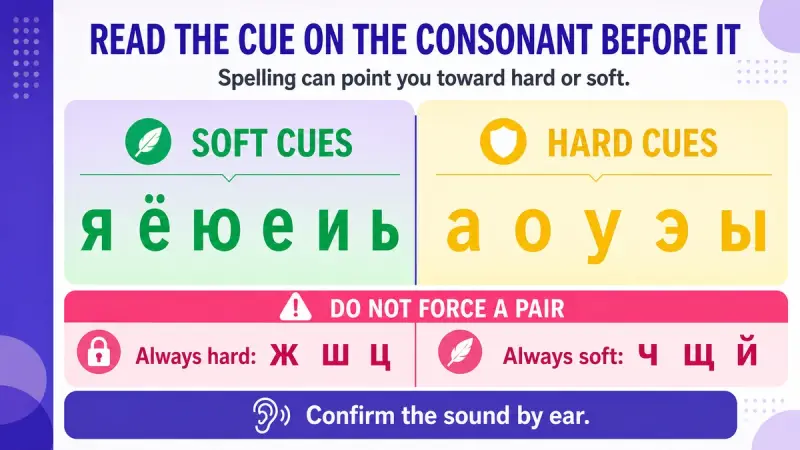
Russian usually hides the hard-soft signal in the letter after the consonant. Cornell's materials lay this out as five vowel-letter pairs: one letter in each pair generally follows a hard consonant, and the other tells you the paired consonant before it is soft.
Read this table as a decoding aid, then confirm each sound against audio, because the always-hard and always-soft consonants break the pattern in ways spelling alone will not show you.
| Vowel sound area | Usually after a hard paired consonant | Usually signals a soft paired consonant | Simple contrast to hear |
|---|---|---|---|
| /a/ | а | я | на / ня |
| /o/ | о | ё | но / нё |
| /u/ | у | ю | ну / ню |
| /e/ | э | е | тэ / те |
| high vowel | ы | и | мы / ми |
The soft sign ь covers the cases where no vowel follows. It marks palatalization when a paired consonant sits at the end of a word or before another consonant, as in уголь and письмо. The sign has no vowel sound of its own; its whole job is to tell you the consonant before it stays soft.
The spelling cue belongs to the preceding paired consonant: я, ё, ю, е, и, or ь usually signals softness, while а, о, у, э, or ы usually supports a hard reading. Just do not apply that rule to ж, ш, ц, ч, щ, or й, which do not alternate the same way, and treat loanwords and consonant clusters as cases to check by ear.
How Can Minimal Pairs Train You to Hear the Contrast Before You Produce It?
A minimal pair changes exactly one meaningful sound and keeps everything else still, which forces your ear onto the hard-soft contrast instead of letting you guess from a long word. Cambridge University Press uses лук and люк to illustrate the Russian contrast, and university listening courses such as the University of Texas's Russian Online recordings give you plenty of hard-soft audio to work with.
Start where the target consonant is easy to find: the beginning or end of a word. These four pairs keep the changed consonant at a visible edge:
| Hard consonant | Soft consonant | Meaning contrast | What to attend to |
|---|---|---|---|
| лук | люк | onion or bow / hatch | Initial л versus лʲ |
| угол | уголь | corner / coal | Final л versus лʲ |
| мат | мать | checkmate / mother | Final т versus тʲ |
| брат | брать | brother / to take | Final т versus тʲ |
Then run three listening passes on each pair. First, listen with the spelling hidden and choose A or B. Second, look at the spelling and replay the item. Third, say out loud which tongue-quality cue you heard.
Keep a score only to find out which pair needs more examples, not to prove one session fixed anything. Minimal-pair practice works as a diagnostic when the learner must identify the word before seeing its spelling. If the letters are visible from the start, you may be testing Cyrillic recognition instead of hearing.
Once the contrast feels findable, do not let it live only in drills. Russian language exchange practice shows how to tuck short sound checks inside normal conversation, so correction stays one small, agreed part of the exchange instead of taking it over.
How Do You Move Your Tongue Differently for Hard and Soft Consonants?
Pick one consonant you can sustain or repeat slowly, such as л, н, or м. Say the hard version, pause, then say the soft partner while raising the middle of your tongue toward the hard palate. The one mistake to watch for: do not release the consonant and then add a separate y.
For л the contrast is often the easiest to feel. Hard л uses a retracted tongue-body quality that can resemble a dark English l, while soft лʲ raises the middle of the tongue. For labials such as м or п, your lips make the main closure, but the tongue still has to move for palatalization at the same moment.
A mirror only shows you the labial part, and the decisive movement happens inside your mouth. An audio model plus your own recording will tell you far more than lip shape. If your soft consonant sounds like two segments, shorten the transition and line the tongue rise up with the main closure.
Also resist the urge to force the whole tongue upward. The main place of articulation for н, т, or л still matters; the tongue-body raise is an added simultaneous gesture, not a replacement. Slow syllables like на / ня, ну / ню, and ла / ля let you coordinate that gesture before you go back to normal-speed words.
How Can a Listen, Choose, Record, and Compare Loop Build a Reliable Contrast?
Drilling production while your perception is still shaky just rehearses the wrong sound with growing confidence. One loop can test both separately before joining them. It has four actions in a fixed order: listen without text, choose the item, record your version, compare it with the model. Each action answers a different question, so keep them apart:
| Action | What you do | What it tests | What to save |
|---|---|---|---|
| Listen | Hear one item with the spelling hidden | Raw auditory access | The audio source and target pair |
| Choose | Select the hard or soft word and state your confidence | Perceptual category | Correct choice plus confidence |
| Record | Say both members in random order | Controlled production | One unedited recording |
| Compare | Replay model and recording back to back | Difference in tongue timing and resulting sound | One specific adjustment for the next attempt |
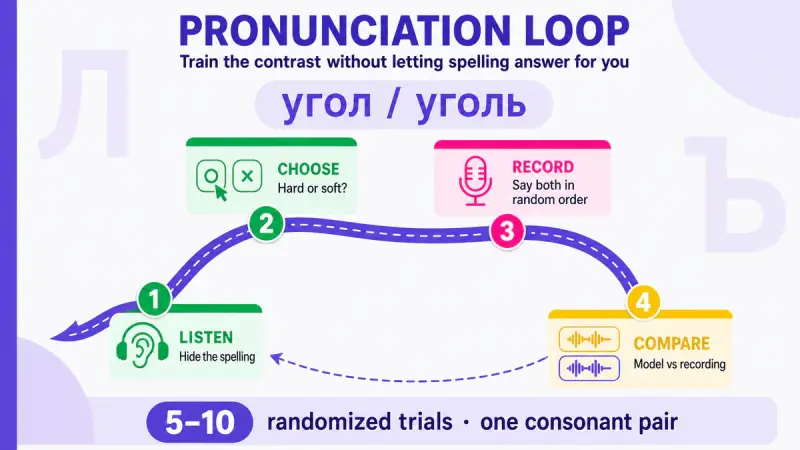
Run five to ten trials with one consonant before switching targets, and randomize the order. Alternating A-B-A-B lets rhythm hand you the answer, which is exactly the shortcut you are trying to remove. When a pair becomes reliable, put each word inside a short phrase so surrounding sounds cannot erase your attention to the target.
This loop is also the missing middle in many beginner routines. Why Russian resources lose beginners after the alphabet stage traces the bigger version of the same gap: Cyrillic gives you visible cues, but recording and comparing is what connects those cues to speech.
Which Consonant Pairs Should Beginners Practice First, and Which Ones Never Alternate?
Cornell lists 15 consonant letters that regularly have hard and soft partners: б, в, г, д, з, к, л, м, н, п, р, с, т, ф, and х. Fifteen is far too many to train at once, so start with contrasts you can both hear and physically monitor, then spread out across places of articulation.
A workable order: л/лʲ first, then н/нʲ and т/тʲ, then labials such as м/мʲ, п/пʲ, and б/бʲ. Treat that as a teaching suggestion, not a difficulty ranking that holds for every learner. Your own listening scores should decide when you move on.
Six consonant sounds sit outside the pairing system entirely, and drilling them as if they had partners wastes your time:
| Category | Consonants | Beginner implication |
|---|---|---|
| Conventionally always hard | ж, ш, ц | A following и or е does not create the same paired alternation you see with н or т |
| Conventionally always soft | ч, щ, й | A following hard-vowel letter does not create a hard partner |
The six unpaired consonants are ж, ш, ц on the hard side and ч, щ, й on the soft side; they should not be drilled as if each had a regular opposite partner. A written soft sign can still appear after an unpaired consonant for grammatical or spelling reasons without turning that consonant into a new soft sound.
If you want to know why your alphabet-focused course probably skipped this whole system, where Russian learning resources break down separates visible spelling coverage from the listening and production work that gets left behind.
How Can You Test Intelligibility With Russian Speakers on HelloTalk?
Your recording can differ from a model and still be perfectly understandable, so the real final test is not "does this match the audio" but "which word did a listener actually hear." The HelloTalk platform supports voice messages, text, voice and video calls, Moments, Voicerooms, and Livestreams across 260+ languages, and HelloTalk's built-in translation, pronunciation, transliteration, and correction tools can support the exchange without replacing the listener's judgment.
The cleanest test is a blinded contrast. Record either угол or уголь without typing the target word first, then ask a Russian speaker which word they heard and what clue made the choice possible. Only after the answer, reveal the pair, and ask for one model recording if the contrast was unclear.
Different feature areas give you different kinds of evidence, so keep private, public, live, and automated feedback apart:
| HelloTalk feature area | Russian hard-soft task | Limit of the evidence |
|---|---|---|
| Chat-based learning | Send a voice note plus a two-option identification question | One listener's interpretation of one token |
| Moments | Post a short pair and invite several descriptions of the difference | Variation across respondents, not a guaranteed consensus |
| Voicerooms and Livestreams | Listen for target consonants in connected Russian before speaking | Natural examples may be fast and context-dependent |
| AI learning tools | Check pronunciation or grammar before sharing a phrase | Form feedback is supportive, not a substitute for human intelligibility |
Keep the request narrow. A specific question like "Which word did you hear, угол or уголь?" is much easier for a listener to answer than a broad "How is my Russian accent?" And if listeners pick the right word but still hear a foreign accent, your contrast is already doing its lexical job. Naturalness can come later.
Frequently Asked Questions
Is a soft Russian consonant just a consonant plus y?
No. Palatalization is coordinated with the consonant itself. A separate y after the consonant creates two gestures and can obscure the intended Russian contrast.
Does ь have its own sound?
The soft sign has no vowel sound of its own. In this context it marks the preceding paired consonant as soft, especially at the end of a word or before another consonant.
Are я, ё, ю, е, and и always reliable softness markers?
They are strong cues after paired consonants, but they are not a complete pronunciation rule. Always-hard and always-soft consonants, loanwords, and some clusters need separate attention.
Should I practice hearing or speaking first?
Start with hearing, because visible spelling can hide a perception problem. Once you can identify a contrast without text, record the same pair and ask a listener what they heard.
How many consonant pairs should I practice in one session?
One or two is enough for focused work. Five to ten randomized listening trials on one pair will tell you more than rushing through the whole consonant inventory.
Choose one pair today, hide the spelling, and test both your ear and your tongue. Use HelloTalk when you want to compare recordings and ask Russian speakers which consonant contrast they actually heard.