
Your First Short Russian Voice Exchange: Prepare the Reply, Too

If you can say a few Russian lines but go quiet when the other person answers, prepare two possible answers and your own next line before you record anything. HelloTalk carries the middle step: you record one short question in the chat, and a partner who agrees answers with their own preference.
If the only line you prepared is a thank-you, an answer like Нет, я люблю́ ко́фе. (No, I like coffee.) can leave you with nothing to send back.
Agree on a Small Russian Exchange With a HelloTalk Partner
A broad invitation such as "let's practise Russian" leaves the size of the first message to the other person, and a long Russian reply is harder to work with than a short one at this stage. Naming the shape in English keeps the request answerable: one question and one answer each, by voice, on one everyday topic, this week.
The step that needs a real person sits in the middle of that plan. You record the Russian question in a HelloTalk chat because a partner answers with their own preference instead of the answer you wrote, and replying to a line you did not script is the part a recording cannot hand you.
HelloTalk's official FAQ describes recording and sending a voice message inside the chat, and it does not promise that any message will be answered. If you have never sent one, HelloTalk's FAQ on sending a voice message covers the recording control in the chat window.
Put the trade and the limits in that same first message. Offer the same exchange back in the language your partner is studying, keep the topic to a preference such as tea or coffee, and leave out your address, workplace and daily schedule. A practice exchange does not need personal details from either side.
Finding someone is a separate job, and how a Russian language exchange works and why partners stay in it covers that step; this page starts after someone has agreed. The lines you bring come from your own study, so a resource list for beginners learning Russian is where to build them, and one short voice exchange is a step inside that routine rather than a replacement for it.
Prepare One Opening Question and Two Possible Answers
A first turn in this plan has three prepared lines: the opening question, a reply for agreement, and a reply for a different preference. A greeting plus one yes or no question invites a short answer and keeps your own side small, though your partner can still reply with more than that. The two prepared replies are what give you something to send once the answer arrives.
This exchange stays with formal вы from the greeting onward, which keeps one set of forms in play while you are listening. Russian changes the verb with the person you address: вы takes лю́бите while я takes люблю́, so choosing formal address also chooses the verb form you practise. The same split shows up in the name question, Как вас зову́т? for вы and Как тебя́ зову́т? for ты, so keep one level for the whole exchange.
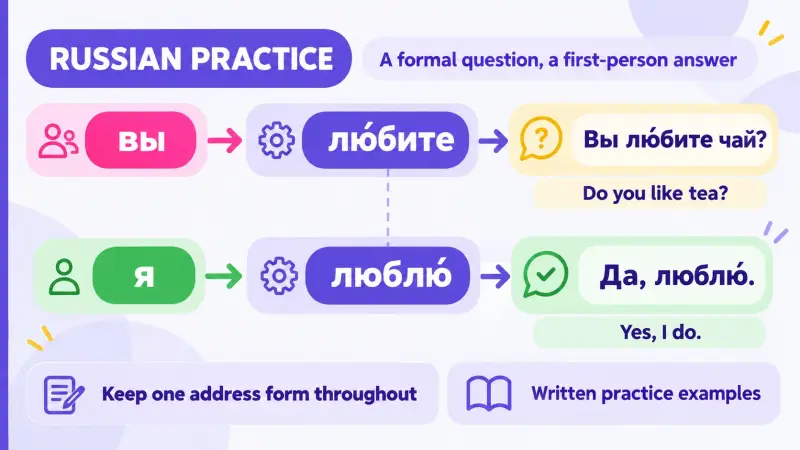
The table below covers the first turn only: what you record or hear, what each line means, and why it is in the plan. These lines are practice material written for this page rather than a transcript of a real chat, and the acute marks are reading aids that mark the stressed syllable.
| Part of the first turn | Russian | English | Why it is in the plan |
|---|---|---|---|
| What you record | Здра́вствуйте! Вы лю́бите чай? | Hello! Do you like tea? | A yes or no question invites a short answer, though your partner can still reply with more than that |
| Possible answer A | Да, люблю́. А вы? | Yes, I do. And you? | The agreement branch, where А вы? hands the same question back to you |
| Possible answer B | Нет, я люблю́ ко́фе. | No, I like coffee. | The branch where your partner names a different preference, so your reply needs to acknowledge it |
Record the question first in the voice recorder already on your device and listen back to it there, so the chat is not the first place you hear the sentence. That pass is rehearsal only.
Then record it again in the HelloTalk chat and send it to the partner who agreed, because a person is the one who can tell you whether чай was recognizable. HelloTalk's official FAQ covers recording and sending inside the chat window, so expect to record the line a second time there.
Send one narrow request in English with that same HelloTalk voice message: "Please tell me if you understood чай in my voice message; no need to correct everything." Naming one word tells the partner who just listened what kind of answer you want, and leaves them free to reply in a sentence rather than a correction list.
A request to fix everything in a short message can come back as more notes than you can apply to the next recording, and a partner may not have time for it. The request is an invitation either way, and it can go unanswered.
Choose Your Next Reply Instead of Memorizing a Whole Script
Once the answer arrives, the work is choosing between two prepared lines rather than recalling a script. If you hear Да, люблю́. А вы?, your line is Я то́же люблю́ чай. (I like tea too.) If you hear Нет, я люблю́ ко́фе., your line is Поня́тно. А я люблю́ чай. (I see. I like tea.), which acknowledges what your partner said and still gives your own answer.
Ко́фе does not decline in Russian, and чай keeps the same form as the object of люблю́, so neither word changes its ending in these two replies. A voice message is recorded rather than live, so you can replay the answer before you choose, and fewer endings to track means less to listen for while you do.
If nobody answers today, record the whole shape alone in a local recorder: the question, then answer A followed by your reply, then answer B followed by your reply. Keep the question saved for whoever agrees later. That is preparation rather than an exchange, and the limit is worth naming: your own recording cannot tell you whether a listener understood чай, which is why the question stays ready for a HelloTalk partner.
Keeping each message to roughly thirty seconds is a practice arrangement you can adjust to your time and level. It is not a measured completion time or a recommended dose.
Ask for a Repeat When the Answer Takes an Unexpected Turn
Sometimes the answer belongs to neither branch. Guessing at that point risks a reply that does not match what your partner said, and the turns after it can go to repairing the misunderstanding instead of the topic you agreed on.
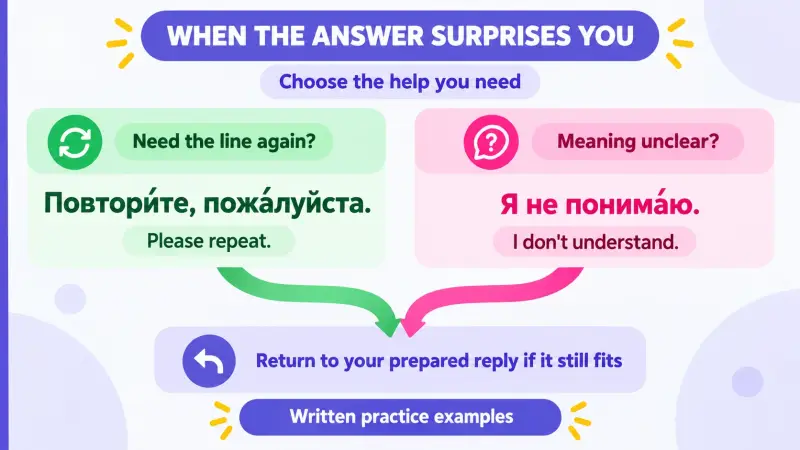
Send a repair line in the same HelloTalk chat, as a short voice message or as text, so the person who answered can close the gap while the topic is still open. Повтори́те, пожа́луйста. (Please repeat.) asks for the line again, while Я не понима́ю. (I don't understand.) reports that the meaning did not arrive. Choosing between the two tells a real person which kind of help you need.
You can also ask your HelloTalk partner to type the one word you missed, since seeing it written tells you whether you already know that word and narrows what to check next, rather than settling on its own whether the gap was vocabulary or listening. A person can slow down or swap in a simpler word, so ask for that instead of a translation of everything they said.
After the repair, go back to your prepared line if it still fits. A repeat request inside a short exchange is ordinary. What tells you the topic has outgrown the one you agreed on is the content of the answers, for example several unfamiliar words in a row or a question that has left tea and coffee behind, and you can say so in English and return to the agreed question.
Save One Useful Reply and Prepare a Different Version
The line worth saving is the one you actually needed, not the longest one in the chat. Copy it into your own notes with the date and the situation it answered, because a line buried in chat history is hard to find again when you are preparing the next exchange.
The table below turns one finished exchange into the next one: what you saved, the Russian as you used it, why it stays useful, and the version to prepare before you record again. Which branch you actually hear is not something this page can know in advance, so the rows stay conditional.
| Saved item | Russian line | Why it is worth keeping | Different version to prepare next |
|---|---|---|---|
| The reply that fit, if the answer was branch A | Я то́же люблю́ чай. | It is your line for the agreement branch, and то́же is short enough for one narrow check: ask your HelloTalk partner whether that word came through in your recording, since only a listener can report that | Stay on the same tea or coffee question and rehearse the other branch, Поня́тно. А я люблю́ чай., so both replies are ready before you record |
| The branch the answer actually took, if it was B | Нет, я люблю́ ко́фе. | If your partner answered this way, the line you keep is their own preference rather than the one you rehearsed, which is the reason for asking a person at all | Borrow the shape of branch A for the turn where you are asked first: Да, люблю́. А вы? answers and hands the question back on the same topic |
| The repair line, if you needed it | Повтори́те, пожа́луйста. | A topic you have not rehearsed can produce an answer outside both branches, and this line keeps the turn open | Pair it with Я не понима́ю. so that next time you can tell your HelloTalk partner which of the two problems you had, and ask them to type the word you missed |
Keeping the exchange small is what makes that loop possible: material from your course or resource list becomes one question, a partner's answer becomes new material, and your next recording starts from a line a person actually said to you. When your question and both replies are ready, open HelloTalk and send the voice message to the partner who agreed to the same small exchange.
Frequently Asked Questions
How long should a first Russian voice exchange be?
One question and one answer from each side, with messages of roughly thirty seconds, is enough for a first exchange, and that length is an arrangement you can adjust rather than a rule. A voice message can be replayed as often as you like, so the useful question is how much of it you understand and what you prepared to answer.
Should I use вы or ты in a first exchange?
Formal вы is the cautious choice with someone you have just met, and it keeps your verb forms consistent, since вы takes лю́бите while я takes люблю́. The name question follows the same split, Как вас зову́т? with вы and Как тебя́ зову́т? with ты. This is a practical decision for a practice exchange rather than a universal social rule, and a partner may invite you to switch.
What should I do if nobody replies?
Record the exchange alone in a local recorder: your question, then answer A with your reply, then answer B with your reply, and keep the question saved for whoever agrees later. HelloTalk's FAQ about voice messages makes no promise that a message will be answered, and availability depends on real people. Treat the solo version as preparation only, because your own recording cannot report back on whether you were understood.
Why do the Russian lines here have accent marks?
The acute marks in люблю́, ко́фе and Повтори́те show which syllable carries the stress and are used as a reading aid in learning materials. Standard written Russian normally leaves them out, so do not expect them in a partner's typed messages. They are also not a transcription of audio; they tell you where the stress belongs, not how any particular speaker sounded.
How do I ask for feedback without being corrected on everything?
Ask one answerable question about one thing and send it with the voice message in the same HelloTalk chat, such as "Please tell me if you understood чай in my voice message; no need to correct everything." Naming one word gives the partner who just listened something they can answer in a sentence, and it is also easy to decline. A general request to correct a short message can return more notes than you can apply to the next recording.
Can I type the lines instead of recording them?
You can send the same lines as text in the HelloTalk chat, and that is genuinely useful for checking a word you missed during a voice message. Typing does not cover the voice part, though, because the reason to record is to find out whether your чай or ко́фе is recognizable to a listener and whether you can follow a spoken answer.