
Use an Easy German Clip to Practice Your Own German Replies

If you can follow an Easy German clip with subtitles but go blank when someone asks you that question, the missing step is saying one true thing about yourself and then handling wording you did not write. The clip supplies the topic and the words. On HelloTalk you can ask a German-speaking partner to answer and to re-ask it their own way; if they do, you learn whether you understood the question or only your own version of it.
Choose a Short Easy German Clip You Can Follow
The clip is not the exercise, so choose it for the topic rather than for difficulty. You want a segment whose subject you could talk about in your own language without preparing, short enough that replaying it twice is not a chore. Everyday routine topics work well because they hand you sentences you can make true about yourself right away.
If you are pausing every few seconds to read, pick something slower before you pick something shorter. Easy German publishes its videos with both German and English subtitles, and it runs a slower Super Easy German line alongside its regular street material. One workable starting point is "Having Breakfast in Slow German | Super Easy German 233", published by Easy German on 9 August 2023 and presented in its own title and description as a slower breakfast conversation with Cari and Janusz.
Easy German also offers learning paths, beginner series and member learning resources, so the channel is not only loose street footage. If you are still deciding which free material to build a week around, the overview of free German resources ranked by what you actually need covers that choice. This article assumes the clip is picked and you want an answer out of it.
Separate What You Heard, Read, and Can Say Yourself
Most of the frustration here comes from treating one pass through a video as one result. Following subtitles and answering a question are different jobs: one is recognition inside a finished clip, the other is production in an exchange where you cannot see the next line. The table below splits a single viewing into three outputs, so you can tell which ones you actually have.
One practical note before you use it. Easy German's German and English subtitles may be part of the picture rather than a track your player lets you switch off, so the checks below rely on where you point your eyes rather than on a settings menu. If your player does give you a subtitle control, switching it off does the same job.
| Layer | What you produced | How to check it in one pass | What it does not prove |
|---|---|---|---|
| Heard | Words and phrases you caught from the audio alone | Play the segment once while looking away from the screen or covering the subtitle area, then write down what you caught | That you could produce any of it yourself |
| Read | Meaning that arrived once you let yourself read the German or English subtitles | Replay while reading, and mark every line that only landed after you read it | That you heard it, since the subtitles can carry the meaning for you |
| Can say | Sentences about your own life you can produce with the clip closed | Close the video and say two sentences about your own breakfast out loud | That a listener will follow your pronunciation |
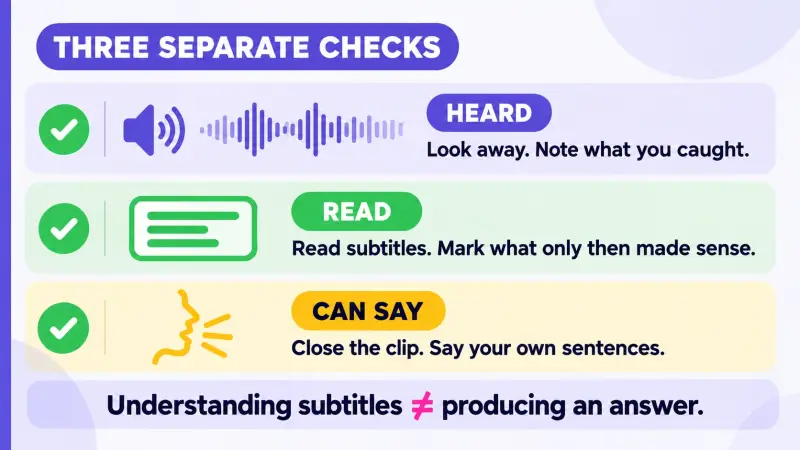
The third row is usually the short one, and it is the only row another person can respond to. So build it on purpose instead of waiting for it to appear after enough viewings.
Turn the Breakfast Topic Into Your Own Answer
Building that third row starts with a smaller target than "talk about breakfast". A usable answer has two parts: one sentence that is true about you, and one question the other person can answer. The statement gives you something to say without translating in your head, and the question is what keeps the turn from dying after four words.
Both examples below were written for this article as practice material. They are not lines from the video, and the nouns should be swapped for what you actually eat and drink.
- Ich esse morgens Brot. Was isst du zum Frühstück? (I eat bread in the morning. What do you eat for breakfast?)
- Ich trinke morgens Tee. Trinkst du lieber Tee oder Kaffee? (I drink tea in the morning. Do you prefer tea or coffee?)
The second pattern asks what someone prefers rather than what they always do, so an answer that names a preference and then an exception is normal rather than a contradiction. Keep your version short enough to say with the screen off; if you cannot produce it without reading, it is still a reading exercise. Written down, though, that pair is only your half of the exchange.
Ask a HelloTalk Partner to Vary the Question
Send the pair to a German-speaking partner on HelloTalk and ask for two things in one message: their own answer, and the same question asked back in different words. The second request is the one that matters here, because you already know you can understand your own phrasing, and what you have not tested is whether you can understand the question when somebody else builds it.
HelloTalk's chat microphone control records and sends a voice message, which lets the same two sentences go out as audio rather than as typed text. That puts your pronunciation in front of a listener, not only your word order. A voice message gives a partner something to listen to rather than something to rewrite, so paste the same two sentences as text in the chat if you also want them looked at in writing.
Ask for one correction rather than a review. Something narrow, such as whether "Was isst du zum Frühstück?" sounds like a normal question or like a translated one, names what you want checked, so the answer can fit in a line and your partner can tell when they are done. Write the request itself in whichever language the two of you both read, rather than assuming English.
On HelloTalk, a long press on a chat message opens the correction action, so a fix comes back as a corrected version of your written sentence instead of a loose comment. The steps for correcting a message sit in HelloTalk's FAQ if your partner has not used that feature before. Nobody is obliged to answer either request, and a reply may land days later or not at all.
If you would rather not wait on one person, post the same two sentences to HelloTalk Moments, where other users can reply and where the same long-press correction is available, which widens the pool of people who might send back a differently worded question. HelloTalk's homepage lists 260+ languages and 200+ countries and regions among its figures; that is the size of the platform, not a sign that a German speaker is free to answer today.
Answer Again With a New Detail Instead of Replaying the Script
If a reworded question does come back in the HelloTalk chat, the easiest move is to resend your original sentence, because that is the one you can say. Answer what was actually asked instead, and add one detail that was not in your first version, since the reply is the part of this exchange you did not script.
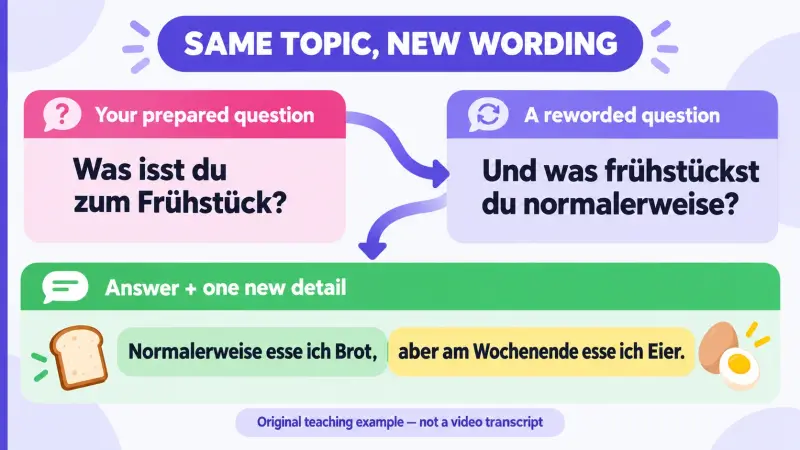
Here is what that can look like. Both lines below were written for this article as teaching material, not taken from the clip or from a real chat. A partner might ask "Und was frühstückst du normalerweise?" (And what do you usually have for breakfast?). The topic is the one you prepared, but the verb frühstücken replaces your zum Frühstück essen, so you recognize the subject without recognizing the structure.
An answer that fits that question, carrying a detail your first version did not have: "Normalerweise esse ich Brot, aber am Wochenende esse ich Eier." (Usually I eat bread, but at the weekend I eat eggs.) The first clause answers what was asked, the second adds the weekend exception, and an addition of that size is enough to carry a second turn.
If your partner corrected something in the first round, use the corrected form in the next answer where it fits rather than storing the screenshot, and send that answer in the same HelloTalk chat so the person who made the correction can see whether it landed. Putting a fix into a different sentence is how you find out whether you can apply it or only recognize it. This does not have to happen the same day.
If no reply arrives, keep the pair and send it to a different HelloTalk partner later, or re-record it after your next clip, because what you are short of is wording you have not seen before.
Repeating the clip's own lines is not wasted either. Reading aloud, shadowing and retelling have their own uses. They are simply a different task from answering a question somebody else phrased, and another person is one of the most direct sources of that phrasing.
One clip and one exchange is a session, not a routine. If you want this to repeat weekly with the same few people, the walkthrough on German speaking practice with native speakers covers partner selection and a loop you can keep running.
HelloTalk also hosts live Voicerooms you can enter as a listener when a room is running and you would rather hear unscripted German than produce it. Once your next clip is picked, open HelloTalk and send your two sentences before you rewatch anything.
Frequently Asked Questions
Do I need to understand the whole video before I practice speaking?
No. One segment you can follow is enough, because the video's job here is to supply a topic and a few words rather than to be completed. Easy German also publishes learning paths and beginner series if you want a structured route running alongside single clips.
What do I do about the subtitles if I cannot switch them off?
Change where you look instead of what the player does. Easy German's German and English subtitles may be part of the picture itself, so a listening check can be as simple as turning away from the screen or covering the lower part of it for one pass, then replaying with your eyes on the text. Understanding a line once you have read it tells you that you understood the words on screen, not that you heard them.
What if I cannot write even two German sentences yet?
Keep the frame and change one word. Ich esse morgens Brot becomes whatever you actually eat, and the question can stay exactly as it is. This exercise needs one true statement and one answerable question, not range.
Can I just repeat the lines from the video to my partner?
You can, and reading or shadowing a line has its own value for pronunciation and rhythm. It is a different exercise from this one, though: saying a sentence you have already seen does not tell you whether you can handle a question put to you in wording you did not choose.
Is a voice message better than a text message for this?
They test different things. Text gives a partner a sentence they can rewrite, while a voice message puts your pronunciation in play. HelloTalk's FAQ on voice-to-text notes that transcription can be inaccurate when audio quality is poor or the wrong language is selected, so a clean transcript is not evidence that your pronunciation was clear. Sending both is a reasonable default.
What if nobody answers?
That happens, and no platform can promise a reply. Send the same pair to another partner on HelloTalk, or post it to HelloTalk Moments where more people can see it, because you still need somebody else's wording to test yourself against. A language partner is trading practice with you, not working as a tutor on call.
How long should one round of this take?
Treat it as an adjustable budget rather than a measured figure: one short clip segment, a few minutes writing the two sentences, and one message sent. The limit that matters is not the clock but whether you can say your sentences without reading them.