
Ten Minutes of Quiet Language Practice Before Your Next Conversation

If you cannot speak out loud right now, aim for one saved line you can send later, not a silent version of speaking practice. On a packed train or at a shared desk, the honest task is choosing what to say and what to ask. The spoken part, a HelloTalk voice message and whatever a partner answers, waits until you can talk.
Choose One Message Your Next Conversation Will Need
Start from the turn you actually owe someone. Open the HelloTalk chat with that partner and scroll back to the last question you did not answer, because your next turn has to fit what they asked, not what you happened to study that morning. If the last message was "What do you usually do on weekends?", that is today's message.
If nothing is pending, choose the message your next conversation will need anyway. Examples: explaining what you do, asking about a word you keep stepping around, or saying why you went quiet for two weeks. Pick one. Ten minutes does not survive a list.
A grammar goal can still steer what you study. "Practice the past tense" just does not end this particular block with anything sendable, while "tell her what I cooked on Saturday" ends it with a sentence that happens to sit in the past tense. Choose a detail that is true and that you do not mind a near stranger knowing.
Typing in silence prepares what you will say; it does not replace the turn where you speak and someone answers. That is the trade this block makes. If you are still deciding which app fills your short daily slots, the comparison of apps built for quick daily English practice handles that question. This page starts after the app is chosen and the real constraint is silence.
A Flexible Ten-Minute Plan: Read, Adapt, and Save
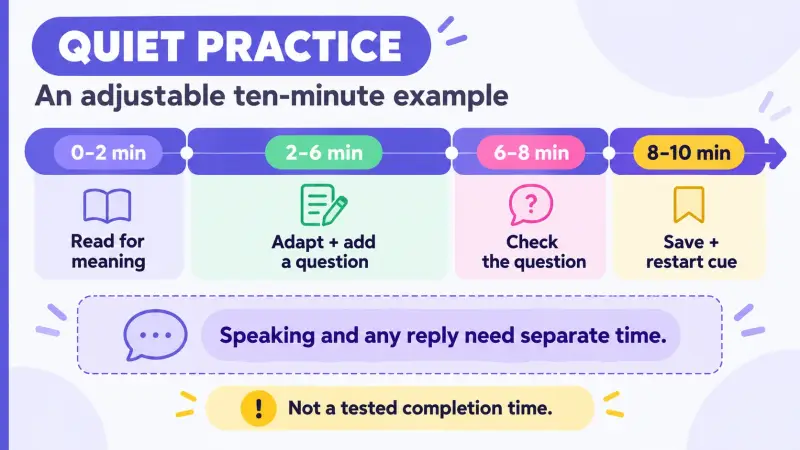
Here is one way to spend the block so it ends with something saved instead of something half-read. Treat the minutes as an adjustable budget rather than a tested completion time: stop at the timer, keep the restart note, and continue later if the task needs longer.
| Minutes | What you do | What exists when the minutes are up |
|---|---|---|
| 0-2 | Read one short message, lesson line, or caption for its meaning, not for every word | One topic and one idea you understood |
| 2-6 | Rewrite that idea as something true about you, then add one question a partner could answer | A short draft with any uncertain word marked |
| 6-8 | Check that the question invites an answer instead of repeating the text you read | A question you can use out loud later |
| 8-10 | Save the draft and write the next unfinished step beside it | Saved text plus a restart cue |
Run it through with the weekend message and the draft might read: "On Saturday I cooked soup with my brother. It came out too salty." Under it goes the question, "What do you cook when you have almost no time?" The marked word is salty, because that is where you would hesitate if someone asked you to say the line again.
The British Council's advice for building an English reading habit is to read at a level you can follow and keep useful vocabulary for later, which is also how to choose the two-minute source text here. A paragraph you have to decode word by word can take the whole block, and the block still has to end with something you can send. The last two minutes exist for the same reason: they are what turns an unfinished block into something you can pick up again.
Leave a Restart Cue If You Get Interrupted
This block often ends on someone else's schedule. The train pulls in, or a colleague walks over, and it can land anywhere, including halfway through rewriting a sentence. A usable restart cue names the next unfinished action instead of summarizing what you already wrote. "Weekend message" tells you nothing on Thursday. "Draft written, still deciding between salty and too salty, then add the quick-meal question" puts you back on the exact line.
Keep the draft and the cue in a notes file you control on the phone you actually carry, and do not count on an unsent message waiting for you in any input box. This routine needs no syncing between devices and no special save feature. One file is the whole system.
If you get pulled away in the first two minutes, save whatever exists, even three rough words. A rough line gives you something to edit next time, while a blank screen sends you back to choosing a topic from zero.
Turn the Saved Draft Into a HelloTalk Voice Message Later
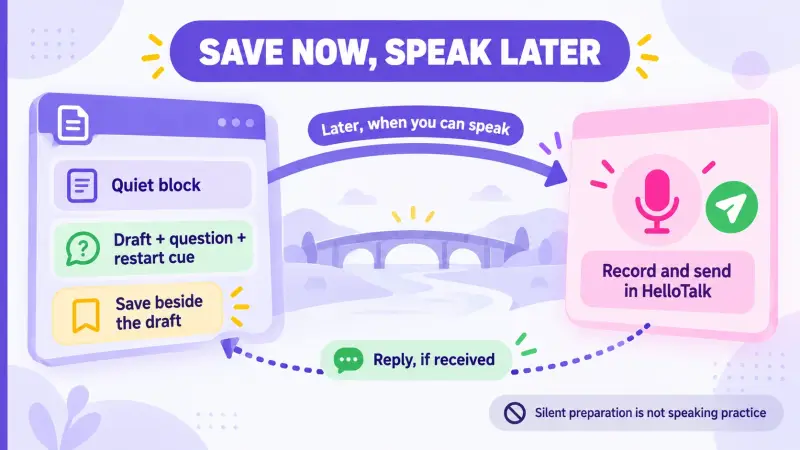
When you reach a place where talking is fine, a stairwell, a parked car, a walk between buildings, open that chat and record the saved sentence and question as a HelloTalk voice message, because the one thing a silent block cannot produce is another person hearing you and reacting. You can check the recording step in HelloTalk's FAQ on sending voice messages before the first time you try it.
HelloTalk's chat recording control sends a voice message to a partner, and nothing in the HelloTalk platform's voice message FAQ promises that a partner will answer. Sending it is an invitation. A partner can leave it, answer tomorrow, or reply to the question and ignore everything else you recorded.
A voice message is also not a call. Your partner hears the whole recording before saying anything, so the question goes at the end and one narrow request goes with it. In that same HelloTalk message, ask either about the wording, "would you say too salty here, or something else?", or about whether the recording was clear enough to follow. Those are two different answers, and a short single question is easy to reply to in one line and easy to decline.
If an answer comes back, keep it in the same notes file, beside the sentence it belongs to, so the wording travels with the message instead of sitting in a list you never reopen. If nothing comes back, the draft is unchanged and still sendable, later to the same partner or to someone else.
On days when you do have a room, a door, and more than ten minutes, this block is not the plan you need. The thirty-minute daily English speaking routine is built around blocks where you talk out loud, and the drafts from quiet days give those blocks something specific to say.
Check What You Could Say Without Reading the Draft
Before you record, close the notes and try to produce the message without them. In a silent place that means writing it again from memory and comparing the two versions. Where you can talk, say it once without looking. Recalling a line from memory shows the draft is available to you; it does not show how the spoken version lands with a listener.
Four outcomes are worth planning for. Read the first column as what just happened, the second as something to look at rather than a conclusion, and the third as one small next step, including the row that involves another person.
| What happened in the check | Something to look at, not a conclusion | One small next step |
|---|---|---|
| The sentence came back, the question did not | Compare your question with the line you read it from and see how much of it is your own wording | Rewrite the question shorter, in words you already use, and keep it with the draft |
| A word stopped you | Look at whether that word is hard to read, hard to say, or both | Mark it, then ask one HelloTalk partner what they understood from that word in your next voice message, because a listener can report what actually came across |
| A simpler sentence came out instead | Keep both versions and look at what the simpler one dropped | Record the simpler version and keep the longer one as reading material |
| The whole message came back from memory | This tells you the draft is available without notes, not that the spoken version works yet | Record it as a HelloTalk voice message to that partner when you have a place to talk, so someone can hear the spoken version, and leave separate time for a reply a willing partner may or may not send |
Row two is the one that asks a partner for feedback on a single word, and it works better kept small: one word, one context, one question. A partner may not answer, so treat it as optional. If an answer does arrive, save it next to the sentence rather than in a separate word list, then reuse that wording the next time the same situation comes up in a HelloTalk chat, so the correction stays attached to a message you actually send.
One partner's preference is also one person's preference. If the wording matters to you, ask again in a later conversation with someone else instead of turning a single reply into a rule about how a whole country speaks.
When the quiet part is done and you can talk again, HelloTalk is where the saved line stops being a draft and becomes something a person can answer.
Frequently Asked Questions
Does ten minutes of silent practice count as speaking practice?
No. A quiet block decides content: one sentence, one question, one marked word. Speaking practice starts when sound comes out of you, in a recorded voice message or a live call, and that part needs its own slot in your day.
What if I never get a quiet place to record?
Short recordings fit into smaller gaps than calls do, such as a stairwell, a parked car, or a walk between buildings. If even that is impossible this week, send the same sentence and question as text in your HelloTalk chat so the exchange keeps moving, then record it when a gap appears. Written turns keep a conversation going, but they are not the speaking part.
What should a restart cue actually say?
Name the next unfinished action and the detail it depends on. "Still deciding between salty and too salty, then write the question" puts you back on the line, while "weekend message" does not. Keep the cue in the same file as the draft so you only open one thing.
How long should the voice message be?
Long enough for one sentence about you and one question someone can answer, and short enough that your partner does not have to replay it to find the question. The length follows from that content rather than from a target number of seconds.
What if my HelloTalk partner never replies?
That can happen, and a HelloTalk voice message is an invitation the other person is free to leave unanswered. Choosing the message, saving the draft and sending it do not depend on a reply. Finding out what this particular person understood does depend on it, so that part stays open until someone actually answers. Keep the draft and reuse the sentence and question in your next exchange.
Can I use a course lesson instead of a chat message?
Yes. Take one line from the lesson as the two-minute source, then rewrite it as something true about you so it fits your next turn rather than the lesson's situation. The end of the block looks the same: a draft, a question, a marked word, and a restart cue.