
Check Russian Word Stress With Audio, Recording, and a Listener

If you need to know which word your sentence is supposed to contain, that is a dictionary job: check the meaning and the exact form. If you need to know what came through when you said it out loud, that is where a short recording sent to a willing HelloTalk partner helps. The confusion is specific: за́мок and замо́к are spelled the same in ordinary text, so moving the stress changes the word without changing a letter.
Check the Meaning and Word Form Before Marking Stress
Which word your sentence needs is settled by meaning, not by how it sounds. The Gramota dictionary lists за́мок and замо́к as separate entries: the first is a castle, the second is a lock. Russian writes за́мок and замо́к identically in ordinary text, so the stressed vowel, not the spelling, is what separates castle from lock. Choose the word before you think about the syllable.
The second check is the form you will actually say. Russian stress can move when a word changes case or number, so a dictionary headword does not always show where the stress falls in the form you are about to use. A Russian word stress reference lists дверь with в (на) двери́ next to о две́ри, which is why the practice line below is На двери́. Another dictionary allows a variant there, so treat this as checking your intended form, not as catching an error.
Stress is also a different question from whether a consonant comes out hard or soft, and the two are easier to check one at a time. This article stays with stress. If your real doubt is about softness, the hard and soft consonant practice set deals with that pairing on its own.
Compare Two Stress Patterns in Short, Meaningful Sentences
A single word is awkward to comment on, and it is not what you say in a conversation anyway. A short sentence gives you something speakable and gives a listener a meaning they can name. It cuts the other way too: the rest of the sentence can help someone work out the word you intended even when the stress slipped, which is a limit of this exercise rather than a score.
The two lines below were written for this article, not taken from a real chat. In the first, both words make sense, so the answer depends mostly on what reached the listener. In the second, a lock on a door is the likely reading, so the sentence itself can carry the meaning for them.
Settle the first three columns in a dictionary before you record. The fourth names the word that the other stress pattern would produce, which is a fact about the two words rather than a prediction about any listener. The last column is what goes out with the recording.
| Sentence to record | What it means | Stress you are checking | Word the other stress pattern would produce | What to send with it on HelloTalk |
|---|---|---|---|---|
| Я ви́жу ста́рый за́мок. | I see an old castle. | The first vowel, за́- | замо́к, a lock, which also fits this sentence | Send the recording as a HelloTalk voice message and ask, "Which word did you hear, castle or lock, and were you sure or guessing from the rest of the sentence?" You are asking because this sentence cannot tell them the answer by itself. |
| На двери́ но́вый замо́к. | There is a new lock on the door. | The second vowel, -мо́к | за́мок, a castle, which is an odd fit here | Send it in the same HelloTalk chat with, "Did the word for lock sound clear here, or did you work it out from the sentence?" The meaning is predictable in this line, so clarity is the useful thing to ask about. |
The acute marks in those sentences are a learning aid. Dictionaries and course materials print them so the pattern is visible, while ordinary Russian writing leaves them off. That is why the written line cannot settle the question, and why listening comes before you record your own version.
Listen to a Checked Reference, Then Record the Same Sentence
Checked here is something you do, not something that arrives pre-approved. Before you play a clip, know three things: which word it belongs to, which form of that word it is, and whether a person or a program produced it. Pages for homographs usually keep a separate entry for each stress, so an entry opened by accident teaches the wrong word with complete confidence.
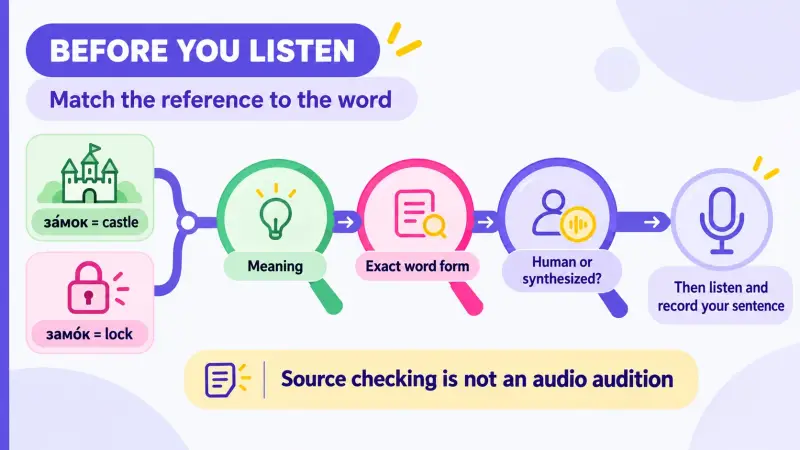
Audio on a dictionary page is not automatically a human recording: Gramota labels its playback as SaluteSpeech synthesized speech. That label tells you where a clip came from, not how it sounds or whether the stress in it is realized the way you need. Provenance is one check; listening to a clip that matches your exact word and form is a separate one.
Forvo keeps separate entries for the two stress patterns and names its Russian contributors. A contributor name tells you who uploaded an entry, not that the entry has been verified for your sentence, so open the one that matches the word and form you intend before copying anything.
Plan around one more limit. A single-word reference does not contain your sentence, so it can show you the word while the pace and the rest of the line stay your own work. Record the whole sentence anyway, because the whole sentence is what another person will listen to.
If you are still assembling references you trust for this language, the beginner Russian resource guide covers what is worth keeping in rotation. For this check, one matching entry and one recording of your own sentence are enough to move on.
Ask a HelloTalk Listener Which Word They Heard
Record that sentence as a voice message in a HelloTalk chat and attach one question about which word came through. HelloTalk's official FAQ on sending voice messages describes the recording control in chat. The reason to involve a person is that you cannot hear your own stress the way someone else does, and a dictionary cannot hear you at all.
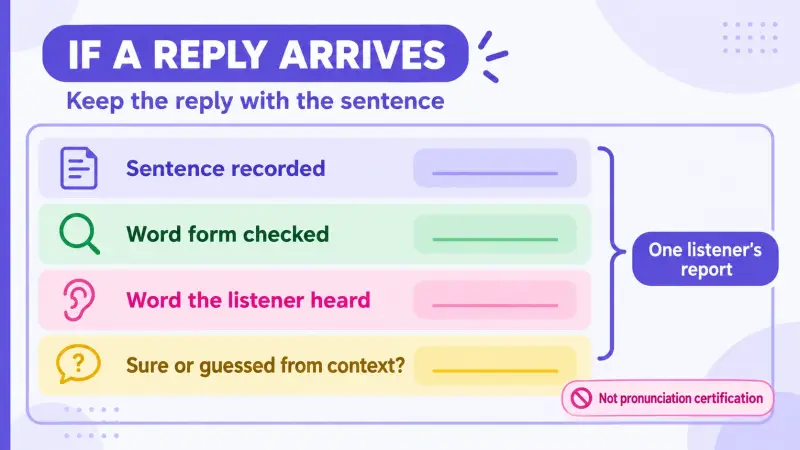
A listener can tell you which word came through in your recording, while a dictionary documents the standard stress for the form you intended, and neither one on its own certifies your pronunciation. Dictionaries sometimes list variants, and a teacher or an experienced speaker can explain why a form is stressed as it is. One reply is one person's impression, which is useful and limited at the same time.
A narrow question is easier to answer than a general request for correction. Something like: "Hi Emma, this is one short sentence. Which word did you hear, and were you sure? No need to correct anything else." Voice messages are asynchronous, so the other person hears the full recording and answers when they get to it, and the two of you can agree that comments come after each turn rather than during one.
Nobody is obliged to reply. The HelloTalk FAQ covers how to send a voice message, not a promise that an answer comes back, and the person you asked may be busy or may not want to judge pronunciation at all. Treat the question as an invitation that can be declined, and ask a different willing partner in a later chat if nothing arrives.
When an answer does arrive, save it with the material it belongs to: the sentence you recorded, the form you had looked up, the word the listener reported, and whether they said they were sure. That small saved set is what the next round compares against.
Recheck One Difference Before Changing Your Recording
Changing three things at once makes the next round unreadable. If the reported word was not the one you intended, recheck a single item first: the stress on the exact form you used. Reopen the entry, listen again to a reference that matches that form, then record the same sentence with nothing else altered.
An answer in your favour does not automatically close the question either, since the rest of the sentence may have carried the meaning. If both versions sounded similar to that listener, that is also not proof that stress played no part. The practical move is a follow-up question: did they identify the word clearly, or work it out from context? Then check one variable at a time, the form you looked up, the reference you compared against, and whether the recording itself was clear.
After re-recording, you can ask the same person one optional follow-up in that HelloTalk chat: "I recorded the same sentence again and changed only the stress. Did the word sound clearer this time, or about the same?" A before and after comparison from one listener on one item is easier to interpret than a fresh general opinion, and they are free not to answer.
Reach for a consonant explanation only when you have separate evidence for it, such as a correction that named a specific sound, rather than making it the default answer whenever stress work stalls. One response from one person is a report, not a diagnosis, and a second round usually says more than a theory does.
Two sentences and one question are enough for a round, and a second word pair can wait until this one is closed. Saving the repaired line matters for reuse: when that word turns up in a later HelloTalk message or voice note, you send the version you checked instead of guessing again, and the same listener already knows what you were working on. If you want one person's report on which word actually came through, record the sentence and send it in a chat on HelloTalk.
Frequently Asked Questions
How do I know whether my sentence needs за́мок or замо́к?
Meaning decides it, not sound. The Gramota dictionary lists за́мок as castle and замо́к as lock, in separate entries with different stress. Write the meaning you intend first, take the Russian form from the entry that matches it, and only then record.
Are stress marks written in normal Russian?
No. Dictionaries, textbooks and practice sentences print the acute mark so learners can see which vowel is stressed, while ordinary Russian writing leaves it out. That is why a written line cannot resolve a stress question on its own, and why a recording plus one listener adds something here.
Is the audio on a dictionary page a native speaker?
Not automatically. Gramota labels its playback as SaluteSpeech synthesized speech rather than a human recording, and that label describes where the audio came from, not how it sounds. If you want human audio, choose a source that names its contributors, such as Forvo, and confirm which stress entry you opened.
What if my HelloTalk partner never replies?
Your dictionary check is unaffected. The HelloTalk FAQ explains how to send a voice message, not that one comes back, and silence is not a verdict on your pronunciation. Ask someone else in a later chat, and keep the question to one word so it stays easy to answer.
Can one listener confirm that my pronunciation is correct?
One listener reports what they heard, which is not the same as certifying a standard pronunciation. People differ, and a single reply is not agreement among native speakers. Use a dictionary to establish the documented stress for the form you intended, and use the listener to learn whether that word carried across.
Do I need to check the stress of every form of a word?
Check the form you are about to say. Russian stress can shift with case and number, so the headword pattern does not always transfer. A stress reference lists дверь with в (на) двери́ alongside о две́ри, for example, while another dictionary allows a variant, so look up your specific form instead of assuming either way.
The listener heard the right word, so is the stress fine?
Not necessarily, because the rest of the sentence may have made the word predictable. Ask whether they identified it clearly or inferred it from context, then recheck one thing at a time: the form you looked up, whether your reference matched that form, and whether the recording was clear. Do not blame a consonant unless something specific points there.