
Correct Every Mistake or Talk First? Agree on Feedback in a Language Exchange

If this round is about getting a whole thought out, ask your partner to hold feedback until you finish. If you are checking one form, such as past tense verbs, ask them to flag it when that message lands. HelloTalk carries the request, the practice and the correction in one chat, but it cannot decide which errors are worth stopping for. So a fix for "go" comes back after the first of your three story messages, and the ending never arrives.
Decide Whether This Round Is for Fluency or One Accuracy Goal
Two rounds can look identical from outside. In one, you are telling someone what happened at a family dinner and the job is reaching the end of the story. In the other, you are checking whether five sentences about yesterday use past tense correctly. Fluency here means finishing what you wanted to say, not sounding native, and stopping breaks it. The accuracy round is the one where stopping is the point.
Teaching guidance published by the British Council treats immediate and delayed feedback as normal options and ties the choice to the activity, with freer meaning-focused speaking taking fewer interruptions and accuracy-focused practice taking feedback closer to the error. That is a classroom rule of thumb rather than proof that one timing suits every learner, so in a two-person exchange the choice stays with the two of you, and it only works if somebody says it out loud.
Look at what you brought to the chat. Came straight from a lesson or a pattern you just drilled? That is a target round. Want to tell a person something that actually happened to you? That is a fluency round, and when the story runs across several messages, every reply you stop to read is a thread you have to pick back up. Not every step needs another person either: checking whether a verb form exists is faster alone, while whether your message landed is something only a listener can answer.
If you are not sure which kind of practice this round even is, the overview of four ways to practice English speaking on HelloTalk sorts the main formats by what each one asks you to produce. The table below turns the choice into the sentence you are about to send. Read it across each row, and pay attention to the last column: naming what you are not fixing gives a well meaning partner a reason not to work through everything at once.
| This round's goal | What counts as a win | What to ask your HelloTalk partner for | What you are not fixing today |
|---|---|---|---|
| Tell a connected story or opinion | You reach the end instead of abandoning it | Nothing until I say I am done, then one or two points | Articles, small prepositions, accent |
| One grammar target, past simple for example | That form is right in most of your sentences | Flag that form as soon as the message lands | Word choice, fillers, word order elsewhere |
| One pronunciation target, a word you keep missing | A listener gets the word without asking you to repeat | Flag that word only, in your next reply | Grammar inside the same message |
| Getting used to voice messages at all | You press record and send it | No corrections this round, only "did that make sense?" | Everything else |
Each row is already most of a message. Turning it into one your partner can act on takes one more detail: what "right away" can actually mean in a chat.
Agree on One Feedback Request With Your HelloTalk Partner
"Correct my mistakes" sounds polite and sets no boundary. Your partner has to guess what counts as an error this round, so what comes back might be a screen of fixes, one small fix, or nothing at all. None of those versions tells you what to work on next.
On HelloTalk a correction is something a person does by hand: your partner long presses a specific message and chooses the correction option, sentence by sentence, as the HelloTalk FAQ on correcting messages describes. In this exercise, then, the timing you get is the timing the two of you agreed on before the practice started.
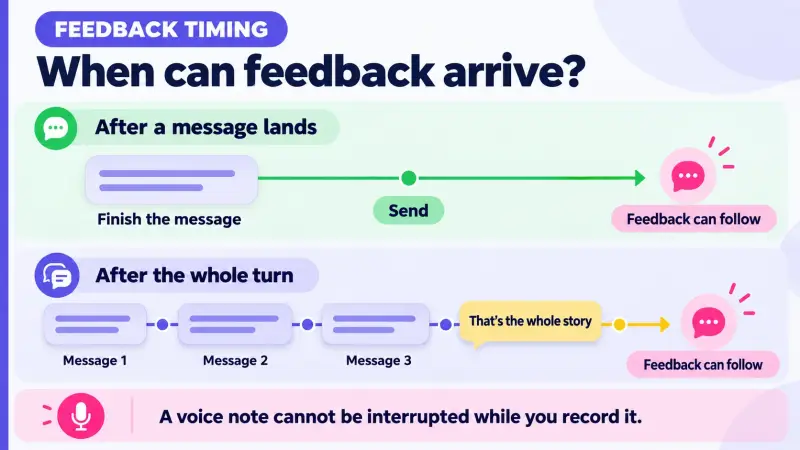
In a chat built on messages, nobody can cut into the middle of a sentence you are still typing or a voice note you are still recording, so the earliest a correction can arrive is after that message lands. "Flag it right away" therefore means "answer that message before I send the next one".
If your turn runs across several messages, the end of it is invisible to your partner. Finish with a short "that's the whole story" and treat that line as the signal to start marking.
Send the agreement before the practice, in the same chat, so the person deciding what to mark knows what counts as an error this round. A request that can be answered looks roughly like this, with a real name and a real task:
Hi Sarah, I want to practice telling a story in English, maybe ten minutes. Could you let me finish, then correct only the past tense verbs in my last message? Nothing else needs fixing today. Happy to do the same for your Spanish after.
The ten minutes is a budget you are offering, not a measured dose, so shorten or stretch it to whatever either of you has. If the point is speaking rather than typing, record the same turn with the microphone control in the HelloTalk chat and say the request out loud first, so the agreement sits next to the practice it governs; the HelloTalk FAQ on sending voice messages covers the recording step.
Ask for the correction itself in writing, because a written sentence is something you can copy into a later message. HelloTalk's own troubleshooting note says voice to text can be inaccurate when audio quality or language recognition is off, so a clean transcript is not evidence that your partner understood you, and a messy one is not evidence that your pronunciation failed.
Your partner may propose a different arrangement, or say nothing at all, and both are normal where time is being traded rather than paid for. A language exchange partner is not a teacher on call, so the request worth sending is one that fits inside a single reply and can be turned down without awkwardness. If you want more eyes on one sentence, posting that single sentence to Moments on HelloTalk puts it in front of other users who can apply the same correction action, with nobody obliged to answer.
See How Three Correction Agreements Change the Same Exchange
Here is one short message written for this comparison rather than taken from a real exchange. Picture it arriving as a single text or voice note, with the errors left in on purpose:
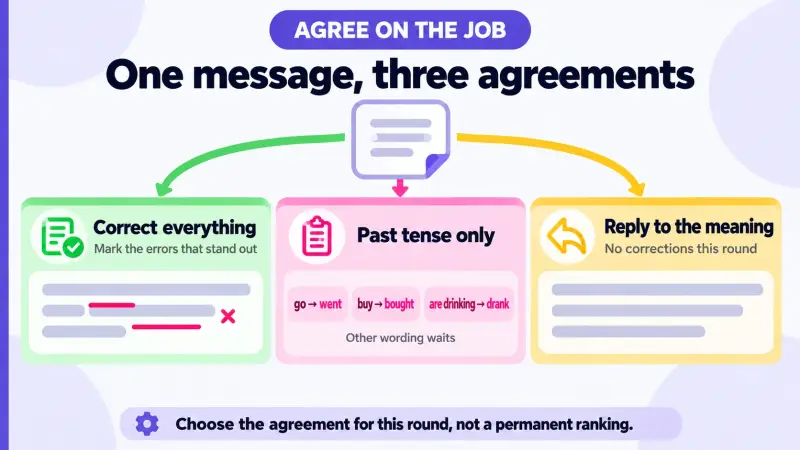
Yesterday I go to the market with my sister. We buy some fruit and after we are drinking coffee near the station. It was very nice.
Before reading on, do what is worth doing in a real chat: read your own message once and fix what you already know. If "went" and "bought" surface without help, a partner naming them is confirmation, which is a different job from teaching you the form.
Unlike a story spread across several messages, this one is a finished unit, so every version of the feedback below reaches you after your partner has already read the whole thing. The rows are constructed examples of what could come back in a HelloTalk chat under three agreements, not records of replies anyone sent. Read them as processes rather than a ranking.
| Agreement you sent before you started | What your partner might mark | What could come back to you | What that costs this round |
|---|---|---|---|
| Correct everything, as soon as it arrives | go, buy and are drinking, plus anything else that stands out, such as after used as a connector | Several separate fixes landing one after another once the message is read | Your next turn can get crowded out while you sort through them |
| No corrections today | Nothing; they reply to the content, which market, what fruit, who your sister is | A question you need to answer in English | All three verb errors go unflagged this round |
| Past tense verbs only, after I finish | go, buy and are drinking, rewritten as went, bought and drank | Three fixes that share one pattern you can name out loud | After as a connector stays in, on purpose, until another round |
Nothing here makes one row the correct default. The second row keeps a conversation moving, the third row is aimed at a specific habit, and alternating between them across a week is one way to get both without renegotiating every chat. One message, one target, a round you can end early: treat that as a shape to adjust rather than a schedule anyone has proven optimal.
The rows also assume you want feedback at all, and some days you do not.
Set a Boundary When You Do Not Want Corrections
Some days you want to say something to a person rather than file a sentence for inspection. "Today I just want to chat, no corrections needed" is a complete request on its own. Your partner still has plenty to do, because they can answer what you actually said, and you do not owe them a replacement task or a promise to collect the fixes later.
If you would like something back that is not a correction, you can add it in the same HelloTalk message, where the person who would otherwise be marking your sentences will read it:
Today I just want to chat, no corrections needed. If something I write does not make sense, tell me which part was unclear and I will say it another way.
That second line is optional. It asks whether the meaning landed rather than whether the grammar was right, which is useful on a day when you care about being understood and not about being accurate.
If corrections keep arriving anyway, you have more than one move, and none of them involves softening what you already said. You can restate it in one line: "I would rather skip corrections today, thanks." You can pause the conversation or end it. You can run your fluency rounds with a different partner on HelloTalk who is happy with that arrangement.
Moving the feedback to the end is a different choice, and it only makes sense if you actually want the fixes later. In that case say so and name the point: "Could you save them until I say I am done?" Do not offer that version as a polite way out of a boundary you meant, and do not count on any particular reaction either way.
The same boundary runs in the other direction, and that half is what keeps an exchange balanced. Before you start marking up their English, ask in the HelloTalk chat whether they want corrections on that message or just a reply, for the reason you wanted the choice yourself: David may be in a fluency round of his own, and corrections he did not ask for may not be what he wants from that chat.
When the two of you simply want different things, split the week instead of negotiating every chat. One partner who enjoys detailed grammar feedback and one who prefers long uninterrupted conversation can cover both kinds of round, as long as both are willing. Whichever way it splits, the round is not finished the moment a correction arrives.
Use One Agreed Correction in Your Next Reply
A correction you read and agreed with is easy to file away as done. The round closes when that form comes back out of you in a sentence you chose, in a situation the original correction never covered.
So spend one fix. "Went" from the market message goes into a different event two days later: "Last Friday I went to my cousin's place after work and we watched a terrible film." Send that line in the same HelloTalk chat and attach one question your partner can answer in a few words: "This is the past tense fix from Tuesday, does the first sentence sound right?" A narrow check like that fits inside one short reply from someone who is trading time with you. "Check my whole paragraph" is a bigger request, and it is fair for a partner to leave it or answer only part of it.
Keep the raw material where you will see it before the next chat. Copy the corrected sentence into your notes with the situation attached rather than as a loose verb list, and leave the original where it happened in the thread so the context stays with it. One correction carried forward per exchange, across two or three exchanges a week, is a shape you can adjust rather than a target anyone has measured.
The agreement itself is one or two lines, and it is the part that tells your partner what to do with everything that follows. Put yours at the top of your next chat on HelloTalk, then send the practice.
Frequently Asked Questions
Should corrections come during the conversation or after it?
Both are standard practice, so the useful question is what this round is for. Teaching guidance from the British Council presents immediate and delayed feedback as normal options, including the arrangement where errors are collected and discussed once the activity ends. If you are trying to produce a connected message, delayed feedback protects it; if you are checking one form you already studied, feedback close to the error is easier to connect to what you did.
How do I make sure corrections only come at the end?
Write it into the chat before you practice. In a HelloTalk chat, a correction is an action your partner takes on a specific message: they long press it and choose the correction option, one message at a time. So the thing that controls timing in this exercise is the agreement, with a line such as "please correct only after I say I am done, and only the past tense verbs". That sentence is what your partner actually acts on.
If I ask for corrections right away, can my partner interrupt a voice message?
No. A recorded voice message or a message you are still typing reaches your partner as a finished unit, so the earliest possible correction is a reply to that message. "Right away" in a chat means your partner answers the message before you send the next one, which is still much closer to the error than waiting until the end of a twenty minute conversation.
What do I say if my partner keeps correcting after I asked them not to?
You can restate the boundary plainly, in one line: "I would rather skip corrections today, thanks." You do not have to justify it or trade it for something else. If you do want the feedback but later, that is a different request and worth naming: "Could you save them until I say I am done?" If the corrections continue anyway, pausing the chat, ending it, or practicing fluency rounds with a partner who is comfortable holding feedback are all reasonable next steps.
Does asking for fewer corrections slow my progress?
Nobody can promise either direction from one arrangement. The tradeoff is that an error nobody mentions is one you have no information about, while a round full of interruptions may not get you to the end of a thought. Alternating, with some rounds held for feedback at the end and some built around a single form you want checked closely, is one way to avoid committing to either extreme.
How many corrections should I ask for in one exchange?
Ask for a number you can actually reuse rather than one that fills the screen, since one or two you plan to put back into a sentence are the ones that get used again. Naming the number in your request also tells your partner where the job ends, which matters when they are trading time with you rather than teaching you.
Should I correct my partner if they did not ask?
Ask first, in one short question: "Do you want corrections on this, or just a reply?" It is one line, and it gives them the same choice you wanted for yourself. Offering the same deal you asked for is also what keeps an exchange an exchange rather than a free tutoring request.