Beginner English Speaking: Four Practice Types and the App Each One Needs

There is a piece of advice every beginner receives within the first week: speak more. It is correct and almost useless. It does not say what speaking means when you cannot yet hold a sentence together, and it does not say which of the four very different activities hiding inside that word is the one you are currently missing.
A learner who freezes because no English word arrives needs something completely different from a learner who has the words, writes them fine, and still cannot get them out of their mouth. Both say "I need speaking practice," both install the same app, and one of them wastes three months.
This article splits beginner English speaking into four practice types, binds each one to the blocker it removes, and names the tool that runs it best. HelloTalk runs two of the four well and is the wrong choice for the other two, stated plainly below rather than buried. For the wider category view first, the comparison of the best English learning apps for beginners covers the market by app rather than by practice type.
Beginners Are Told to Speak More Without Being Told Where
The instruction assumes a room: somewhere a beginner can go, open their mouth, produce a broken sentence, and have something useful happen. For most learners that room does not exist. Their colleagues and family speak their first language, and the nearest conversation partner is a paid tutor they have not booked.
So the instruction gets converted into whatever is available, usually an app with a microphone button. The learner repeats sentences into a phone for six weeks, gets a score each time, and concludes that speaking practice is a thing you do alone with a device. Repeating a sentence you were just shown is a different cognitive task from producing a sentence nobody prompted, and beginners who only ever do the first one stay unable to do the second. That is a category problem, not a motivation problem.
The second failure mode goes the other way. A beginner books a conversation hour with a stranger while holding two hundred words, sits through forty minutes of silence, and concludes they are bad at languages. They attempted the hardest of the four practice types with none of the three that normally precede it. Neither learner did anything lazy. Both took one instruction that does not distinguish between four activities and picked at random.
Four Places Beginner English Speaking Actually Happens
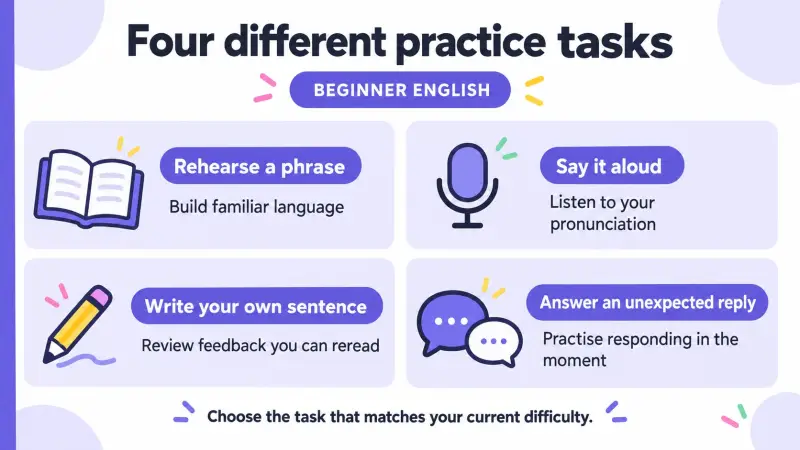
The four types are separated by two things: whether you are producing language or reproducing it, and whether anything comes back to correct you. A beginner needs all four eventually, in roughly this order.
Type one is scripted production. You are handed a sentence, a chunk, or a word pair, and your job is to get it into memory so it is retrievable later. Flashcards, spaced repetition, and app lesson trees live here. Nothing you say is original, because the point is stock, not performance.
Type two is solo spoken output with machine feedback. You say something out loud, alone, and software tells you which sounds were wrong. No human hears it, which is why beginners can do it daily without dread. Pronunciation and mouth mechanics get fixed here.
Type three is corrected written output. You write something that came out of your own head, and a real speaker of English marks what is wrong with it. It is slower and far more forgiving than speaking, and it is the only type where you see your own errors in a form you can reread.
Type four is the live unscripted reply. Someone says something you did not anticipate, and you have a few seconds to answer. Everything the first three types built is either accessible under pressure or it is not, and this is where you find out.
The four types are not four versions of the same exercise, they are four separate skills that fail independently, and a beginner can be strong in three of them and completely stuck in the fourth. That is why "speak more" is bad advice. It does not tell you which one you are missing.
The next three sections take the three most common blockers beginners describe and map each one onto the type that removes it.
When You Cannot Produce a Sentence Without Rehearsing It First
The symptom is precise. You can say "Where is the train station" fluently because you have said it forty times. Ask you where you went last weekend and nothing arrives, not because you lack the grammar, but because the words are not retrievable at speed. You recognise them on a page. They do not show up when needed.
This is a type one problem, and no amount of conversation fixes it. Sitting in a live call with two hundred retrievable words produces two hundred words of output and a lot of apologising. What fixes it is spaced repetition on chunks rather than single words.
Anki is the standard tool, because it schedules each card at the interval where you are about to forget it, which is the only moment review does anything. A beginner running a deck of two thousand high-frequency English chunks for twenty minutes a day will have a usable spoken stock inside four months. Quizlet does the same job with less setup and less control. Memrise and the Duolingo tree are prepackaged versions for learners who will not build their own decks.
The mistake to avoid is collecting single words. "Reluctant" as an isolated card gives you a word you cannot place in a sentence. "I was reluctant to ask" gives you a frame you can swap the ending on. Beginners who drill chunks rather than isolated words reach usable spoken output months earlier, because a chunk arrives with its grammar already attached. Emma spent three months on single-word cards and could name eleven vegetables while being unable to say she was tired. The deck was not wrong. The unit was.
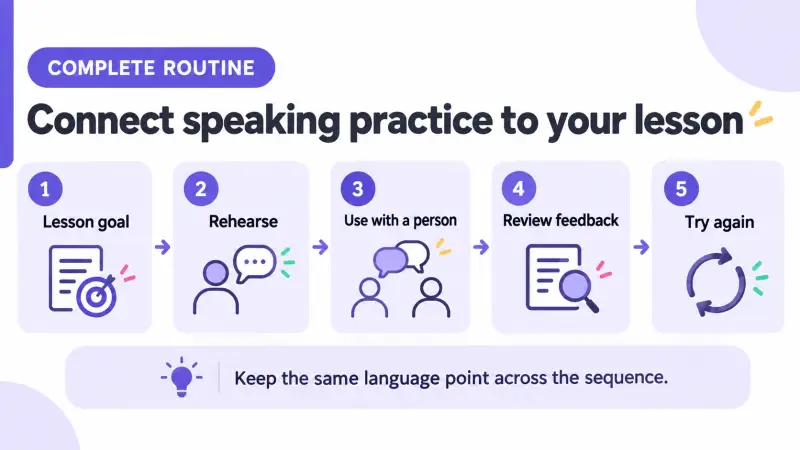
Make the vocabulary practice part of a wider routine. Learn a small set of useful chunks, use one in a HelloTalk message about your day, and add the revised sentence to your review. Keep early exchanges short enough that the words from the lesson are still doing the work; expand the task as your vocabulary grows.
When You Can Write It but Freeze Saying It Out Loud
A different learner has the opposite profile. Give them a text box and they produce a paragraph. Ask them to say the same paragraph and their throat closes. They have never heard their own voice making these sounds, they suspect it is wrong, and they have no way to check.
This is type two, the most solvable of the four because software is genuinely good at it now. ELSA Speak scores individual phonemes and names which sound in which word was off, a level of detail most human partners will not give you because it is tedious to interrupt someone eleven times per sentence. Speechling adds a human coach reviewing recordings. Pimsleur takes the audio-only route and builds mouth mechanics through forced recall rather than scoring.
What all of these share is that nobody is watching, and that matters more than the feature list. A beginner will record themselves thirty times in an empty room and will not attempt the same sentence once in front of a person, and those thirty repetitions are what makes the one attempt possible later.
HelloTalk covers part of this through its AI learning tools: AI pronunciation scoring that names the specific problem rather than returning a pass or fail, AI grammar correction delivered in real time with an explanation attached, and image translation for words you meet offline. That works as a check inside a conversation app, but it is not a substitute for a dedicated pronunciation trainer if phonemes are the actual blocker. David used pronunciation scoring for six weeks before speaking to anyone; the first conversation was still hard, but hard for reasons he could name.
When You Can Speak but Nobody Ever Corrects You
This is the plateau that looks like progress. You can talk, and you have been talking for a year. Your errors have been talking with you for a year, and every one is now automatic because nothing in your environment ever flagged them. The common version is a learner fluent in a private dialect of English that native speakers understand through effort.
Two practice types fix this, and they work at different speeds.
Type three is corrected written output, the gentler entry point. You write a few sentences about something real, a speaker of English marks what is wrong, and you can reread the correction as often as you need. HelloTalk's Moments feed is built for this: you post a short piece of writing publicly and multiple native speakers correct it, which surfaces error patterns a single tutor might let slide, and the same feed lets you read what native speakers post about their ordinary days. LangCorrect and Journaly run the same mechanic in a smaller pool.
Type four is the live unscripted reply, and it cannot be simulated. HelloTalk's chat carries in-chat translation and in-chat correction inside the message thread, so a partner can fix your sentence without leaving the conversation and you can look up a word without switching apps. HelloTalk's Voicerooms run around the clock as multi-person audio spaces you can enter as a listener before saying anything, which removes the hardest part of a first conversation, and HelloTalk's livestream sessions add small interactive classes on top. HelloTalk carries 70M+ registered users across 200+ countries and 260+ languages, with over 1 billion messages daily and 90% of core features free, and was named 2017 Google Play Best Social App before a 2024 global Google Play homepage feature.
Correction is the only mechanism that turns a spoken error into a fixed one, and a learner who speaks daily with nobody correcting them is rehearsing their mistakes rather than their English. Scheduled alternatives work differently: italki and Preply give you a booked hour with a paid teacher, structured and reliable but arriving on a calendar rather than at the moment you wanted to say something. For how the exchange model feels at the very start, whether HelloTalk suits beginners covers the first month specifically.
Two Practice Types People Combine Too Early
The most common sequencing error is running type one and type four at the same time, from day one. It looks sensible: you are building vocabulary with flashcards and also chatting with real people, so surely both are progressing. In practice, live conversation at two hundred words is a stress test you fail repeatedly, and failing it repeatedly teaches you that conversation is painful. Sarah quit twice before realising the problem was not her personality but that she was attempting type four with a type one deficit.
The threshold is roughly measurable. Once you can produce about eight hundred to a thousand chunks without rehearsal, live conversation becomes productive rather than punishing, because you have enough material to recover from a stall. Below that, the same conversation produces silence and a conclusion about yourself that is not true.
The second premature combination is type two with type four: fixing pronunciation while also holding live conversations. A learner actively rebuilding their vowel sounds gets contradictory input, because conversation partners optimise for understanding you and will not correct a sound they already parsed. Run the pronunciation work to a stable point first, then let conversation maintain it.
What does combine well early is type one with type two. Drilling chunks and saying them out loud with a scoring tool is the same material worked twice, and it roughly halves the time to first usable conversation. Type three slots in next, then type four, which never stops being necessary. For a feature-by-feature view, language learning apps compared handles the head-to-head.
Which One to Add Next, by What Currently Stops You
The table below is a routing device, not a ranking. Find the row that describes what actually stops you today, add only that practice type, and use the last column to decide whether it is working before adding anything else. Adding two at once makes it impossible to tell which one moved.
| What currently stops you | Practice type to add | Where it happens | Signal it is working |
|---|---|---|---|
| No English word arrives at all; you translate every sentence first | Type one, scripted production | Anki or Quizlet chunk decks, or a prepackaged tree like Duolingo or Memrise | You produce a complete sentence about your weekend without pausing to build it |
| You write fine but your mouth refuses; you avoid saying words you can spell | Type two, solo spoken output with machine feedback | ELSA Speak for phoneme scoring, Speechling for coached recordings, Pimsleur for audio-only recall | You read a paragraph aloud and can name which sounds you got wrong |
| You speak often and nobody has corrected you in months | Type three, corrected written output | HelloTalk Moments for multiple native corrections on one post, LangCorrect for smaller-pool review | The same error stops reappearing across three consecutive posts |
| You handle prepared topics but freeze when the reply is unexpected | Type four, live unscripted reply | HelloTalk chat with in-chat correction, and HelloTalk Voicerooms you can enter as a listener | You recover from a stall inside a sentence instead of ending the conversation |
| You need a syllabus, graded grammar, and a fixed order to follow | A lesson-led sequence that includes practice, feedback, and review | Follow the course objectives, apply each one in HelloTalk text or voice practice, and take unresolved questions into the next lesson | You can state which grammar point you are on and what comes after it |
The last row connects the other four practice types to a course sequence. Start with the lesson objective, rehearse the language, use it in HelloTalk, review the correction, and repeat the task before moving on. Correction is one part of that complete process, not a separate destination for learners who have already finished studying. HelloTalk's optional VIP tier comes as regional monthly, yearly, or lifetime options (see in-app quote).
Frequently Asked Questions About Beginner English Speaking Practice
How many words do I need before live conversation is worth attempting?
Roughly eight hundred to a thousand retrievable chunks, meaning phrases you can produce without rehearsing them. Recognition vocabulary is much larger and does not count. Below that threshold, conversations consist mostly of long silences, which teaches avoidance rather than fluency.
Can one app cover all four practice types?
No app covers all four well. Spaced repetition engines and pronunciation scorers are built for solitary drilling, and conversation platforms are built for unpredictability. Two apps that each do one thing properly beat one that does all four shallowly.
Is text chat real speaking practice?
It is type three, not type four. Text gives you the correction loop and sentence construction without real-time pressure, which genuinely transfers. It does not train retrieval under pressure, so it is a step before live conversation rather than a replacement for it.
What if I am too nervous to talk to a stranger in English?
Enter as a listener first. HelloTalk Voicerooms let you sit in an ongoing audio conversation without speaking, so you get used to the rhythm of real English before contributing. Most learners speak for the first time in their third or fourth room rather than their first.
Should I fix pronunciation before or after I start conversations?
Before, if pronunciation is what stops people understanding you. Conversation partners optimise for comprehension and will not correct a sound they already parsed, so errors that are merely understandable tend to survive indefinitely once conversation begins.
How long does each practice type take to show results?
Type two shows measurable change fastest, often inside three weeks of daily scoring. Type one takes about four months to build a usable stock. Type three shows up as fewer repeated errors across a month of posts. Type four improves in steps, usually after a conversation that went unexpectedly well.
Are language exchange partners as useful as paid teachers?
They serve different functions. A paid teacher gives structured explanation and a syllabus. An exchange partner gives volume, unpredictability, and availability at the hour you are actually free. A comparison of the best language exchange apps covers how the exchange model works in practice.
The First Reply You Were Not Ready For
Every beginner remembers the same moment. Someone asked a question that was not in the script, there was a gap of about three seconds, and something came out. It was not correct. It was produced rather than retrieved, and that is the only thing separating a person who speaks English from a person who is studying it.
The four practice types exist to make that moment survivable. Drilling gives you the material, pronunciation work makes it audible, written correction removes the errors before they set, and live conversation is where all three either hold or do not. Skipping the first three does not make the fourth arrive faster, and staying in the first three forever means it never arrives at all.
Work out which one currently stops you, add that one, and give it a month before adding another. When you are ready for the unscripted reply, start a conversation on HelloTalk and find out what you can already produce.