
German Learning Apps Compared by the Speaking Task You Need

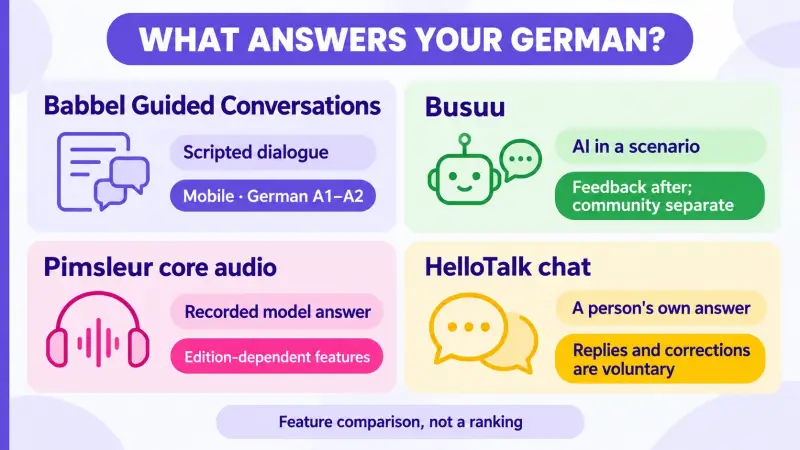
Pick by the speaking task you are stuck on, not by which German app is most popular. Babbel's Guided Conversations rehearse a scripted dialogue, Busuu's German course sequences lessons and its AI Conversations give feedback after the scenario, and Pimsleur's audio lessons have you answering aloud with no screen. When you can deliver a rehearsed breakfast line but stall at the reply you did not plan for, HelloTalk is the step where a German speaker answers your own question.
Quick Comparison: Babbel, Busuu, Pimsleur, and HelloTalk
This comparison is built from what each company documents publicly about the German feature named in each row, not from a hands-on trial run for this article. Read every row in three parts: what you actually say, what responds to it, and the access limit worth confirming before you give it a week.
If the question underneath yours is which material to use at all, the ranked guide to free German resources by need handles that layer. This page assumes you already have material and want to know which app makes you produce German out loud.
| App | What you actually say | What responds | Access limit to check |
|---|---|---|---|
| Babbel | Your side of a scripted German dialogue, recorded turn by turn in Guided Conversations | The script, which already supplies both sides | Documented as a mobile app feature, German listed at A1 and A2, and separate from Babbel Speak |
| Busuu | Course exercises in the German course, plus a full attempt at an AI Conversations scenario | Busuu's AI reacts inside the scenario and flags vocabulary and grammar once the dialogue ends; separately, German speakers in the community may respond to work you submit | Limited AI Conversations attempts before a qualifying paid plan; Busuu notes the AI can give incorrect answers, and no community reply is promised |
| Pimsleur | Spoken answers into the pauses of a core audio lesson | The lesson's own recorded response, which you compare your answer against | Lessons its German pages describe as about 30 minutes; review and speaking features depend on plan or edition |
| HelloTalk | A short German text or voice message holding a question only that person can answer, because you need a reply built from their situation instead of a script | Another user, who may answer and may long press your text message to send back a correction | No guaranteed reply or reply time; a correction happens when someone chooses to send one; HelloTalk notes voice-to-text transcription can be inaccurate |
What differs is what sits on the other end of the specific feature in each row. Babbel's Guided Conversations hand you a script that already contains both sides, and a Pimsleur core audio lesson plays a prompt followed by a response recorded in advance.
Busuu is two things at once here: the AI in AI Conversations does react inside the scenario before flagging vocabulary and grammar at the end, and the Busuu community is a separate human channel where German speakers may respond to work you submit. A HelloTalk message goes to one real person, and the answer comes out of that person's own situation.
Babbel: Rehearse a Guided German Dialogue
Babbel's Guided Conversations are a mobile feature that currently covers German at A1 and A2, and the practice is listening to a scripted dialogue and then recording your own lines. You open the Practice area in the app, choose a conversation, and work through it turn by turn.
That suits one specific problem. You recognize the words, you can read the sentence, and you still stall when a complete turn has to leave your mouth in real time. Rehearsal takes the planning load off, because the content is already decided and only the delivery belongs to you.
The limits are worth stating plainly, and they describe this exercise rather than everything Babbel offers for German. Babbel documents Guided Conversations as part of the mobile app rather than a desktop browser, which matters if you study at a laptop. It is also a separate feature from Babbel Speak, so a description of one tells you nothing reliable about the other. And a script cannot adapt: the moment you change your answer, the dialogue stops matching you.
Inside this exercise you are working on a line that is already written for you. It will not show you how an attempt you compose yourself holds together from beginning to end, and that is closer to what Busuu's German course is arranged for.
Busuu: Combine German Lessons With AI and Community Feedback
Busuu's German course runs from A1 to B2 with structured lessons, a pronunciation course and built-in revision, so it behaves like a syllabus rather than a drawer of exercises. If your German so far is assembled from scattered videos, this is the part that imposes an order on it.
Busuu lists German among the languages supported by its AI Conversations, and the vocabulary and grammar feedback arrives after the dialogue ends rather than during it. That timing describes AI Conversations specifically, not every exercise in the course. It fits a complete attempt: you say everything you planned to say, then review what was flagged. Busuu's own help documentation states the AI can give incorrect answers, so treat a flag as something to check rather than a verdict.
Access is the detail people skip. Busuu gives a limited number of AI Conversations attempts before continued use requires a qualifying paid plan, so it is worth deciding in advance which scenarios deserve those attempts.
The AI is not the only responder in the German course. German speakers in the Busuu community can give feedback on work you submit, which is a separate asynchronous channel rather than a faster or better version of the AI, and no community reply is scheduled or owed. Submit the exercise, then carry on practicing instead of waiting on it.
Both the lessons and the scenarios happen inside the app. If the free time you actually have does not include a block with an app open in front of you, the format itself has to change.
Pimsleur: Practice Responding to German Audio Prompts
Pimsleur's German course is audio led, with lessons its German pages describe as running about 30 minutes and built around recalling language rather than reading it. That figure is the stated length of a lesson, not a promised result. A prompt asks for something, you answer aloud into the pause, and the recording then gives you the response to compare yours against.
This format solves a scheduling problem more than a linguistic one. Speaking practice that needs no screen can happen while walking, cooking or commuting, which is often the only unclaimed half hour available. The tradeoff sits in the check itself: in this core audio practice you are measuring yourself against the lesson's recorded answer, not against what a person actually meant.
Two things are worth confirming before you lean on it. Which review and speaking features you get depends on the plan or edition you hold, and Pimsleur's German presentation varies between pages, so check what your own access includes rather than assuming.
After that, if you want to know whether a line you recalled this morning works on someone who is not following the script, put it into a HelloTalk message as a question one specific person can answer. The audio can confirm the wording, but only a person can tell you whether it suits the person in front of you.
HelloTalk: Ask a German Speaker a Question With a Personal Answer
On HelloTalk the task differs from the previous three: you send a short German text or voice message containing a question only the person you are writing to can answer, then you deal with whatever comes back. The reason to go to a person for this step is that the content of the reply has to come from their life, not from a script. A message like the one below gives them something concrete to respond to.
Hallo! Ich lerne seit zwei Monaten Deutsch. Ich esse morgens meistens Brot mit Käse. Was isst du morgens vor der Arbeit?
(Hello! I have been learning German for two months. In the morning I usually eat bread with cheese. What do you eat in the morning before work?) That is a constructed example written for this article, not a transcript of a real exchange.
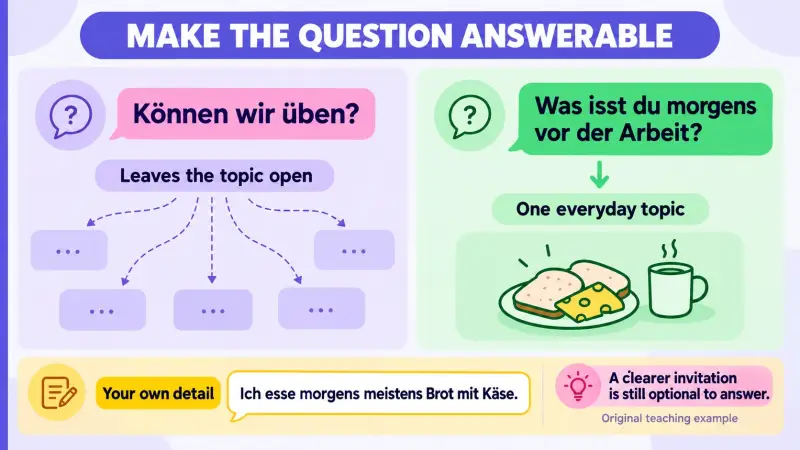
The final sentence sets the size of the request. A message ending in "Können wir üben?" leaves the whole conversation for the other person to invent, while a question about their own morning narrows what you are asking for to a sentence or two. Whatever comes back, if it comes back, is that person's routine, and no lesson script holds that.
If pronunciation is the worry, send the same content as a voice message instead. HelloTalk records and sends voice messages from the microphone control in the chat screen, as described in HelloTalk's FAQ on sending a voice message, and the reason to use it is that hesitation, stress and vowel length are audible in a way text hides. If audio comes back, remember that HelloTalk's own documentation warns voice-to-text transcription can be inaccurate, so read the transcript as a hint and listen again.
On HelloTalk, another user can long press a text message and send back a correction, so naming one sentence defines the scope of the request instead of leaving the whole message open. Ask for it directly: "Kannst du bitte nur den letzten Satz korrigieren?" (Can you please correct only the last sentence?) The long press and the correction options are described in HelloTalk's correction FAQ. If you sent the sentence as audio, send the written version too, because those options act on the text of a message and a recorded voice note is not something another user can edit word by word.
None of this is owed to you. A HelloTalk partner may be busy, may answer the question without touching the grammar, or may not reply at all, and an exchange partner is not a free teacher on call. Posting the same question to HelloTalk's Moments feed gives more people the chance to respond, and other users can run the correction action there as well, but it stays an invitation.
The loop closes when the correction goes back into your course work. Copy the repaired sentence into your notes or save the phrase inside HelloTalk, change one detail, and send it again in a new HelloTalk message or use it in the next lesson you rehearse, because putting it in front of a person is the only way to find out whether the repaired version holds up outside the exercise. One repaired sentence is a defined piece you can carry forward; a full rewrite leaves you deciding which part to keep.
Choose for One German Speaking Task, Then Check Access and Limits
Four apps for one language is more than most weeks have room for. Match your current blocker to one starting point and one thing to confirm before spending real time on it.
| Your current blocker | Start with | Confirm first |
|---|---|---|
| You know the words but freeze when a whole turn has to come out | Babbel Guided Conversations | That you will study on a phone or tablet, since Babbel documents this as a mobile feature |
| You have no syllabus and want one place that sequences German | Busuu's German course from A1 to B2 | How many AI Conversations attempts you get before a qualifying paid plan is needed |
| Your only free time has no screen in it | Pimsleur core audio lessons | Which review and speaking features your plan or edition includes |
| You can deliver prepared German but stall when the answer is not the rehearsed one | A short question in a HelloTalk message, because you need a reply built from a real person's situation rather than a recorded one | That your question is small, specific and answerable in one or two sentences |
Two of these at a time is an easier week to plan than four. One adjustable combination is audio prompts during a commute, then one evening HelloTalk message to a person that reuses a line from that lesson, so you find out how that line lands with someone whose answer is not recorded in advance. Another is rehearsal before exposure: run the scripted dialogue first, then send the unscripted version. Any session length you set is an adjustable practice budget, not a measured or prescribed dose.
The four features compared here are built around different speaking actions, so the decision is less about overall quality than about which action you currently cannot perform. If your constraint is cost rather than task, the comparison of DW Learn German, Duolingo and HelloTalk as a free stack answers that question with different candidates. To see how the message, voice note and correction steps sit together before you try one, look at HelloTalk.
Frequently Asked Questions
Which German app should a complete beginner choose first?
Start with whichever one matches what is actually stopping you. If you have no structure, Busuu's German course runs A1 to B2 and will sequence the material for you. If you have structure and freeze when speaking, a scripted rehearsal in Babbel's Guided Conversations at A1 or A2 is a narrower fix. Sending one short question in a HelloTalk message is possible earlier than many beginners assume, as long as the question is small and answerable.
Does Babbel's Guided Conversations work on a laptop?
Babbel documents Guided Conversations as a feature of the mobile app, reached through the Practice area, so plan on a phone or tablet for that specific exercise. It is also a distinct feature from Babbel Speak, so the availability of one does not tell you anything definite about the other.
Does Busuu give feedback from real German speakers or only from AI?
Both channels exist and they are separate. Busuu's AI Conversations supports German and returns vocabulary and grammar feedback at the end of the dialogue, and Busuu's help pages note the AI can give incorrect answers. German speakers in the Busuu community can also respond to exercises you submit, though no community reply is guaranteed or scheduled.
Is Pimsleur enough on its own for speaking German?
The core audio lessons compared here cover one part well: answering aloud from memory with no screen, in lessons its German pages describe as about 30 minutes. What those lessons do not do is react to a sentence you invent yourself, and which other features your plan or edition includes is a separate thing to check. For a reaction to your own wording, send a short question to a person on HelloTalk, since the answer then comes from them rather than from a recording.
How do I ask for a correction on HelloTalk without getting my whole message rewritten?
Name the target inside the message, for example "Kannst du bitte nur den letzten Satz korrigieren?" (Can you please correct only the last sentence?). HelloTalk's correction options are reached by long pressing a message and act on its text, so send the written version if you recorded the sentence as audio. The narrow request keeps the scope to one sentence instead of leaving the whole message open.
Will a German speaker reply if I send a message?
There is no guarantee of a reply or a reply time, on any platform. A specific question about someone's own routine is a smaller thing to answer than a general request to practice, but nothing obliges anyone to respond. Send your question to more than one person on HelloTalk, or post it to Moments where other users can also respond or send a correction, and keep practicing while you wait.
Can I use a course app and HelloTalk in the same week without running two separate courses?
Yes, if the two share material. Take a sentence pattern from the lesson you already completed, build one HelloTalk message on it so a real person responds to your version of it, and bring any correction back into your next review. The added time is whatever the exchange itself takes, which depends on how much comes back, so treat it as variable rather than fixed.