
Grammatically Correct but Too Direct? Check Tone in a Real Conversation

If your sentence is already grammatical, the open question is usually how it reads to the person receiving it. Grammar guidance narrows the options; a reader can say how your wording lands in the context you give. You might type "Can you send me the notes?" to a classmate you have met twice, then delete it three times. HelloTalk covers one step: you hand a partner the relationship and the situation, then ask which version sounds more like a request.
Separate a Grammar Problem From a Tone Mismatch
The two problems need different kinds of checking. A grammar doubt has a checkable answer: a reference or a correction tells you whether the form is possible at all. A fit question has published guidance too, but what no general source covers is how one particular reader takes your exact sentence in the situation you are writing into.
If your own English draft leaves you unsure about grammar or spelling, AI Grammar is one optional check. How a well formed sentence reads in a given situation is the other kind of question, and it is the one this page takes to a HelloTalk partner.
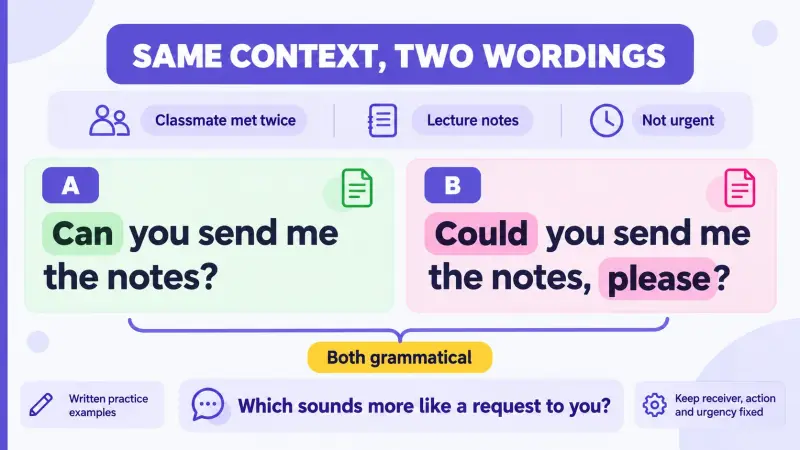
"Can you send me the notes?" and "Could you send me the notes, please?" are both grammatical requests, so choosing between them is a question of fit rather than correctness. Both use a modal followed by the bare infinitive "send". The British Council's grammar reference sets out request forms that differ in politeness and directness, and the "could" version carries more conventional softening.
Direct wording is not automatically rude, since British Council writing guidance on giving instructions treats plain phrasing as appropriate when the instruction matters. So "Move your bag, please." is not an error waiting to be deleted. It is one option, and whether it suits depends on who you are talking to and how ordinary the request is.
Before asking anyone for an opinion, pin down three details: who receives the message, what you want them to do, and whether anything is urgent. Those details turn a vague worry into a question someone can answer about your sentence instead of about English in general. They also keep this small check separate from the wider work of making yourself understood while you are still learning the language.
Compare the Same Request in Two Different Relationships
A wording comparison is only interpretable when the action, the receiver and the urgency stay fixed and the sentence is the only thing that changes. If you rewrite the line and move the situation inside the same question, any answer leaves you guessing which change produced the impression.
So run one relationship at a time. Pick the context closest to a message you actually need to send, compare the same Version A and Version B inside it, and only afterwards, if you still want to know, ask about the second relationship as a separate comparison using the same two sentences.
The table holds two ordinary, non-sensitive requests steady and sets out the two wordings, the contexts that make each pair interesting, and the one question to carry into a chat. Both requests are written practice material, not a record of any conversation.
| Everyday request | Version A | Version B | Contexts worth comparing (one per round) | One question for a HelloTalk partner |
|---|---|---|---|---|
| Asking for shared class notes | Can you send me the notes? | Could you send me the notes, please? | A study partner you message every week, or a classmate you have met twice | In HelloTalk chat, state the one context you picked, send both lines, and ask which sounds more like a request to them and which word creates that impression, because a reader can only judge the pair against the single situation you describe |
| Asking someone to move a bag off a shared seat | Move your bag, please. | Could you move your bag, please? | A familiar study partner, or a stranger at a shared library table, with nothing urgent in either case | Give the HelloTalk partner the same action and the same unhurried situation you picked, then ask whether Version A reads as normal or abrupt to them there, because a reading collected under a different urgency would not answer this one |
In the first row, both versions use a modal with the bare infinitive "send". In the second, Version A is an imperative with "please" and Version B is an interrogative request. None of the four lines contains a mistake, which is why the decision has to come from the situation. What the table cannot supply is the context you hand over, so that is the next step.
Give a HelloTalk Partner the Context and Ask One Tone Question
A tone question becomes answerable once the receiver, the action and the urgency are attached to it. Keep the request to one judgment as well. If you ask someone to correct everything, the reply can cover anything in the message, and the choice you were worried about may never come up.
Here is one way to package it as a chat message in HelloTalk, where the partner is also learning your language and can see both versions on one screen:
Quick English question if you have a minute. Context: a classmate I have met twice, nothing urgent, I want their lecture notes. Version A: Can you send me the notes? Version B: Could you send me the notes, please? Which one sounds more like a request to you, and which word changes that impression? No need to fix anything else.
HelloTalk's chat carries the same pair as text or as a recorded voice message, and HelloTalk's official FAQ describes the sending step without promising that anyone will reply. A voice message is recorded and sent whole, so a partner responds after listening rather than in the middle of your sentence.
That makes voice worth using when your doubt is about how the line lands when spoken rather than how it reads. The HelloTalk FAQ on sending a voice message covers the recording step itself; whether a partner answers, and how fully, is their choice.
Send it inside an exchange rather than as a standalone quiz. Someone working on your language has a reason to answer and a reason to ask you something similar later, though answering is an invitation they can decline, and some messages will go unanswered.
Recheck the Context When Two People Prefer Different Wording
If two partners answer differently, that is not a sign that one of them misunderstands English. The first thing worth checking is whether both read the same situation, because a missing detail about urgency or closeness quietly changes the message they were judging.
The three replies below are written as examples of what a partner might say, not answers anyone gave. Each row sorts what that wording would support, what it would not, and the one follow-up worth sending. Use the row whose wording matches what you were told.
| Possible reply | What that answer can support | What it cannot support | Next check to run in HelloTalk chat |
|---|---|---|---|
| "Version B sounds friendlier." | This reader found the "could" and "please" version more softened in the context you described | That Version A would have bothered the actual classmate, or that B is the safer pick in general | Ask the same HelloTalk partner the identical question with only the receiver changed to someone you message daily, and say it is a second comparison, because you want their reading of the new relationship rather than support for the first answer |
| "Both sound fine to me." | Neither version stood out to that reader in the situation you gave | That both would pass unnoticed in a first message to a stranger | Send the second context to the same HelloTalk partner with the two sentences unchanged and the same single question, because that gives you a separate reading instead of stretching the first one |
| "Version A is normal, B sounds stiff." | This reader found the extra softening unnecessary for the receiver and situation you described | That politeness markers are pointless in English requests, or that your original line was impolite | Ask that HelloTalk partner which word produced the stiff impression, because one named word is something you can change in the next message instead of rewriting the whole thing |
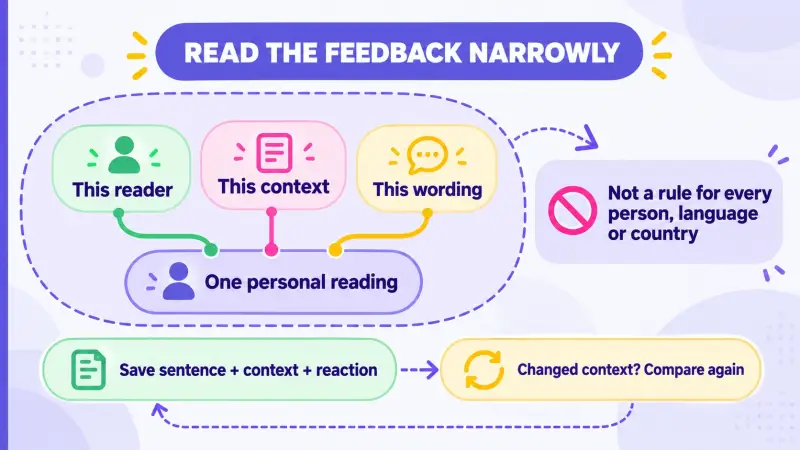
One partner's answer is evidence about how that person read the context you supplied, not a rule about a language, a country or the person who will actually receive your message. A second partner agreeing adds a second reading. Two partners differing shows that readers vary on this wording; it does not by itself locate a regional difference.
For the wider question of how cultural context shapes conversations across languages, cross-cultural communication in language learning covers more ground. This page stays with one request and one message.
Revise the Message Without Turning One Preference Into a Rule
Change only the wording the feedback named, and leave the action alone. If a partner pointed at "please", or at the switch from "can" to "could", edit that and stop. Rewriting the whole message around one comment removes the thing you were comparing and leaves nothing comparable for next time.
Save the sentence together with the situation it belongs to, because the sentence alone is hard to place later. A note like "first message to a classmate I have met twice, nothing urgent: Could you send me the notes, please?" tells you when it applies. Keeping it with the rest of your phrase work fits the kind of routine for practising communication in a foreign language you may already run.
Reuse it where the saved context matches: similar closeness, a favour of similar size, the same absence of urgency. That is trying the wording again in a comparable situation, not carrying a confirmed result forward, since the people in the next exchange are not the partner who read it.
When the request becomes urgent, consequential or tied to authority at work, write the new context out and run a fresh comparison with a partner in HelloTalk, because the wording that suited a classmate was never read against that setting.
If you want somewhere to run this check with people who are learning your language in return, HelloTalk is where the two versions and the single question can go.
Frequently Asked Questions
How do I know whether my message has a grammar problem or a tone problem?
Look at what kind of answer the doubt needs. If a reference or a correction can tell you whether the form is possible, it is grammar. If the sentence is well formed and your worry is whether it suits this receiver in this situation, published guidance narrows the options, and a reader who has been given that situation can tell you how your wording reads to them.
Is "Can you send me the notes?" rude in English?
It is a grammatical request, not an error. The British Council's grammar reference describes several request forms that differ in politeness and directness, so "could" plus "please" reads as more conventionally softened while "can" remains a normal request. Whether the shorter version fits depends on the relationship, the size of the favour and the urgency.
What exactly should I ask a language partner about tone?
Give the receiver, the action and the urgency, show both versions, and ask one question in HelloTalk chat, such as which version sounds more like a request to them and which word creates that impression. The narrow question is what keeps the reply attached to your message, while a bare "is this polite?" leaves the partner free to answer about English in general.
What if nobody answers my tone question?
That can happen. HelloTalk's official FAQ describes how to send a text or voice message in chat and does not promise a reply. Keep the saved pair and its context, raise it inside a normal exchange with a HelloTalk partner rather than as a standalone quiz, since you are asking for a favour, and in the meantime use the version that matches the guidance you already have.
Two partners gave me opposite answers. Who is right?
Possibly both, each for the situation they pictured. First confirm that both were given the same receiver, action and urgency, because people often answer about a slightly different message. If the context really was identical, you have two personal readings, which tells you readers differ on this wording rather than establishing a rule for a region or a language.
Can I reuse the version my partner preferred in every situation?
Reuse it where the saved context matches: similar relationship, similar favour, similar urgency. A preference from one or two readers is not a check against every future recipient, so when the request becomes urgent, consequential or involves authority at work, compare again instead of carrying the old line across.
Should I ask about tone by text or by voice?
Text suits differences that live in the words, since the partner can see both versions side by side. HelloTalk's chat also has a recording control for voice messages, which fits cases where you want someone to react to how the line sounds spoken; the recording is sent whole, so any comment comes after listening. Sending the text pair plus one short recording lets a partner reply in whichever form is easier for them.