
After a Nicos Weg Lesson: Use One Scene in a Real German Exchange

If you can introduce yourself in German after one Nicos Weg A1 lesson but stall the moment someone answers in words the scene never scripted, the next step is one short exchange with a person. Deutsche Welle's course keeps the teaching order and the sentence patterns. HelloTalk is where you send that introduction to someone, ask one thing they can answer from their own life, and request a check on a single sentence.
Start With the Introduction Scene in Ich heiße Emma
The lesson to use is the one labeled (1) Meeting people in Nicos Weg A1, titled Ich heiße Emma. The characters in it practice introductions, and the published material for the lesson covers both the informal and the formal way to ask someone's name. You need those two patterns, not the plot.
Read the script and the vocabulary list, then mark exactly two things: the sentence that states a name, and the question that asks for one. Deutsche Welle publishes the script and vocabulary for Nicos Weg A1 lesson (1) Meeting people, Ich heiße Emma, as a downloadable document, so those sentence patterns stay available to reread without replaying anything. Deutsche Welle also publishes a teacher's handout with exercises for the same lesson, which is worth having if you want more drilling first.
A scripted lesson scene can teach you how to introduce yourself, but it cannot supply the one thing a conversation needs: an answer written by someone who did not read the script. That is not a flaw in the course. Nicos Weg does the job it was built for, and it earns its place among free German resources ranked by what you actually need. The part left to you is turning Emma's details into yours.
Replace the Characters’ Details With Information You Choose to Share
Keep the pattern and change the details. Where the lesson gives a character's name, put the name you are willing to use with strangers, a first name or a nickname: Hallo, ich heiße Alex. Wie heißt du? That line is a beginner pattern written here with an invented name rather than a quotation from the lesson, and it is the whole opener.
You are choosing what to share, not completing a form. A first name or nickname, a city you are comfortable naming, and one everyday detail are enough. A full legal name, your address, your employer, or your school are not needed for a language exchange, and they can stay private.
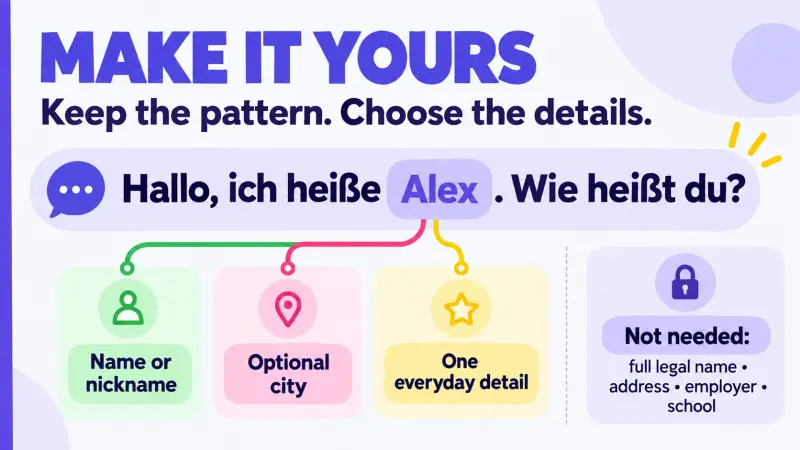
One grammar point decides whether the swap holds together. The du in Wie heißt du? is informal and singular, and the same lesson also presents the formal way to ask a name. Pick one register for one exchange and stay inside it instead of switching halfway through a message; every example here uses the informal du.
For the detail sentence, reuse a pattern you have already practiced in the course rather than building a new sentence out of a dictionary, because you want a line you can repeat from memory when a reply lands. If you want to see where a single lesson sits inside a longer plan, a free German roadmap from beginner to conversational lays out the sequence.
Send a Short Introduction and an Answerable Question on HelloTalk
Your first message has three parts: who you are, one detail, one question. Send it in a HelloTalk chat to someone who is learning your language, because this step needs an answer nobody wrote in advance, and that person has a reason to write one: you can check their sentence in your language the way they check yours.
Two to four sentences is a workable first message, and that is a practice arrangement you can adjust rather than a measured standard. A question is answerable when the other person can reply from their own situation in one or two sentences without preparing anything first.
Voice or text both work for the first send. HelloTalk's chat has a microphone control that records and sends a voice message, which gives the other person your pronunciation to react to. A text message is easier for a partner to mark up line by line, since a written sentence can be corrected directly. Neither format makes a reply appear.
The table below separates the three parts that go out first from two lines that belong later in the same chat. Read the third column as timing: the opener stands on its own, while the last two rows wait for something to react to.
| Part | What you send on HelloTalk | When it goes out | Why this part needs a person |
|---|---|---|---|
| Greeting and name | A text or voice message opening with Hallo, ich heiße Alex, using the name you are happy to use publicly | In the first message | The greeting that comes back is the first thing in the exchange that was not written for you |
| One detail you chose to share | One sentence you have already practiced, carrying your own city, job, or subject | In the first message | It gives the other person something concrete to compare, so the reply is about their life instead of the lesson |
| The question | Wie heißt du? or another question they can answer from their own day | In the first message, as the last line | A scripted scene comes with its own answer already written in; a person answers from their own situation, and that reply is where you see whether your question was understandable |
| An optional feedback request | One line asking for a check on one sentence, for example whether your name sentence sounds natural | Optional, and easier to place after a reply than in a cold opener | A language partner is another learner, not a hired teacher, so a request this small is one they can accept or decline without much effort |
| A repair line, held in reserve | Kannst du das bitte wiederholen? | Only after a reply arrives that you cannot follow | It asks the other person to send that turn again, so one unclear message does not end the exchange |
Silence after a message is common. No single quiet chat tells you much about your German on its own: hard-to-follow wording can make a reply less likely, and so can time zones, a crowded inbox, or plain chance.
So spread the attempt. Send the same introduction to two or three people on HelloTalk rather than waiting on one chat, and consider posting a short self-introduction to Moments, since HelloTalk's public feed shows that post to other users and anyone who wants to can reply or use the correction action on it. Nobody owes you an answer.
Follow the Reply When It Does Not Match the Lesson
The exchange below is written for this article. It is not a transcript of a real chat and not a quotation from the lesson. Read it as what a HelloTalk chat looks like one turn at a time once your introduction has gone out: your name question gets answered, and then something arrives that the scene never prepared.
You: Hallo, ich heiße Alex. Ich wohne in Toronto. Wie heißt du? (Hello, my name is Alex. I live in Toronto. What is your name?)
Them: Hallo Alex! Ich heiße Jörg. Ich wohne in Hamburg. Kennst du Hamburg? (Hello Alex! My name is Jörg. I live in Hamburg. Do you know Hamburg?)
You: Nein. Kennst du Toronto? (No. Do you know Toronto?)
The third line is the move worth copying, and it is deliberately small. Kennst du Hamburg? is sitting on your screen inside Jörg's message, so you answer the part you understood with one word and send that same question back with one noun changed: Hamburg becomes Toronto. The verb form stays exactly as he wrote it, so the turn needs no grammar you have not met.
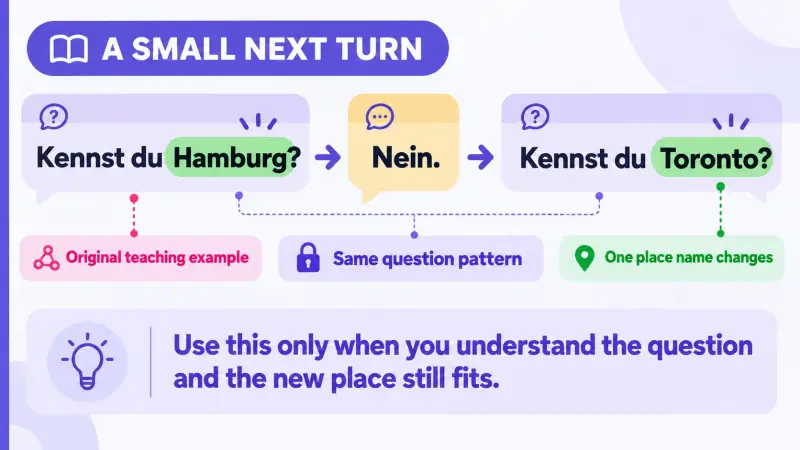
Jörg is a constructed partner, not somebody's real message. The swap holds here for a narrow reason: you already understand what Kennst du Hamburg? is asking, and the question still makes sense with a different place name in it, so the sentence pattern can stay exactly as he wrote it. That will not be true of every question you can read, so check that the new word still leaves a sensible question before you send it back.
Names are the common snag, and the useful question depends on the channel. If the reply is text, the name is already on your screen, so asking how it is spelled changes nothing; what you are missing is the sound, and Wie spricht man deinen Namen aus? asks for that. HelloTalk's chat accepts a voice message as a reply, so you can say you would like to hear it, and the other person can record the name or leave the request alone.
If the reply came as a voice message and the name went past you, the opposite applies. Wie schreibt man deinen Namen? asks how it is written, and Kannst du das bitte wiederholen? asks for that turn again. Send whichever one you need as your next message in the same HelloTalk chat, since the person who recorded the name is the one who can say it again.
One thing not to expect: a recorded message is already finished when it reaches you, so neither line interrupts anything. They go out as your next turn, and the two of you simply agree, in practice, to sort out unclear parts when each message lands. The second phrase asks for a repeat, not automatically slower speech, so say that separately if slower is what you need. All of these are support phrases written for this exercise, and deinen Namen is the accusative form that belongs in both name questions.
HelloTalk's correction action runs only when a person chooses it: someone long-presses a message and selects the correction option, so a reply with no correction in it is normal and is not a verdict on your sentence. HelloTalk's FAQ on correcting messages describes that long press and the Correction, Correct Sentences, and Edit options. Keep any request to one item, such as whether your name sentence sounds natural or whether your question was clear. The other person can do it, skip it, or say no.
Then offer the same thing back inside that HelloTalk chat: long-press the line your partner wrote in your language, correct one point, and name the point you checked. Doing it in the same thread is what makes this an exchange rather than a favour, and a partner who gets something usable has a reason to keep writing. Nicos Weg supplies the pattern and the order; the other person supplies a response that belongs to your sentence and nobody else's.
Reuse One Useful Phrase in Your Next Introduction
Keep one line, not the whole conversation. It might be the corrected version of your own sentence, a phrase your partner used that you understood immediately, or the question that got you past an unreadable name. The checkable result of this round is narrow: one line you can send to a different person from memory, without opening the course page.
Store it where you will see it before the next message. HelloTalk's chat includes a way to save phrases, and a note on your phone holding the line plus the situation it fits does the same job. What matters is that the line stays attached to a moment you can recognize again instead of being buried in a long vocabulary list.
Then use it. Open a HelloTalk chat with a different person, put the saved line into the opener, and change one detail and one question, because sending it where the reply is not predictable is the specific check this round sets up: either the line comes out from memory and gets an answer, or you find out which part you still have to look up.
If you want this to become a weekly habit rather than a one-off, a routine for German speaking practice with native speakers covers how to keep partners and corrections going over time, while Nicos Weg keeps handing you the next scene to convert. If the lesson is done and there is nobody to send the introduction to yet, HelloTalk is where the chat side of this loop starts.
Frequently Asked Questions
Which Nicos Weg lesson does this exercise use?
Nicos Weg A1, the lesson labeled (1) Meeting people and titled Ich heiße Emma, in which the characters practice introductions. Deutsche Welle publishes a script and vocabulary document and a teacher's handout with exercises for that lesson. Reading the script is enough for this exercise; you do not have to work through the exercises first.
Do I need to finish Nicos Weg A1 before messaging anyone?
No. This exercise runs on one lesson's patterns: a sentence that gives your name and a question that asks for one. The course keeps the teaching order and will keep adding grammar you have not met yet, while the exchange only needs the part you can already say without looking at the page.
How long should the first message be?
Two to four sentences works: a greeting with your name, one detail you chose to share, one question. Treat that as a practice arrangement you can scale up or down rather than a fixed rule. Short messages are easier for a stranger to answer and easier for you to repeat from memory next time.
Should the first introduction be text or a voice message?
Either. HelloTalk's chat has a microphone control that records and sends a voice message, which gives your partner your pronunciation to react to. A text message is easier for a partner to mark up, because a written sentence can be corrected directly. Neither format guarantees a reply or when one arrives.
The reply has a name I cannot pronounce. What should I ask?
It depends on how the name reached you. If it is written in a text message, spelling is not the gap, so ask for the sound with Wie spricht man deinen Namen aus? and say you would like to hear it, since HelloTalk's chat accepts a voice message as a reply. If you missed the name inside a voice message, Wie schreibt man deinen Namen? asks how it is written.
What if nobody answers my message?
It happens often, and one quiet chat on its own does not tell you much about your German, since timing and inbox volume matter too. Send the same short introduction to two or three people instead of waiting, and post a short self-introduction to Moments so HelloTalk's public feed shows it to more users. Answering other learners' questions in your own native language is the other half of a language exchange.
How do I ask for a correction without treating my partner as a teacher?
Name one line and one question about it: whether the name sentence sounds natural, or whether your question was clear. On HelloTalk the other person corrects by long-pressing a message and choosing the correction option, so the request has to be small enough to be easy to accept or decline. Offer the same check on their sentence in your language.
Should I use du or Sie with a new language partner?
The lesson presents both the informal and the formal way to ask a name, and the examples here all use the informal du, as in Wie heißt du?. The practical rule for a single exchange is consistency: choose one register and stay in it. If your partner opens with the formal form, match it instead of mixing both inside one message.