Best English Conversation Apps in 2026: Where You Actually Get to Talk

You open your English app after work, ready to practice. Twenty minutes later you have matched four pairs of words, filled in six blanks, and heard a cheerful chime tell you that you are doing great. But you have not said a single word out loud. Your thumb is tired. Your English is not any more ready for the meeting you have tomorrow, where you will have to speak in real time to real people who do not wait for you to tap the right answer.
This is the quiet problem with most English conversation apps: they are not conversation apps at all. They are quiz apps with a friendly interface. Real conversation means talking to a person who responds unpredictably, corrects you, and does not slow down to a multiple-choice pace. This guide compares the apps that actually get you talking, explains what "conversation" should mean when an app claims to offer it, and helps you pick the one that fits how you want to practice.
Why Most "Conversation" Apps Do Not Involve Conversation
The word conversation gets stretched pretty thin in the app store. Before you download anything, it helps to sort the genuine talk-based tools from the ones that just borrowed the word for marketing.
There are roughly three kinds of apps calling themselves conversation apps in 2026.
The first kind is the gamified vocabulary trainer. These are excellent for building a base of words and grammar, and they are addictive in a good way, but the interaction is entirely tap-based. You are answering questions, not producing your own sentences. You can finish a whole session without speaking aloud once.
The second kind is the AI chatbot. These have improved a lot. You can talk to a bot, it responds, and it never judges you. That is genuinely useful for low-stakes warmup and for the days when you cannot face a real human. But a bot is endlessly patient and endlessly predictable, which is exactly the opposite of a real conversation. It never surprises you, never misunderstands you in the way a real person would, and never teaches you the small human things, humor, slang, the rhythm of interruption, that make you sound natural.
The third kind is the human exchange app. Here you talk to actual native speakers, in text, voice, or live audio, usually through language exchange, where you help someone with your language while they help you with theirs. This is where conversation actually happens, because the other person is a full human with opinions, a schedule, and the ability to tell you when something you said sounded strange. Our breakdown of AI conversation versus real human language practice goes deeper on when each type earns its place in your routine.
The honest answer is that you want a mix, and you want the human exchange to be the core, with the vocabulary trainer and the chatbot as support. The rest of this guide focuses on getting the human part right, because that is the part almost everyone skips.
What Makes an English Conversation App Actually Work
When you strip away the marketing, a good English conversation app does five things. Judge every option against this list.
-
It puts you in front of native or fluent speakers. No amount of AI replaces a person who grew up speaking the language and can tell you that "I am agree" is wrong in a way you will never forget.
-
It gives you talk time, not tap time. The measure that matters is minutes spent producing your own speech. If an app maximizes taps and minimizes talking, it is optimizing the wrong thing.
-
It corrects you in context. The best correction happens right inside the conversation, where your partner fixes your sentence and hands it back, so you learn from your own real mistake instead of a generic drill.
-
It lowers the pressure to start. Live speaking is scary. A good app lets you warm up with voice messages you can re-record, or with group audio rooms where you can just listen at first.
-
It has enough people that you can always find someone. An empty app is a useless app. Scale is not vanity here, it is the difference between practicing tonight and giving up.
If you want a full framework for weighing these against each other, our guide on how to choose an English speaking app turns this into a step-by-step checklist you can apply to any tool.
The Best English Conversation Apps in 2026, Compared
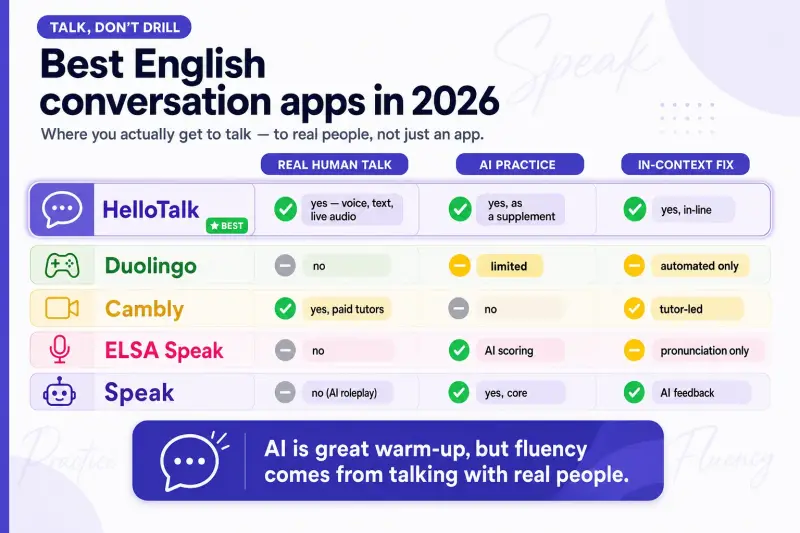
Here is how the leading options stack up on the thing that matters most: how much you actually get to talk.
| App | Real human talk | AI practice | In-context correction | Best for |
|---|---|---|---|---|
| HelloTalk | Yes, voice, text, live audio, Voicerooms | Yes, as a supplement | Yes, in-line | Talking with native speakers daily |
| Duolingo | No | Limited | Automated only | Vocabulary and grammar base |
| Busuu | Community feedback only | Some | Delayed community review | Structured course with occasional review |
| Cambly | Yes, paid tutors on video | No | Tutor-led | Paid one-on-one video lessons |
| ELSA Speak | No (pronunciation drills) | AI scoring | Pronunciation feedback | Accent and pronunciation training |
| Speak | No (AI roleplay) | Yes, core feature | AI feedback | Solo AI speaking drills |
A few things worth calling out. Duolingo is a strong vocabulary base, but it does not put you in a real conversation, so treat it as a warmup, not the main event. ELSA and Speak are useful for pronunciation and solo AI roleplay respectively, and they earn a place if accent work or bot practice is your specific goal. Cambly gives you real humans on video, which is great, but they are paid tutors, so the cost limits how often most people can afford to talk.
HelloTalk is built around the human conversation itself. With 70M+ registered users across 200+ countries speaking 260+ languages, there is always a native English speaker online who is also trying to learn your language, which gives them a reason to talk to you tonight and again tomorrow. You can send a voice message while you are on the bus, jump into a live audio call when you have twenty minutes, or drop into a Voiceroom where a group is discussing something you care about. For a look at the best free options in this space, our roundup of free English speaking apps for 2026 covers what you can do without paying anything.
How to Actually Get Talking, Not Just Downloading
Downloading the app is the easy part. Here is how to turn it into real conversation practice within your first week, arranged from lowest to highest pressure so you can climb at your own pace.
Start with listening. Drop into a Voiceroom on a topic you enjoy, keep your microphone off, and just absorb how native speakers actually talk to each other. This is not passive time-wasting. You are training your ear to the real pace, the fillers, the way people interrupt and agree. Ten minutes a day of this makes live speaking far less intimidating.
Next, move to voice messages. Pick one partner and start trading thirty-second voice messages about your day. You can re-record until you are happy, which takes the fear out of it, and your partner can correct your sentences in text right alongside. This is the single most efficient practice for most learners, because you produce real speech but on your own timeline.
Then, when you feel ready, do a live audio call. Twenty minutes, one topic decided in advance. The real-time pressure is exactly the skill you need for that meeting or that trip, and you cannot build it any other way than by doing it. It feels clumsy the first two or three times. Then it does not.
Finally, use the AI and the vocabulary apps as support, not substitutes. Warm up with a chatbot before a real call if it settles your nerves. Drill vocabulary on your commute. But keep the human conversation as the center of gravity, because that is where fluency is actually built. If you want a structured routine to build this into a habit, our guide on how to practice English speaking in 2026 lays out a daily plan.
A One-Week Plan to Break the Silence
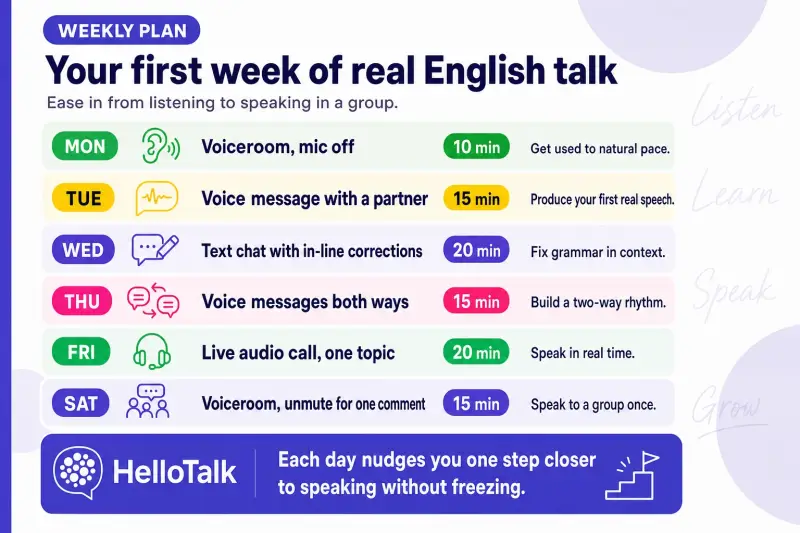
If you have been stuck in tap-only practice, this week gets you talking. Keep the sessions short, because consistency beats intensity.
| Day | Activity | Time | Goal |
|---|---|---|---|
| Monday | Voiceroom, mic off | 10 min | Get used to natural pace |
| Tuesday | Voice message with a partner | 15 min | Produce your first real speech |
| Wednesday | Text chat with in-line corrections | 20 min | Fix grammar in context |
| Thursday | Voice messages both ways | 15 min | Build a two-way rhythm |
| Friday | Live audio call, one topic | 20 min | Speak in real time |
| Saturday | Voiceroom, unmute for one comment | 15 min | Speak to a group once |
| Sunday | Review corrections from the week | 10 min | Lock in what you learned |
The whole point is to move you from listening to speaking over seven days. By Friday you will have done something most learners avoid for years: had a real, unscripted conversation in English. That single experience is worth more than a hundred perfect quiz scores.
Common Mistakes That Keep You From Talking
A few habits quietly keep people stuck. Watch for these.
Chasing streaks instead of talk time. A 300-day streak on a vocabulary app feels like progress, but if none of it was speaking, your conversation skill has not moved. Measure yourself in minutes talked, not days logged.
Waiting until you are "ready." You will never feel ready. Fluency is built by speaking before you are ready, badly, and improving. The learners who wait until their grammar is perfect never start.
Only texting. Text chat is comfortable and useful for correction, but it does not build the real-time skill you need. Push yourself to voice as soon as possible. If you want help picking a tool that prioritizes this, our guide to the best app to learn English speaking fluently compares options by how much they push you to speak.
Treating the AI bot as the destination. A chatbot is a great warmup, but it will not surprise you, correct your cultural missteps, or become a friend who keeps you accountable. Use it, then graduate to humans.
Frequently Asked Questions
What is the best free English conversation app? For talking with real native speakers at no cost, HelloTalk's free tier lets you find partners and exchange voice and text messages. Duolingo is free for vocabulary but not conversation. For a full comparison, see our roundup of free English speaking apps for 2026.
Can I practice English conversation without a partner? Partly. AI chatbots and pronunciation apps let you practice solo, and they are useful for warmup and confidence. But real conversation skill, handling the unpredictable back-and-forth of a live human, only comes from talking to people. Use solo tools as support, not as the whole plan.
How long until I can hold a conversation in English? With twenty to thirty minutes of daily speaking practice, most learners can hold a basic conversation within three to six months, depending on where they start. The single biggest accelerator is moving from tap-based practice to actual talking early.
Are AI conversation apps good enough on their own? They are good for low-pressure practice and never get tired of you, but they are predictable and cannot teach you the human texture of real conversation, humor, slang, and cultural nuance. The best results come from combining AI warmup with real human exchange.
How do I get over the fear of speaking live? Climb gradually. Start with Voiceroom listening, move to re-recordable voice messages, then to short live calls on a prepared topic. Each step is a little scarier than the last, which is exactly how you build confidence without overwhelming yourself.
Which app is best if I want to fix my accent? For pure pronunciation and accent work, ELSA Speak is purpose-built. But accent improves fastest when combined with real conversation, where you hear and mimic native speakers constantly, so pair the drill app with a human exchange.
Stop Tapping, Start Talking
The gap between where you are and fluency is not more vocabulary quizzes, it is talk time with real people. You can find native English speakers, trade voice messages, and join live Voicerooms tonight at HelloTalk.