
Thai Directions: Follow a Route and Check What You Heard
Published on

A short Thai route description is often something you can check alone: write the steps in order, trace them on a small map, and see where the line stops. Ask a person when your line and the speaker's intention could still differ. That is the moment to send your sketch in HelloTalk chat and ask which corner they meant. The usual snag is small: you catch เลี้ยวซ้าย and ตรงไป, then lose your facing direction, and the destination lands on the wrong side.
Separate Asking Where It Is From Asking How to Get There
The split here is about what you need back, not a fixed rule about how Thai answers come out. ที่ไหน (where) points at a position, and a question about getting there points at steps. In practice, someone answering a where question often adds the whole walk anyway, and a how-do-I-get-there answer can come back as one short relation.
So decide before you ask which one is useful right now. If you only need to know that the pharmacy sits on Pine Lane near the bookshop, a position answer is enough. If you plan to walk from where you are standing, say that, and name the point you are starting from.
Thailand Starter Kit's article on direction conversations keeps both questions in view and then chains movement into an order, which is the shape worth borrowing even though the places are not yours. Its routes run through real Bangkok locations, so treat them as sentence patterns rather than as current navigation.
When you want the step version, ask for it plainly. In HelloTalk chat you can send a photo of your own sketched map with a short voice message asking for the steps in order from the point you marked, because a position-only reply skips the turns you are trying to practise. HelloTalk's chat carries text and voice messages, photos, translation and correction tools in one thread, so the map, your question and the answer stay in the same place.
Whichever kind of answer arrives, the next job is knowing which pieces to hold onto while it goes past.
Catch the Start Point, the Turns, and Which Side It Is On
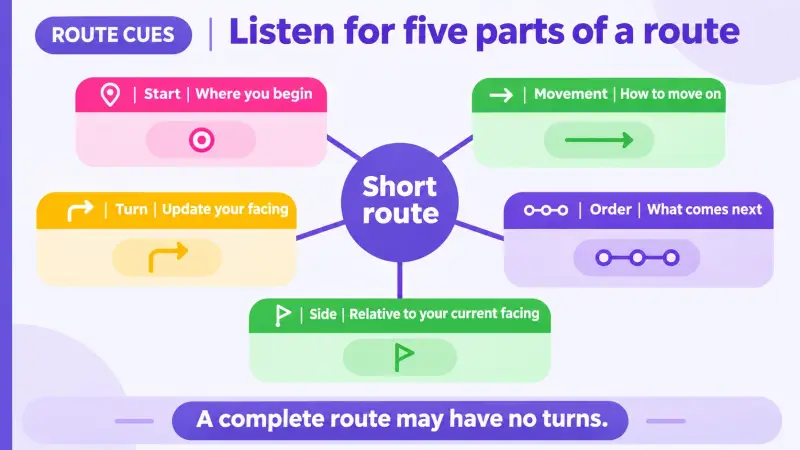
Five cues carry most of a short route: where you start, the movement itself, any turn, the order the steps come in, and where the destination sits relative to something else. A route answer can be a straight line from start to finish, so an answer with no turn in it is not automatically incomplete.
The start point usually arrives early, and จาก (from) is a common marker for it. It can also be implied, or given as a plain landmark name with no จาก at all. Either way, write it down before anything else, because every later step is measured from it.
Turns quietly rewrite everything after them. Which side อยู่ทางขวามือ points to depends on the direction you are facing after the last turn, not on the top of your map. Mark your facing direction next to each step instead of only the turn word.
The destination's position tends to land at the end of a long sentence. Counting often sits inside the route too, since directions commonly tell you to pass a number of side streets or shops before turning, and counting objects and confirming the quantity in Thai deals with that pattern on its own.
Each of those cues attaches to a small set of words that keep coming back.
Route Words to Hold Onto: จาก, ตรงไป, เลี้ยวซ้าย, แล้ว, อยู่ทางขวามือ
The table below is sorted by what each word does to your drawing rather than by part of speech, because while you listen you are mainly deciding whether to move the pencil, turn it, or stop. Read the third column first, then the Thai.
| Thai | Rough meaning | What it fixes in your trace |
|---|---|---|
| จาก | from | the start point of the route |
| เดินตรงไป / ตรงไป | walk straight on / go straight | movement with no change of facing |
| เลี้ยวซ้าย | turn left | a new facing direction from that point on |
| ขวา | right | the mirror of ซ้าย, in a turn or in a side phrase |
| แล้ว | then | the boundary between one step and the next |
| อยู่ทางขวามือ | is on the right-hand side | which side the destination sits on |
Two named resources cover this vocabulary from different angles. Thailand Starter Kit's direction conversation article shows the words inside continuous dialogue, with จาก, ตรงไป, เลี้ยวซ้าย and แล้ว chained into one route, so you see how steps join. ThaiPod101's Absolute Beginner Season 1 curriculum, lesson 30, gives a route sequence built on เดินตรงไป, เลี้ยวซ้าย and a destination-side phrase in the อยู่ทางขวามือ pattern, which is a compact model sentence shape to imitate.
Access differs between them. The ThaiPod101 curriculum page is a public listing of lesson order, while the lesson materials themselves sit in the course library behind an account. Thailand Starter Kit's conversations can be read straight off the page. For the fictional route in this article, the check comes from the worked example further down, or from a partner tracing the same map.
If you are still putting your first Thai routine together, the first steps for Thai beginners guide covers where listening practice fits around vocabulary and sounds.
Trace the Sequence on a Simple Map While You Listen
Tracing a route while you listen turns an ordering problem into a visible one, because a wrong turn shows up as a line going the wrong way. Draw the map before you listen, not during it, so your hand is free for the route line alone.
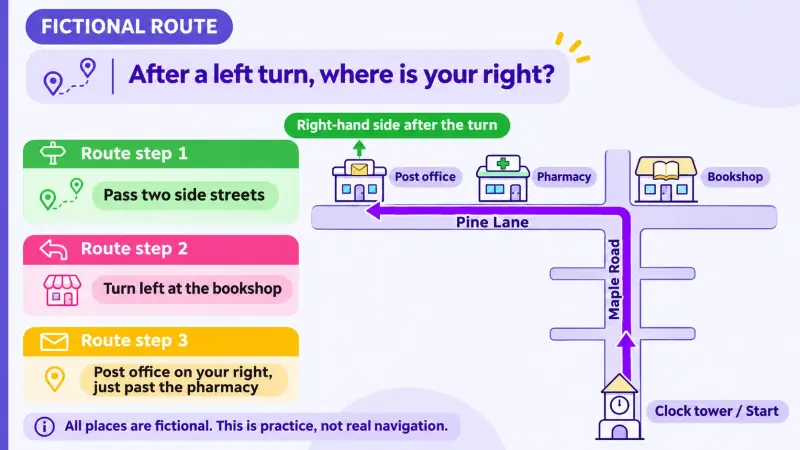
Draw one vertical road running up the page and call it Maple Road. Put a clock tower at its bottom end and an arrow showing that you start there facing up the page. Cross Maple Road with two short side streets, then draw a horizontal road, Pine Lane, crossing it higher up as the third crossing.
On the corner where Maple Road meets Pine Lane, draw a bookshop. Going left along Pine Lane from that corner, draw a pharmacy on the upper side of the lane, and a post office on the same upper side a little further along. Every place on this map is invented for the exercise.
Here is a short original route written for that map, with a translation after each line. ถนนเมเปิล and ถนนไพน์ are just transliterated names for the invented roads.
- จากหอนาฬิกา เดินตรงไปตามถนนเมเปิล ผ่านซอยสองซอย (From the clock tower, walk straight along Maple Road, past two side streets.)
- แล้วเลี้ยวซ้ายที่ร้านหนังสือ เข้าถนนไพน์ (Then turn left at the bookshop, into Pine Lane.)
- ไปรษณีย์อยู่ทางขวามือ เลยร้านขายยาไปหน่อย (The post office is on the right-hand side, a little past the pharmacy.)
Trace it one cue at a time. Start the pencil at the clock tower, run it up the page past two crossings, and stop at the bookshop corner on Pine Lane. Turn the line left there, which leaves you facing the left side of the page.
Facing that way, your right hand points to the upper side of Pine Lane, so the post office belongs on the upper side, just beyond the pharmacy. If that is where your line ends, the trace agrees with the three sentences.
If it ends somewhere else, the mismatch tells you to go back, not what went wrong. Reread the Thai with your finger on the line and check the pieces one at a time: the start point, the number of side streets, the direction of the turn, your facing arrow after it, and the side phrase at the end. A flipped facing arrow is only one candidate among those.
What your own trace cannot settle is whether the person who gave the route meant the same line.
Say the Route Back and Compare Traced Routes With a HelloTalk Partner
That gap needs a second person, and it stays small if you set the roles before you start. Both of you need the same map with no route drawn on it, the same marked start point and the same facing arrow.
One round works like this. You send the blank map image and your three Thai sentences in HelloTalk chat, as text or as a voice message, to a partner who has agreed to the exercise. They trace the route on their own copy without seeing your line.
Only then do you both send the traced images and compare. HelloTalk's chat carries the map, your text or voice description and the traced results in one thread, and the partner's independent line gives you a second reading of your wording to set beside your own.
Swap roles in the next round. If your partner is willing to record a short route from the same map as a voice message, you get the listening version; if they type it instead, you are practising reading and the order of the steps, which is useful but is not listening. Either way you trace from the same map and then compare. Keep one person describing and one person tracing within a round rather than mixing both.
When you are the one tracing, say the route back in your own words instead of replaying the sentence. A compressed learner version such as จากหอนาฬิกา ตรงไป ผ่านซอยสองซอย แล้วเลี้ยวซ้าย ไปรษณีย์อยู่ทางขวามือ is not polished phrasing, but it shows the order you took away. Saying the route back checks whether you followed the sequence; it does not establish that your pronunciation or grammar was right, and a partner reconstructing your meaning does not settle either question.
Partners are people with their own schedules rather than teachers on call, so keep each request small and answerable.
When a piece of the route goes missing, keep the question narrow so the other person knows exactly which part you want clarified. The rows below match a gap in your trace with a question short enough to answer in a line, and they work typed, recorded as a voice message, or written with help from the chat translation while your Thai is still coming together.
| What is missing | How the trace looks | One short question to send |
|---|---|---|
| the start point | the line begins nowhere in particular | "Do I start at the clock tower or at the bookshop?" |
| a middle step | a gap between two drawn segments | "After the two side streets, do I turn or keep going straight?" |
| the turn direction | the line turns, but you guessed which way | "At the bookshop, เลี้ยวซ้าย or the ขวา version?" |
| the destination side | the building is drawn on the wrong side of the lane | "After the turn, is the post office อยู่ทางขวามือ or on the other side?" |
| the count | you passed the wrong number of crossings | "Two side streets before the bookshop, or three?" |
When a reply gives you wording clearly better than yours, copy it into your own notes by hand along with the map it came from. The point is reuse: next time you describe a route, start from the phrasing that already worked and change only the places. That is the same loop behind checking the day and time of a Thai arrangement, where repeating the detail you heard is what makes the confirmation count.
Traced routes fit into an adjustable Thai speaking and listening plan as listening work with a visible result whenever the route reaches you as audio, and they sit well next to vocabulary review, since the map gives you a reason to say the words in order.
FAQ: Understanding Thai Directions
What is the difference between asking where a place is and asking how to get there in Thai?
The difference is in what you are asking for. A ที่ไหน question asks for a position, such as near a market or behind a school, while a getting-there question asks for steps you can walk. The answer you receive may not match the question type, so if you intend to walk, say so and name your starting point.
Which Thai direction words should I learn first?
Start with จาก (from), ตรงไป or เดินตรงไป (go straight, walk straight on), เลี้ยวซ้าย (turn left) with its ขวา counterpart, แล้ว (then), and the destination-side phrase อยู่ทางขวามือ. They attach to the cues a short route usually carries: start point, movement, turn, order and the destination's position.
How do I stop mixing up left and right after a turn?
Write your facing direction next to every step, not just the turn. In a walking route, left and right are given from the direction you are travelling at that moment, so one turn rotates the whole frame. Marking the arrow on your sketch lets you catch the slip while you are still on paper.
What if the route has no turns at all?
Then your traced line is straight, and that can be the complete answer. The useful checks become the start point, how far you go, and which side the destination is on, rather than hunting for a turn that was never said.
Can I just use a map app instead of practising this?
For real travel, use whatever navigation you normally use. This exercise is about understanding spoken Thai directions, and the map in this article is fictional and built only for tracing practice.
What should I do if I miss one step in the middle?
Draw the segments you did catch, leave the gap visible, and ask one question about that gap only, such as whether you turn or continue straight after the second side street. A narrow question names the exact gap, so a partner knows which part you want clarified.
If my partner understood my repeated route, does that mean I said it correctly?
Not necessarily. Someone who already knows the route can reconstruct your meaning from one or two clear words, so being understood is not proof that your pronunciation or grammar was right. Take it as a sign that the sequence matched, and ask separately if you want feedback on one specific word.
If you have a traced route and one question you cannot settle on your own, bring the sketch and that single question to HelloTalk and ask a willing Thai-speaking partner which corner they meant.