
Thai Classifiers: Count Objects and Confirm the Quantity
Published on

For a phrase like two books or three sheets of paper, you can practise the structure yourself and check it against a lesson page. A human reply helps when you need to know whether someone understood which objects you meant and how many. The usual stumble is the classifier: หนังสือ takes เล่ม, ปากกา takes ด้าม, and shape alone is a poor guide. On HelloTalk you can send a photo of the real items with your Thai sentence and ask a willing partner what they would hand you.
Noun, Number, Classifier: The Order for Plain Numeric Counts
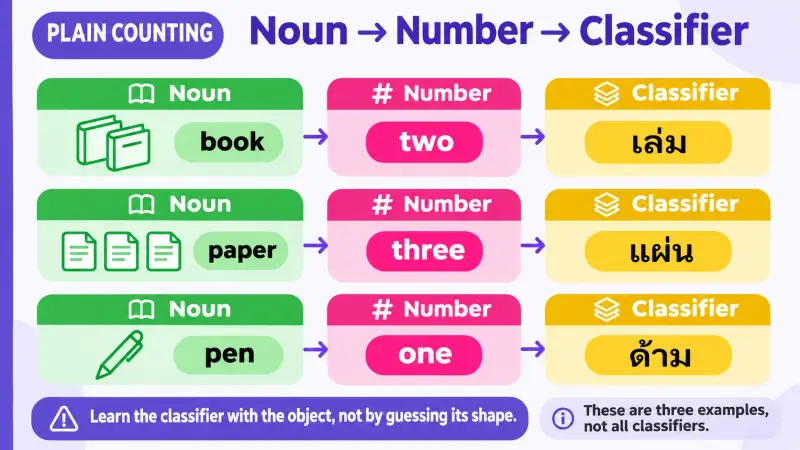
In plain numeric counting, Thai puts the noun first, then the number, then the classifier. Lingopolo's practice lesson for the book classifier shows หนังสือหนึ่งเล่ม (nangsue nueng laem), literally book, one, เล่ม. The romanisation here is a rough reading aid and does not mark tones.
The same lesson carries a longer line, หนังสือสองเล่มนั้นดีไหม, where สอง and เล่ม stay next to each other before นั้น. The counted chunk does not break apart when the sentence grows around it.
This pattern covers ordinary explicit counts of objects, the kind you say while holding them. It is not one rule stretched over every classifier construction in Thai. If nobody has mentioned classifiers to you until now, that is the kind of gap described in prerequisites Thai materials can assume.
Three Classifiers for Things You Hold: เล่ม, แผ่น, ด้าม
The order only helps once you know which word fills the classifier slot, and that part is vocabulary rather than logic. Lingopolo's classifier lesson lists เล่ม for books, แผ่น for paper and other thin flat objects, and ด้าม for pens and brushes.
Thai classifiers attach to groups of objects rather than to one broad shape rule, so เล่ม, แผ่น and ด้าม have to be learned together with the things they count. The practice lesson built around เล่ม is titled for books, candles and sharp metal objects, so a single classifier can cover a group that looks unrelated from the outside.
Three is a small start on purpose, because you can set all three objects on one desk and photograph them. The table pairs each object with its classifier and with something you could actually send. Read a row from left to right: the object, the Thai noun, the classifier, the counted phrase, and the message that puts that phrase in front of a willing partner.
| Object you can hold | Thai noun | Classifier | Plain counted phrase | What to put in the same HelloTalk message, and why |
|---|---|---|---|---|
| book | หนังสือ | เล่ม | หนังสือสองเล่ม (two books) | A photo of your shelf plus ขอยืมหนังสือสักสองเล่มได้ไหม, asking what the partner would pass you, so the reply shows how the request was taken |
| sheet of paper | กระดาษ | แผ่น | กระดาษสามแผ่น (three sheets of paper) | A photo of the paper you set aside with your own sentence, asking how the partner would request that same amount, so you get wording to compare with yours |
| pen | ปากกา | ด้าม | ปากกาหนึ่งด้าม (one pen) | A photo of the pens on your desk plus ขอยืมปากกาสักด้ามได้ไหม, asking whether that wording fits when you need one pen while filling in a form, so the feedback stays on one point |
These three cover a desk, not a language. For a water bottle, a chair or a bag, look the classifier up in a lesson or dictionary before putting a guessed one into a sentence.
Where the Order Changes: หนังสือเล่มนี้ and หนังสือเล่มหนึ่ง
Once the counted chunk feels automatic, you meet phrases that look like exceptions. หนังสือเล่มนี้, this book, puts the classifier directly before นี้ with no number in it, and that is a simple pointing phrase rather than a count.
Pointing does not block numbers. หนังสือสองเล่มนี้ means these two books, and the question หนังสือสองเล่มนั้นดีไหม keeps สอง and เล่ม in place before นั้น. Counting and pointing can live in the same phrase.
The pair worth slowing down for is หนังสือหนึ่งเล่ม and หนังสือเล่มหนึ่ง. หนังสือหนึ่งเล่ม states the quantity one, while หนังสือเล่มหนึ่ง more often brings in a book that has not been identified yet in the conversation. Context and emphasis decide which reading fits, and these are not two forms that can never swap.
It also helps to stop mapping หนึ่ง onto the English article. Saying "a book" could end up as either form, depending on whether you are counting or introducing. In a sentence like "I bought two books and one magazine", the counting form is the one doing the work.
So the question to ask yourself before sending anything is which job you are doing: counting, pointing at something you can both see, or bringing a new item into the conversation.
Borrow or Ask for Two Items Without Dropping the Classifier
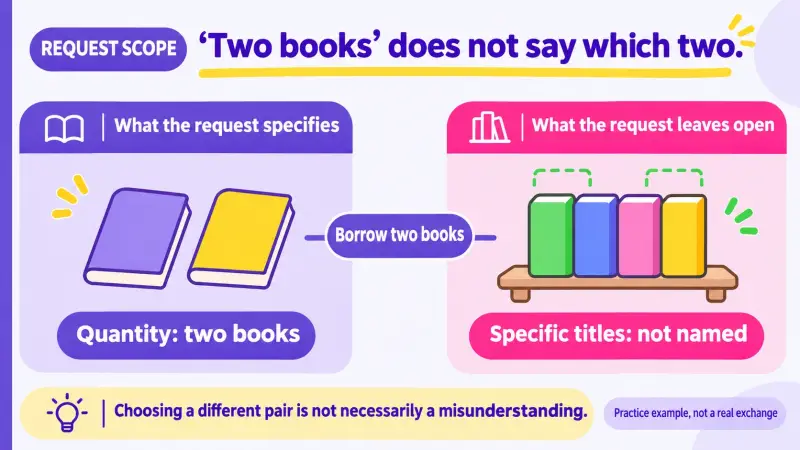
This turns into a real sentence the moment you want something that belongs to someone else, and that is where learners quietly drop the classifier and hope the number carries the meaning. An FSI Thai course drill has ขอยืมหนังสือสักสองเล่มได้ไหม (khor yuem nangsue sak song laem dai mai), can I borrow two books, with the counted chunk sitting whole inside the request.
The same drill has ขอยืมปากกาสักด้ามได้ไหม, can I borrow a pen, where the classifier stays but no explicit number appears. สัก softens the quantity, close to "a couple of" or "just", and it does not replace the classifier. Use that short form as one attested way to ask for a single item, not as permission to drop numbers in general.
Counting two items is not the same as counting two kinds of item, so กระดาษสามแผ่น stays one noun, one classifier and one number. For two different things you build two chunks and join them, as with หนังสือสองเล่ม and ปากกาหนึ่งด้าม side by side.
If you add a polite particle to a question like this, the form matters. A woman ends the question with คะ, as in ได้ไหมคะ, which is not the ค่ะ that closes a statement; a man uses ครับ. The course sentences above also work with no particle at all.
Before you send a request to anyone, run three checks on your own draft:
- Is the number between the noun and the classifier, as in หนังสือสองเล่ม?
- Is the classifier the one your lesson or dictionary lists for that specific object, rather than one you inferred from its shape?
- Can the person you are asking see the object, or do they need a photo to know what you mean?
Send a Photo on HelloTalk and Ask a Willing Partner Which Items They See and How Many
That third check is the one you cannot finish alone. HelloTalk's chat includes text and voice messages, media sharing, translation and correction tools, so a photo of your own shelf can travel in the same message as ขอยืมหนังสือสักสองเล่มได้ไหม, and you can ask a willing partner what they would pass you. That request asks for two books without naming which ones, so a different choice of titles is not a misreading.
Pick a situation you would actually be in: borrowing two books, setting aside three sheets of paper for someone, asking to use a pen while filling in a form. A request a person can answer gives you a reply you can hold against what you meant. A quiz about how many objects appear in a picture mostly tests their eyesight.
Keep the ask finite and keep the feedback on one point. The lines below are wording you could write, not a conversation anyone has had:
- "Here is my shelf. If I sent you this message, which books would you hand me?"
- "I wrote กระดาษสามแผ่น for what is in this photo. Would you say it the same way?"
- "If I needed one pen while filling in a form, would ขอยืมปากกาสักด้ามได้ไหม sound right there?"
A short voice message of the same sentence is a reasonable addition when you want a reaction to how you said it, and sending the text beside it gives the other person something to compare against. A partner's reply tells you how one message landed in one exchange, not that your tones or grammar are generally correct. People there are choosing to spend a few minutes, so one focused question goes further than a request for a verdict.
Reuse is where the work pays off. When a request gets a matching answer, copy the exact wording and the photo into your own notes, in a notebook or whatever notes app you already use, and pull it out the next time you need to borrow something. Pairing it with confirming a day and time in Thai covers arranging when to return the thing, and you can slot the counting practice into your speaking sessions in an adjustable eight-week Thai practice plan instead of running it as a separate project.
FAQ: Counting Things in Thai
What order do the words go in when I count objects in Thai?
Noun, then number, then classifier, as in หนังสือสองเล่ม for two books. Lingopolo's book-classifier practice lesson shows the same order with หนังสือหนึ่งเล่ม for one book.
Can I say the number and skip the classifier?
The counted phrases in those lesson examples keep the classifier, so practise it as part of the phrase. Leaving it out is the habit that strands a memorised number in the middle of a sentence.
Which classifier do pens take?
Lingopolo's classifier lesson lists ด้าม for pens and brushes, and the FSI drill sentence ขอยืมปากกาสักด้ามได้ไหม uses it in a request. For other writing tools, look the classifier up rather than assuming it carries over.
Is เล่ม used only for books?
No. The practice lesson built around เล่ม is titled for books, candles and sharp metal objects, which is a useful reminder that classifier groups are learned by membership rather than guessed from outline.
What is the difference between หนังสือหนึ่งเล่ม and หนังสือเล่มหนึ่ง?
หนังสือหนึ่งเล่ม is the plain counted form and states that there is one book. หนังสือเล่มหนึ่ง, with หนึ่ง after the classifier, more often brings in a book that has not been identified yet. Context and emphasis affect which reading fits, so avoid mapping either form straight onto the English a or an.
Can a number appear together with นี้ or นั้น?
Yes. หนังสือสองเล่มนี้ means these two books, and หนังสือสองเล่มนั้นดีไหม keeps the counted chunk before นั้น. The number-free หนังสือเล่มนี้ is simply the shorter way to point at one book.
Can someone on HelloTalk tell me whether my pronunciation is correct?
A willing partner can tell you what they understood from your text or voice message, and may offer a correction. That is feedback on one exchange rather than a general assessment, and nobody on a language exchange app is obliged to act as a teacher.
What if nobody answers my photo question?
Write the counted phrase out, read it against the lesson audio you are using, and run the three checks on your own draft. You can send the photo again later with a shorter, easier question attached.
If you want to try this, line up a few objects you would really lend or borrow, write the request, and send it with the photo and one specific question on HelloTalk.