
Thai Negative Replies: Understand What the Speaker Is Saying No To
Published on

If you still have your own question in front of you, most short Thai negatives are readable on your own, because ไม่ใช่, ไม่ได้ and ยังไม่ attach to different parts of it. A human reply helps at the point where the form leaves two readings open, such as ไปไม่ได้ for a clash today or a longer-standing limit. On HelloTalk you can send one short follow-up, in text or as a voice message, to the person who wrote that reply.
Read the Reply Against the Question You Actually Asked
Thai short answers tend to reuse the part of your question they are answering. Ask for confirmation with ใช่ไหม and the negative comes back built on ใช่; ask about an action with ไหม and it comes back built on that verb. ThaiPod101's negation lesson describes the same pattern from the teaching side: short negative replies often echo the questioned verb.
A short Thai negative answers the part of your question it echoes, so the form you get back depends on how you asked. Four shapes are enough to show that contrast here: ใช่ไหม for checking a label, a plain ไหม for asking about an action, หรือเปล่า for a plain yes or no check, and หรือยัง for asking whether something has happened yet. Thai has more question patterns than these four; these are simply the ones the replies below are paired with.
It is easy to drop your own sentence and look the reply up as a standalone word. With the question out of view, ไม่ได้ on its own can be read more than one way, and more vocabulary review will not bring the missing half back.
One check you can try is to put your question and the reply on one line and ask which part of your sentence the negative attached to. The table lists question shapes you are likely to use early, one short negative that fits each, and what each reply still does not say.
| Your question | A short negative that fits | What it denies | What it still leaves open |
|---|---|---|---|
| คุณเป็นครูใช่ไหม (khun pen khru chai mai), "You are a teacher, right?" | ไม่ใช่ครับ (mai chai khrap) | that the noun ครู applies to the speaker | what they actually do |
| ไปไหม (pai mai), "Are you going?" | ไม่ไปค่ะ (mai pai kha) | that they will do the action | the reason behind it |
| ไปไหม (pai mai), "Are you going?" | ไปไม่ได้ค่ะ (pai mai dai kha) | that going is possible for them | how long that applies |
| เมื่อวานไปหรือเปล่า (muea wan pai rue plao), "Did you go yesterday?" | ไม่ได้ไปครับ (mai dai pai khrap) | that the event took place | why it did not |
| กินข้าวหรือยัง (kin khao rue yang), "Have you eaten yet?" | ยังค่ะ or ยังไม่กินค่ะ (yang kha, yang mai kin kha) | that it has happened by now | whether they intend to soon |
These pairs are written as teaching examples rather than transcripts, so read any of them back against your own question before reusing it. Keep the polite particle consistent with the speaker: a male speaker uses ครับ on both questions and answers, while a female speaker normally uses ค่ะ on statements and answers and คะ on questions and requests.
The romanization here leaves out tone marks, so treat it as a reading aid rather than a pronunciation model. One detail in row four: หรือเปล่า is a plain yes or no question, and the past reading comes from เมื่อวาน and the situation, not from the question word. If you read Thai script slowly, write the reply out before judging it, because rows three and four differ only in the order of two words.
If you are still building the beginner routine around these exchanges, beginner Thai practice steps sets out the order of early practice, from script and sound work through listening, output and feedback; this article stays on the reply side of the exchange.
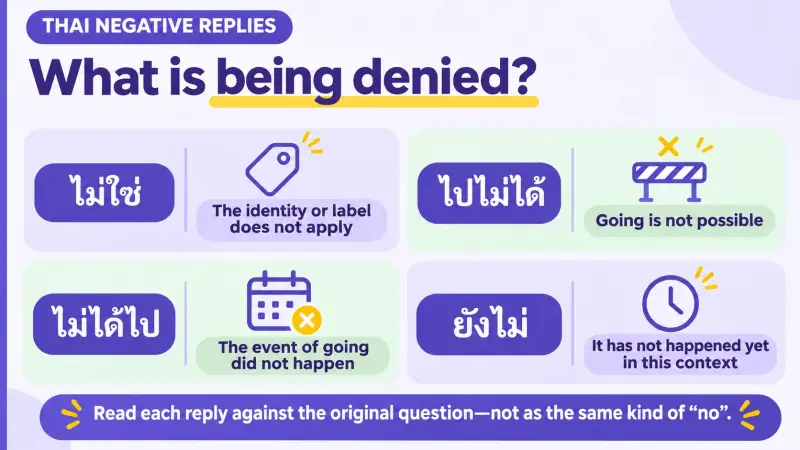
ไม่ใช่ Before a Noun: Denying That Identity
Row one is easy to stretch into a universal "no," so it is worth pinning down before the harder placements.
ThaiPod101's lesson on talking about your occupation puts ไม่ใช่ in front of an occupation noun to deny that the label applies: ผมไม่ใช่หมอครับ (phom mai chai mo khrap), "I am not a doctor." Its Basic Interactions review pairs the same word with confirmation questions built on ใช่ไหม, which is why ไม่ใช่ fits so naturally right after someone checks a label with you.
ไม่ใช่ says that a noun or label does not apply to the subject, not that the person is unwilling or unable. A full exchange can run คุณเป็นครูใช่ไหม and then ไม่ใช่ครับ ผมเป็นนักเรียนครับ (mai chai khrap, phom pen nakrian khrap), "No, I am a student." Correcting the label is the whole content of that reply.
There is a useful mismatch signal here too. If you asked a verb question such as ไปไหม and the answer opens with ไม่ใช่, the thing being denied is more likely a premise inside your sentence than the action, which is a cue to re-read what you wrote.
Where ไม่ได้ Sits: Before or After the Verb Changes What Is Denied
Rows three and four use the same syllables in a different order, so this is the distinction worth the most attention.
ThaiPod101's negation lesson contrasts two placements. After the main verb, ไม่ได้ marks that the action is not possible for the speaker: ไปไม่ได้ค่ะ (pai mai dai kha), "I can't go," or กินเผ็ดไม่ได้ครับ (kin phet mai dai khrap), "I can't eat spicy food." Before the main verb, in contexts where the event itself is what is at issue, ไม่ได้ denies that the event happened: ไม่ได้ไปค่ะ (mai dai pai kha), "I didn't go."
ไม่ได้ changes what it denies depending on whether it sits after the main verb or before it.
The pair worth learning as a pair
ไปไม่ได้ and ไม่ได้ไป answer different questions. The first fits an invitation or a plan you proposed, where the person is telling you that going is not open to them. The second fits something already on the table, where the person is telling you it did not happen.
Practising the two side by side helps, because in a chat you only see one of them at a time, with nothing next to it for contrast.
Why pre-verbal ไม่ได้ is not simply a past tense marker
It is tempting to file ไม่ได้ plus verb as the Thai past negative. In these examples the time information comes from the context and from words such as เมื่อวาน (muea wan), "yesterday," rather than from ไม่ได้ by itself. Read it as denial of the event under discussion and let the rest of the sentence say when.
ได้ also carries more than one everyday sense, including getting something and being able to. A bare ไม่ได้ with no question in view is therefore hard to place from the form alone, and whether you need to ask depends on how much the earlier part of the conversation already told you.
ยังไม่ Plus Verb: Not Yet, in This Context
A third branch sits beside ไม่ใช่ and ไม่ได้. This section covers the not-yet reply you will often get to a หรือยัง question, which is one common answer to that shape rather than the only one.
ThaiPod101's Absolute Beginner Season 1 curriculum introduces ยัง plus ไม่ plus verb for an action that has not happened yet, and the bare ยัง (yang) works as a short answer to the หรือยัง shape. So กินข้าวหรือยัง can be answered with ยังค่ะ or ยังไม่กินค่ะ (yang mai kin kha), "not yet."
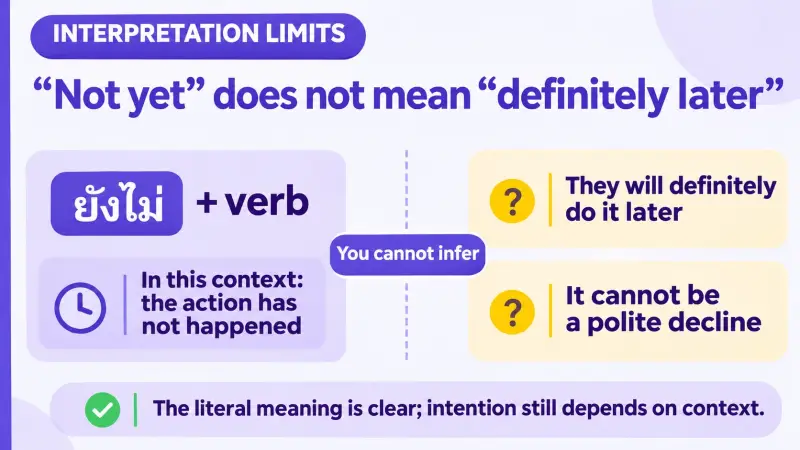
ยังไม่ plus a verb says the action has not happened yet in this context, which is different information from "I won't" or "I can't." That is a statement about the literal content, not about intent. A not-yet answer on its own does not establish that the person plans to do it later, and it does not rule out a polite decline either.
Your next line still has something to work with. After a not-yet answer, asking about timing usually matches what was said. After ไปไม่ได้, the reply has not said how long the obstacle lasts, so if that matters for your next step and nothing earlier in the conversation covered it, one limited clarification is reasonable; there is no need to ask for a private reason.
You will also meet ยังไม่ได้ in front of a verb in simple not-yet contexts. Take it there as the same "has not happened yet" reading, and keep looking at the verb after it and at the surrounding conversation instead of assuming it carries the inability sense.
A Short Negative Does Not Tell You Why: Check It on HelloTalk
Everything above identifies what a reply denies. A short negative tells you what is being denied, not why.
Before asking anyone, do the part you can do alone. Write your question and the reply on one line, mark whether the negative attached to a noun, sat after the verb, sat in front of the verb, or hung on ยัง, then write out the readings that are still open.
A ThaiPod101 lesson page is useful for confirming which pattern you are looking at, since its examples come grouped by pattern. What it cannot tell you is which of your two readings the person in your chat meant.
That last part is what a follow-up on HelloTalk covers. Send a short message to the same partner, in text or as a voice message, and offer the two readings you identified, because the person who wrote ไปไม่ได้ is the one who knows which they meant.
A message you could send, written as an example rather than a record of a chat: วันนี้ไปไม่ได้ หรือ ปกติไปไม่ได้ครับ (wan ni pai mai dai rue pokati pai mai dai khrap), "Can't go today, or can't go in general?"
A female speaker would end that question with คะ. A partner is someone choosing to answer rather than a teacher on call, so keep the question narrow.
When an answer comes, respond to that answer rather than to the script in your head. If it was only today, your useful next line is about another day; if it is a general thing, ask what they do instead.
HelloTalk's chat includes text and voice messages, translation, correction tools and media sharing, so you can send the line you are stuck on and keep the exchange in one thread. Those tools work on wording, not on deciding what the other person meant.
When you are unsure you parsed a reply, restate your reading before moving on: "So you mean you have not gone yet, not that you cannot go, right?" Restating is also the fallback for an isolated ไม่ได้, and the same habit shows up in checking a Thai route instead of guessing.
Keep the exchanges that resolved cleanly in your own notes, with the original question written above the reply, so that later you can reconstruct what that reply meant in that particular exchange. A few saved pairs give you something to compare the next unfamiliar negative against. The listening and speaking weeks in an adjustable Thai learning plan are easy places to slot that short review.
FAQ: Short Negative Answers in Thai
Is ไม่ใช่ the general Thai word for "no"?
No. In the lesson contexts above it says that a noun such as an occupation does not apply to the subject, and it is the natural answer to a ใช่ไหม confirmation question. It is not a catch-all negative for action or ability questions.
What is the difference between ไปไม่ได้ and ไม่ได้ไป?
ไปไม่ได้ puts ไม่ได้ after the verb and says going is not possible for the speaker. ไม่ได้ไป puts it before the verb and denies that the going happened. Same syllables, different order, different answer.
Does ไม่ได้ before a verb mean past tense?
Not by itself. Take it as denying the event under discussion, and let context words such as เมื่อวาน carry the time. Calling it a past marker will mislead you in contexts that are not about the past.
If someone answers ยังไม่, are they refusing?
That form says the action has not happened yet in this context. Refusal, inability and simple not-yet can all look short, so do not read intent from the form alone.
Can a dictionary tell me which reading was meant?
A dictionary can confirm what each word does, but the position of ไม่ได้ and the shape of your original question carry most of the meaning, and a genuinely ambiguous reply needs the speaker.
Which polite particle should I use in my follow-up?
A male speaker uses ครับ on both questions and answers. A female speaker normally uses คะ on a question or request and ค่ะ on a statement or answer, so her follow-up question can end in คะ while her own reply ends in ค่ะ. The particle does not change which part of the sentence is negated.
How do I ask for clarification without requesting a grammar lesson?
Put the two readings you already identified into one short either-or question, in Thai or in English. That keeps the scope of what you are asking clear, and when an answer comes you can note down the part that settles it. An either-or question is one way to ask, not the only one.
If you have a short Thai negative you cannot place, bring the question that produced it and ask one person about it on HelloTalk.