
French Questions in Conversation: Hear the Question and Give the Answer It Needs
Published on

A French speaker can turn a flat statement into a yes/no question without changing a single word, just by lifting the pitch at the end. When that happens, matching dictionary word order to a punctuation mark will not tell you what you actually heard. Recorded audio or a willing partner on HelloTalk can say the same three words twice, once as a statement and once as a question, so you hear what the printed sentence cannot show you.
Why Word Order Alone Won't Tell You It's a Question
In English, a question often announces itself through structure: "Do you work tomorrow?" moves the helping verb to the front. French has that inverted form too, but everyday spoken French also uses the plain statement order, changing the tone at the end instead of the word order.
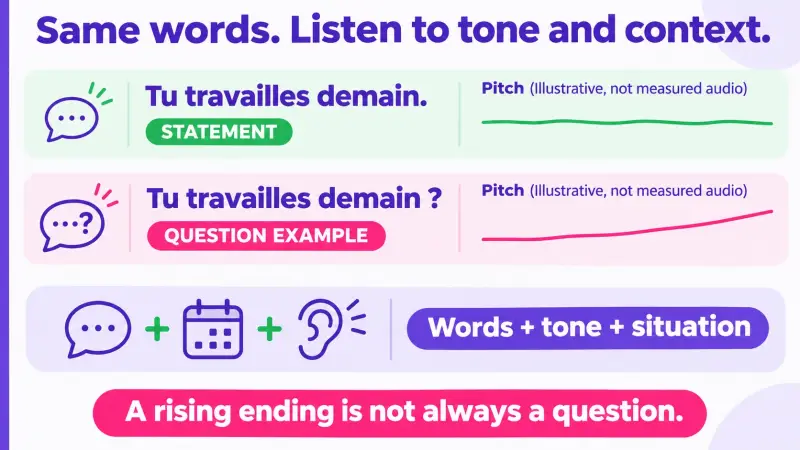
"Tu travailles demain." and "Tu travailles demain ?" use exactly the same three words in exactly the same order, so only intonation and punctuation separate them. On the page, the question mark does that job. In speech, there is no question mark, so the rising pitch becomes one of the main cues standing in for what inversion signals in writing, read together with the surrounding context.
This is documented for specific cases rather than as a blanket rule. TV5MONDE's A2-level teaching material shows rising intonation turning statement word order into a way to ask, invite, or propose, without touching the words themselves. That supports these particular question types, not every French interrogative sentence you might ever hear.
Reading Context Clues Alongside Intonation
Since intonation carries much of that distinction in speech, you still need something besides the rise itself, because a rising ending is not a dedicated question marker on its own.
Rising pitch at the end of a French sentence can mark a question, an invitation, or a proposal, but it also appears in unfinished statements and in expressions of surprise, so pitch alone is not a reliable question signal. An Open University lesson on French intonation makes this point directly: conversational closed questions often keep the plain statement shape, and a high final pitch shows up in more than one kind of sentence.
If someone says "Tu travailles demain ?" while you are both looking at a shared calendar trying to plan a weekend trip, the situation around the words is doing as much work as the tone. If the same three words come up while someone is reading through your week's schedule item by item, that identical rise might just be hesitation before the next item, not a real question aimed at you.
This is where a HelloTalk voice message from a willing partner becomes useful for this specific task: ask them to record the same short sentence twice, once as a flat statement and once as a real question directed at you, so you can compare how the rise actually sounds against a specific situation instead of guessing from a description of intonation.
Recognizing Whether a Question Asks for Information or Suggests an Action
Once you can tell a sentence is a question at all, the next problem is that not every question wants the same kind of reply, and French often uses one declarative-form question to do more than one job.
A declarative-form question like "Tu viens avec nous ?" can function as a neutral request for information or as an invitation, depending on the conversation around it. TV5MONDE groups rising-intonation questions into asking, inviting, and proposing; these are not separate grammatical forms, they are different intentions riding on the same sentence shape.
Comparing Four Example Exchanges
The table below lines up four short examples so you can see how the same kind of sentence shifts meaning with context, and what a reply needs to do in each case.
| French phrase (context) | Literal meaning | Likely intent | What your answer should do |
|---|---|---|---|
| Tu travailles demain. (flat tone, mid-conversation) | You work tomorrow. | Statement sharing information | Acknowledge it; no answer required |
| Tu travailles demain ? (rising tone, checking a shared plan) | You work tomorrow? | Yes/no question confirming a fact | Confirm or correct the day |
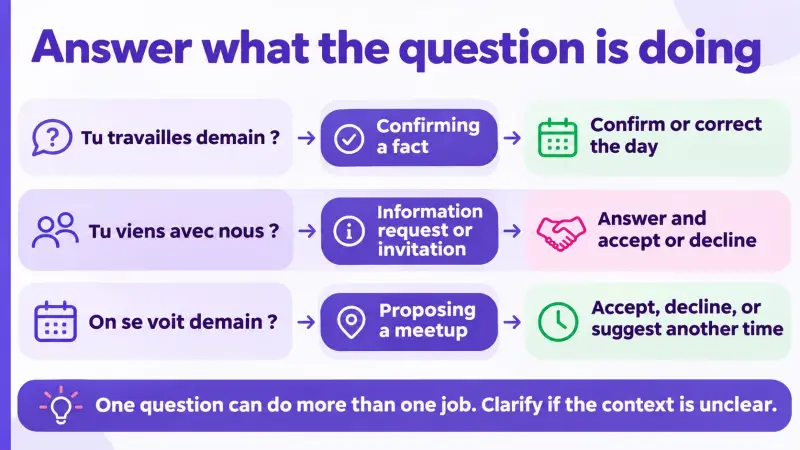
| Tu viens avec nous ? (while making weekend plans) | Are you coming with us? | Could be an information request or an invitation | A reply can answer and accept/decline at once; add a detail if the plan isn't clear yet |
| On se voit demain ? (suggesting a meetup) | Shall we see each other tomorrow? | A proposal phrased as a question | Accept, decline, or suggest another time |
These four rows share the same word-order family, so the table is not sorting by grammar, it is sorting by what the speaker likely wants back from you. The first two rows show the plain statement/question contrast from the previous section; the last two show that a question can double as an invitation or a proposal, which is why confirming intent before answering matters.
Confirming What Was Asked Before You Answer
When the table above does not settle it because the context is genuinely unclear, the simplest fix is not to guess, it is to ask back.
Confirming what was asked before answering can clarify whether the question is a factual check, an invitation, or a proposal, for this specific exchange. For "Tu viens avec nous ?" said in a tone you are unsure about, if you are already leaning toward joining and just don't know the departure time, a possible reply is "On part à quelle heure ?" ("What time are we leaving?"); it asks for a detail you'd want either way, not a way to sort every question into a check or an invitation. This is a hypothetical phrase to try in that situation, not a guaranteed fit for every one.
On HelloTalk, after a partner sends you one of these short phrases as a voice message, you can ask them one limited question back: did they mean it as a statement or a question, and if it was a question, were they asking for information or suggesting something. That narrow request can give you a usable answer about that one sentence, not a general grammar verdict on every French question.
Giving the Answer the Question Actually Needs
Once you know what was actually asked, the last step is matching your reply to that intent instead of defaulting to a flat yes or no.
Matching your reply to the question's actual intent, not just its surface form, is what the exchange actually needs. If "Tu travailles demain ?" turns out to be a factual question, a factual answer fits: "Oui, je travaille jusqu'à 18h." ("Yes, I work until 6pm.") If "Tu viens avec nous ?" turns out to be an invitation, a reply such as "Oui, je viens" ("Yes, I'm coming") already answers and accepts in one line; a decline or a different day works the same way, for example "Je ne peux pas demain, mais samedi oui." ("I can't tomorrow, but Saturday works.")
Reusing a Short Reply Pattern
A short personal note with a few of these reply patterns, such as "Oui, mais..." and "Je ne peux pas, mais...", gives you something to adapt the next time a similar question comes up, instead of starting from zero each time.
If you want a fuller loop from a course lesson to a real exchange, How to Turn a French Course Lesson Into a Voice-Message Exchange walks through turning a single lesson sentence into a HelloTalk voice exchange.
French Listening to Speaking: Retell a Short Clip and Get a Real Response covers a related but separate skill: retelling what you heard rather than answering a question inside it. For a broader list of material to practice with, see Best French Courses, Apps, and Resources for Daily Practice.
FAQ
Does a rising pitch at the end of a French sentence always mean it's a question?
No. Rising pitch also appears in unfinished statements and in expressions of surprise, so it has to be read together with the words and the situation, not treated as a standalone rule.
How do I tell a statement from a question when I'm just reading French text, with no audio?
Written French marks the difference with punctuation and sometimes with inversion ("Travailles-tu demain ?"), but a declarative-form question like "Tu travailles demain ?" only shows the difference through the question mark, so hearing it intoned the way a speaker would say it is part of the skill the text alone cannot teach.
What should I do if I genuinely can't tell whether a declarative-form sentence was meant as a question?
Ask a short clarifying question back, such as confirming whether the person was asking or stating, rather than guessing and answering the wrong thing.
Can I prepare for this without a conversation partner?
You can prepare by writing matched statement/question pairs like the ones in the table above and deciding what each context implies, and recorded course audio can help you practice hearing the rise in isolation, but a live partner on HelloTalk adds a real context and can tell you what they actually meant.
How is this different from recognizing inverted questions like "Travailles-tu demain ?"
Inverted questions already change word order, so they are identifiable on the page. This task covers the harder case where the words stay in statement order and only tone and context signal the question, which is why it needs separate practice.
What if a partner's intonation doesn't match what a textbook example describes?
That is expected. One speaker's intonation in one context is a useful data point about that exchange, not a fixed rule for every French accent or situation.
How does HelloTalk fit into practicing this specific skill?
HelloTalk lets you ask a willing partner to say a short phrase both as a statement and as a question, then tell you which one they meant and whether it was a request for information or something else, which is the kind of feedback a written course alone cannot give you.
Ask a partner on HelloTalk to send the same short phrase once as a statement and once as a question, and tell you which one they meant each time.