
Italian C, G, CH, and GH: Read New Words and Spell the Ones You Hear
Published on

The letter that comes right after c or g decides whether casa sounds hard or gente sounds soft, and ch or gh exist specifically to keep that hard sound before e or i. If you learned English spelling habits first, it is easy to read a new Italian word with the wrong sound, or to type a word you heard without the h it needs. Once a specific word causes confusion, asking a willing partner on HelloTalk can show you which word your spelling or recording actually produced for them, which adds real evidence about that one exchange rather than settling the rule by itself.
Reading and Spelling Italian Words With C and G Correctly
English spelling habits teach that c and g have a few loosely predictable sounds, but Italian ties the sound of c and g directly to the very next letter in the word. That means a new word like centro can be misread with an English guess, and a familiar-sounding word you have only heard spoken can be misspelled if you guess the wrong following letter. This article treats reading an unfamiliar word and spelling a word you heard as the same problem approached from two directions.
If you are still mapping out how to learn Italian overall, this piece fits into the early reading-and-spelling stage described in How to Learn Italian Online as a Beginner: A Step-by-Step Roadmap, rather than replacing that broader plan. Once you can predict a sound from spelling, the next step is seeing exactly which letter does the predicting.
How the letter that follows c or g decides a hard or soft sound
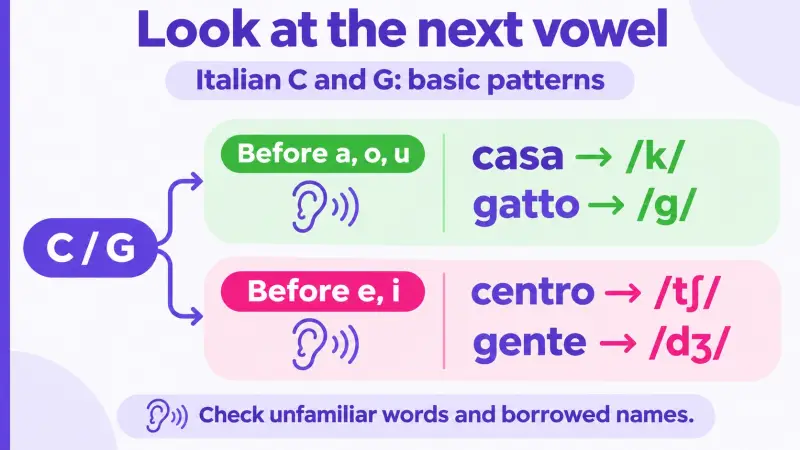
The rule has only two branches, and the table below shows how each one plays out in casa, centro, gatto, and gente.
| Letter | Before a, o, u | Example | Before e, i | Example |
|---|---|---|---|---|
| c | /k/ (hard) | casa | /tʃ/ (soft) | centro |
| g | /g/ (hard) | gatto | /dʒ/ (soft) | gente |
The vowel that immediately follows c or g, not the word's origin or stress, decides whether Italian speakers hear a hard or a soft consonant. This holds for these basic patterns and is the first thing worth checking before you guess a new word's pronunciation from English habits.
Applying the pattern in reverse: spelling what you hear
Listening in reverse means weighing the consonant and the vowel together, not the consonant alone. If a word you hear starts with a soft /tʃ/ or /dʒ/ sound, the following letter is almost certainly e or i, as in centro or gente.
Hearing a hard /k/ or /g/ by itself does not tell you which vowel comes next; only when that hard sound is followed by /e/ or /i/ does the pattern point to ch or gh, as in chi or alghe.
Spelling a word you have only heard means narrowing down a vowel-and-letter hypothesis from the sound, then checking the actual word in a dictionary, course material, or a partner's reply. What still needs its own explanation is why ch and gh exist at all in these cases, which the next section covers.
Why ch and gh keep the hard sound before e and i
Adding an h after c or g before e or i keeps the hard /k/ or /g/ sound that the following vowel would otherwise soften. The h is not decorative; it is the signal that blocks the softening you would expect from e or i alone.
Checked ch and gh examples compared with their soft counterparts
- chi (who): ch before i stays hard, /k/.
- chiami (you call): ch before i stays hard, /k/.
- chiuso (closed): ch before i stays hard, /k/.
- anche (also): ch before e stays hard, /k/.
- alghe (seaweed/algae): gh before e stays hard, /g/.
Compare that with ciao, where c is directly followed by i with no h, giving the soft /tʃ/ sound instead. Not every i after c or g stays silent on its own; some words keep the vowel sound audible for other reasons, so a genuinely new word is still worth checking rather than assumed from this pattern alone.
This kind of letter-triggered sound shift is one of several things covered in Three Things an Italian Resource Has to Handle That a Spanish One Doesn't, since many beginner materials borrow spelling instincts that do not transfer cleanly into Italian. Once you can predict both directions of this rule on paper, the real test is whether it still works in a message you actually send or a word you actually hear.
Turning the rule into a reading-and-spelling check with a real partner on HelloTalk
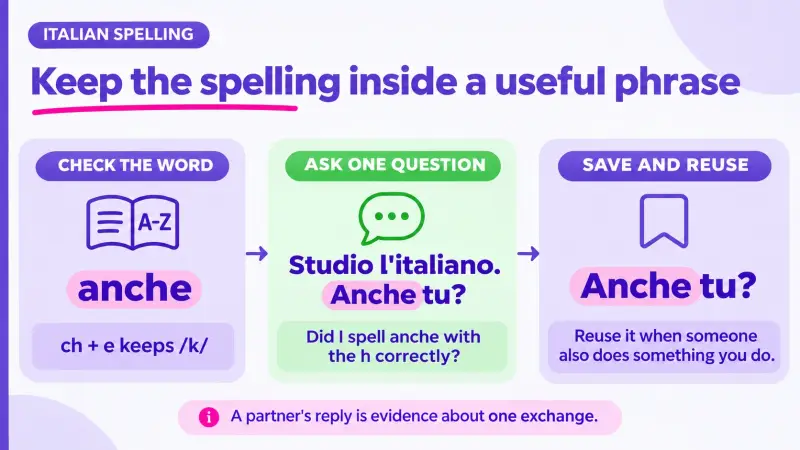
Course exercises and a dictionary are the right first stop for checking whether a form exists at all; a willing person on HelloTalk is the right second stop for finding out what your own spelling or recording actually communicated. On HelloTalk, that means sending a specific word inside a message you would send anyway and asking one answerable question about it, rather than requesting a full grammar lecture.
A reading-and-spelling check table for real messages
| Situation | What to send on HelloTalk | What to ask | Why it matters |
|---|---|---|---|
| An unfamiliar written word from a course or dictionary | The word inside a short message you would send anyway | Did I use this word correctly here | Confirms the word carries the meaning you intended, not just that the letters look right |
| A word you have only heard, not seen spelled | Your best guess at the spelling, with the meaning you intended | Is this how that meaning is spelled | Shows whether you added or dropped the h the sound needed |
| A word whose sound you are unsure you produced correctly | A brief voice message saying the word | What word does this sound like to you | Flags a possible mismatch worth checking against the spelling rule or a model recording |
| A spelling or sound a partner has confirmed | A request for a sentence they would actually use with that word | Could you give me a sentence you would really say with this | Turns a one-time correction into a reusable phrase |
Checking a specific word with a willing partner on HelloTalk confirms how your spelling or recording was actually understood, which a rule chart alone cannot tell you. A partner's answer tells you how that one attempt landed; it does not replace checking the word in a dictionary or course material first, and one reply is not a certified score.
For example, if you are telling a partner you study Italian, you might send Studio l'italiano. Anche tu? (I'm studying Italian. You too?) and ask one narrow question: Did I spell anche with the h correctly? If the reply confirms it, save the short phrase Anche tu? and reuse it the next time someone mentions doing something you also do.
Saving the correction for reuse
If the exchange turns up a useful full sentence with the word, saving it and reusing it in a later, unrelated message is a practical way to keep the correct spelling and the natural wording together, instead of relearning the word in isolation next time. Knowing which kind of resource handles which part of this process, course drills for the base rule, a dictionary for confirming a specific word, and a real partner for checking how your own attempt lands, is explained further in What Each Type of Italian Learning Resource Is Actually Built to Do.
FAQ
Does the i in ci or gi always stay silent? Not always. A following e or i signals the soft sound, but that does not mean every i is pronounced on its own, so treat a genuinely new word as worth checking rather than assuming the i is always silent.
Why does chiuso need an h but gatto doesn't? Gatto already uses a, so c or g followed by a, o, or u stays hard without help. Chiuso needs the h because i would otherwise soften the c, and the h blocks that softening.
Is this the same as the double-consonant length difference in words like pena and penna? No. This rule is about which sound c or g represents, while double-consonant length is a separate pronunciation distinction, and the two issues can appear in the same word without being the same problem.
Do gl and gn follow the same pattern as gh? No. Gl and gn are separate letter combinations with their own pronunciation rules and are outside what this c/g/ch/gh pattern covers.
Can I apply this rule to a word I only hear, without seeing it written? Yes, in part. Listen to the consonant and the vowel together, not the consonant alone: a hard sound before e or i in these ordinary patterns suggests ch or gh, but confirming the exact spelling, especially whether an h is involved, still benefits from checking a dictionary, a transcript, or a partner's answer.
Should I check every single c or g word with a HelloTalk partner? No. The rule and a dictionary resolve most words on their own, and a partner is most useful for the specific word that caused confusion in an actual message or recording.
Do borrowed words or foreign names follow this pattern? Not reliably. Borrowed words and names often keep their original pronunciation, so this pattern is meant for native Italian vocabulary rather than every word you encounter in Italian text.
Pick one new or misheard word today, apply the c/g/ch/gh check, and if it still feels uncertain, ask a willing partner on HelloTalk which word your spelling or recording actually produced.