
Italian Double Consonants: Hear the Difference and Check Which Word You Said
Published on
Reading pena and penna in a sentence and guessing the right one from context doesn't mean you can hear the difference spoken aloud, or that your own pronunciation lands as the word you meant. The real task is narrower: train your ear on consonant length alone, then send a recording to someone who didn't write the sentence and ask which word they heard. A willing partner on HelloTalk fits that checking step, once you've tried listening and recording on your own.
Why guessing the right word from context isn't the same as hearing double consonants
Italian has pairs of words that are spelled almost identically and differ only in whether one consonant is held for a shorter or longer beat. Correctly guessing the intended word from a sentence's context does not by itself prove that you can tell the two sounds apart.
If a sentence only makes sense with one of the two words, context can genuinely help you land on the right meaning, but it cannot tell you whether you got there by hearing the consonant length or by reasoning out the only word that fits; both routes lead to the same correct answer, so the sentence alone gives no evidence of which one you used.
That gap matters once you try to use these words in your own speech, not just read them. A sentence you write yourself can make the intended word just as obvious from context as a textbook sentence does, so a predictable self-composed sentence doesn't automatically test anything different from a predictable textbook one. What actually removes that context clue is practicing the bare word on its own, outside any sentence, which is what isolates whether consonant length alone carries the meaning.
This is a different problem from reading rules for letters like c and g, which change sound depending on the vowel that follows rather than on how long you hold a consonant; that's a separate task covered elsewhere.
Single and Double Consonants That Change a Word's Meaning
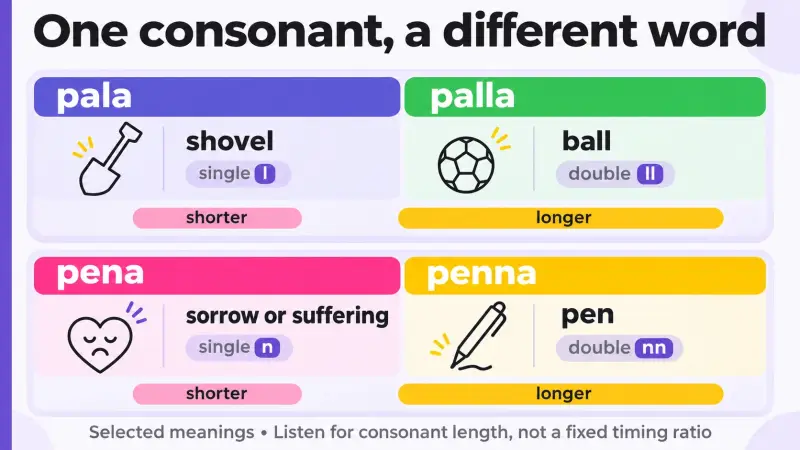
Before practicing by ear, it helps to see the actual pairs you're listening for, since the written difference is just one letter but the spoken difference is the whole task. The words below keep the same vowels and differ mainly through consonant length, though the timing of surrounding sounds in a word isn't perfectly fixed either, so treat each row as a target rather than a precise formula.
| Word | Consonant | Selected meaning |
|---|---|---|
| pala | single l | shovel |
| palla | double l | ball |
| pena | single n | sorrow or suffering |
| penna | double n | pen |
Both pena and penna carry other senses depending on context, so the meanings above are the ones worth fixing in your head first rather than a complete dictionary entry. Pala and palla, or pena and penna, keep every vowel the same and differ chiefly in how long you hold one consonant. This is exactly why guessing from context can mask a listening gap that the bare word, heard alone, would expose.
An Adjustable Listening Practice Routine Before You Try to Produce the Sound
Once you know which pairs to listen for, the next problem is that written material usually hands you the spelling and the sentence at the same time, so you rarely get a listening-only moment on your own. The three steps below each remove a different shortcut, rather than asking you to make the same decision twice.
| Step | What you do | What it checks |
|---|---|---|
| 1. Listen and commit | Play a recording of one word from a pair without reading any script first, then commit to one identification based only on what you heard | Whether you can identify the word from sound alone, before any text appears |
| 2. Check against that recording's answer key | Compare your identification to the transcript or answer key that goes with that specific recording, not a general dictionary entry, since a dictionary confirms spelling and meaning but not which word a particular recording contained | Whether your selection matched the word in that recording, independent of general vocabulary knowledge |
| 3. Add sentence context afterward | Once you've confirmed what you heard, read a full sentence containing the word to see how context and sound line up | Whether meaning and sound agree, without letting context substitute for listening |
Matching your identification to a recording's answer key tells you whether your selection matched that specific item, not that your ear definitely detected the consonant length itself. A correct match could also come from a lucky guess or from recognizing a recording you've already heard before, so treat this step as practice rather than a diagnostic verdict on your hearing.
If you can find a recording with matching written text, where the target word has already been checked against a reliable source, you can approximate this step alone: play the audio, commit to an answer, then compare it against the text. If no such recording is available, ask a willing partner on HelloTalk to say one of the words aloud without telling you in advance which one, then identify it before you see it spelled out; adapting the drill this way is a suggested variation.
This kind of targeted listening drill fits into a broader plan once you've already handled basic reading, as laid out in the Italian beginner roadmap, and the reason consonant length needs its own dedicated practice, rather than general listening exposure, is part of what the piece on what Italian resources have to handle that Spanish ones don't goes into.
Recording your own voice and checking which word a partner on HelloTalk hears
Listening practice tells you whether your ear can separate the two sounds; it doesn't tell you whether your own mouth produces a clear difference when you speak. The next step is to test the target word alone before testing it inside a sentence.
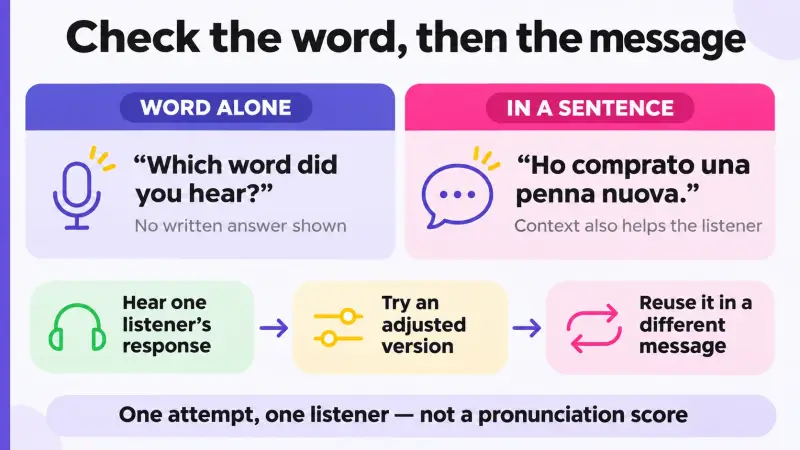
Record yourself saying just one word, for example penna, and send that short recording to a partner on HelloTalk who hasn't seen any text. Ask only: "Which word did you hear?" This reduces the help a sentence's context could offer and lets a listener report the word they actually heard, rather than the meaning they inferred.
Once you have that answer, you can also record a short original sentence using the same word and see how it lands as a whole message. Two examples:
- Ho comprato una penna nuova. (I bought a new pen.)
- Il bambino ha perso la palla. (The child lost the ball.)
Because sentence context can make the intended word easier to guess, a partner's correct answer to the full sentence may reflect both the sound they heard and the meaning the sentence suggested, not the consonant length in isolation. Treat the isolated-word recording and the sentence recording as two different, complementary checks, rather than either one alone proving how clearly you pronounce the sound.
The HelloTalk platform's chat keeps text messages, voice messages and correction tools in one conversation, so you can send a recording and ask a specific question like these without switching to another app. A partner's answer about one recording tells you how that specific attempt sounded to one listener, not a certified pronunciation score. There is no guarantee of how quickly, or whether, anyone replies.
If your partner is willing, ask for one short model of the word in return, then try the sentence again using whatever you noticed changed. Save the correction and reuse the fixed phrase in a different, truthful message later, rather than only repeating the original drill sentence. This kind of specific, limited check is also the gap described in why beginner Italian needs real responses, not just more study material, since a transcript or app score can't tell you what another person actually understood from your own voice.
FAQ
How do I know if I'm really hearing the double consonant or just guessing from context? Test the word alone, outside any sentence. If you can only tell pala from palla when a sentence makes one option obviously correct, you're still relying on context rather than hearing the consonant length itself.
Is a double consonant always exactly twice as long as a single one? There's no single fixed ratio you can rely on for every double-consonant pair. The useful skill at this stage is noticing that one version is clearly longer, not timing it against a precise rule.
What if my HelloTalk partner doesn't reply to my recording? That can happen. Try a different partner, or come back to the same recording later once you've worked through the listening routine further.
Can I practice this without finding a native speaker first? Yes. The listening steps in this article use recordings and answer keys you can work through alone; a partner adds value once you want feedback on how your own recorded voice actually sounds to someone else.
Do I need special audio software to practice minimal pairs? No. A basic audio player that plays a short clip, plus the voice-recording function already on your phone, covers every step described here.
How many word pairs should I practice before trying to produce them myself? There's no required number or order. The two pairs and four words in the table above give you a concrete starting set; you can add more once you're comfortable with those.
Does getting the sentence meaning right in a textbook exercise mean I've mastered the sound? Not necessarily. It can mean you solved that sentence through logic or vocabulary alone, which is a different skill from hearing or producing the consonant length by itself, though it doesn't rule out that you also heard it correctly.
Why involve a HelloTalk partner instead of just listening back to my own recording? Listening to your own recording is useful and can catch some mismatches between what you said and what you intended. Sending it to someone on HelloTalk and asking which word they understood adds an independent perspective on whether the sound reached another person's ear the way you meant.
Try this practice sequence on one pair from the table, then open HelloTalk and ask a willing partner which word they heard in your recording.