
Korean Beginner Messages: Explain What You Don't Do, Can't Do, or Don't Have
Published on

A single Korean negative word rarely tells your partner what happens next. 안 says you are not doing something, 못 says something is stopping you, and 없어요 says a resource or time is missing, and mixing them up, or leaving out the reason, is what leaves a plan unclear. If you need to decline, reschedule, or explain a limitation to a real contact on HelloTalk, in text or voice, the task is picking the right negative, attaching a bounded reason, and asking what they actually understood so the arrangement still works.
Choosing What Your Korean Message Needs to Say: Not Doing, Unable To, or Don't Have
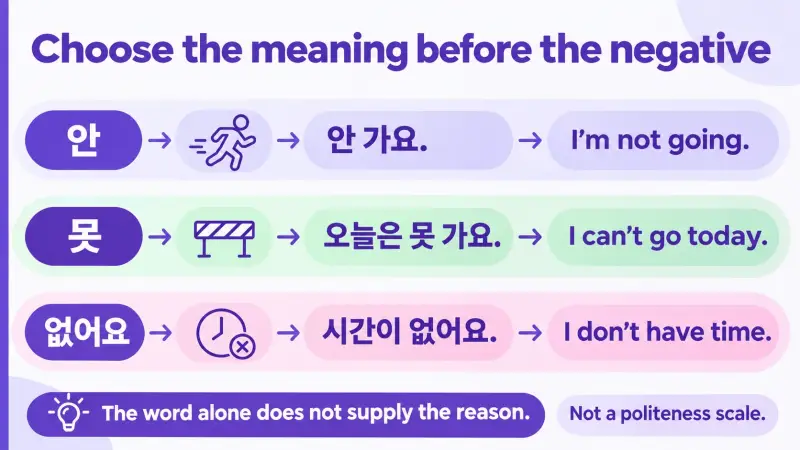
Before typing a message, it helps to know which of three things you're actually reporting: that you simply aren't doing something, that something is blocking you, or that you lack a resource. These three map to three different Korean forms, and English speakers often collapse all of them into "I can't" or "I don't have," which loses the distinction a Korean partner needs to respond usefully.
| What your message needs to say | Form | Example | Reading | Boundary |
|---|---|---|---|---|
| You are not doing an action | 안 + verb, or -지 않다 | 안 가요. | I'm not going. | Doesn't explain why; not automatically a refusal. |
| Something is preventing you | 못 + verb | 오늘은 못 가요. | I can't go today. | Meaning depends on context, not a statement about skill alone. |
| A resource or time is missing | noun + 이/가 없어요 | 시간이 없어요. | I don't have time. | Negates possession or availability, not an action. |
안 reports that an action is not happening, while 못 reports inability or being prevented from it, but neither word by itself supplies the specific reason. If you're still solidifying the basic sentence patterns these three forms sit inside, a roundup of resources for learning Korean quickly covers where this kind of production practice fits alongside vocabulary and listening work.
Saying You Are Not Doing Something, With the Reason Attached
안 가요 is the plain way to say you're not going, and -지 않다 works the same way in a slightly longer form. For some noun-plus-하다 actions, like 공부하다 (to study), 안 slots between the noun and 하다, so 공부 안 해요 means I'm not studying; this placement doesn't carry over to every 하다 word, so it's worth checking a specific verb rather than applying the pattern everywhere.
A bare 안 statement only reports non-action. It doesn't say why, and without a reason it can read as more abrupt than you mean. If a gym partner is expecting you, an adaptable example message on HelloTalk could pair the plain negative with a short reason, such as 오늘 저녁에 운동 안 해요. 너무 피곤해요. (I'm not exercising tonight. I'm too tired.), rather than leaving 운동 안 해요 to stand alone.
One limited way to check this: after sending the sentence in a HelloTalk chat, ask your partner a specific question like 이렇게 말해도 자연스러워요? (does it sound natural to say it this way). HelloTalk's chat includes a correction tool a partner can use to mark exactly what feels off in that one sentence, which is more useful than a vague request to check your Korean. If these basic patterns still feel shaky right after the alphabet stage, that gap is covered separately in the gap between Hangul and real sentences.
What's Stopping You: Explaining a Real Obstacle
When something actually prevents an action, rather than you simply choosing not to do it, 못 is the closer fit. 오늘은 못 가요 (I can't go today) reports an obstacle, but like 안, it doesn't name the obstacle on its own.
Attaching a reason with -아/어서 fills that gap. 비가 와서 못 가요 means it's raining, so I can't go, and 오늘은 바빠서 영화를 못 봐요 means I'm busy today, so I can't watch the movie. Attaching a reason with -아/어서 turns a bare negative into information a partner can act on, since now they know what changed, not just that something changed.
It also matters that 없어요 and 못 are not interchangeable, even though both forms can describe something the speaker doesn't have. Saying 책이 없어요 reports that you don't have the book, a plain absence. Saying 편지를 못 받았어요 reports that you didn't receive a letter, an action that didn't happen, though it doesn't by itself say why you didn't receive it. The two sentences translate differently and work through different Korean mechanisms.
Neither 안 nor 못 is inherently more polite; politeness comes from the full wording, the relationship, and the tone, not from the negative word itself. 못 is not automatically a softer refusal, and 안 is not automatically rude; what matters is stating the true constraint rather than picking a word for its assumed politeness. A practical next step on HelloTalk: send a voice message with the reason attached, such as 비가 와서 오늘 못 가요, then ask directly 그럼 언제 괜찮아요? (then when works for you), which moves the conversation toward an actual alternative instead of ending on the obstacle.
Saying a Resource or Time Is Missing and What You Need Instead
없어요 negates possession or availability rather than an action, so it cannot replace 안 or 못 in every sentence. 시간이 없어요 (I don't have time) reports that a resource, here time, isn't available; it doesn't say you're refusing or being prevented from anything specific.
Stopping at 시간이 없어요 only tells your partner what's missing, not what would work. Pairing it with what you actually need keeps the message useful: 이번 주는 시간이 없어요. 다음 주는 괜찮아요 (I don't have time this week. Next week works).
On HelloTalk, send that two-sentence message to whoever proposed the original plan, then follow with a specific, answerable question such as 다음 주 괜찮은 요일 있어요? (is there a day next week that works). Asking something concrete, instead of leaving the message on the negative, is what keeps the exchange moving toward an actual time.
Proposing a Feasible Alternative and Checking What Your Partner Understood
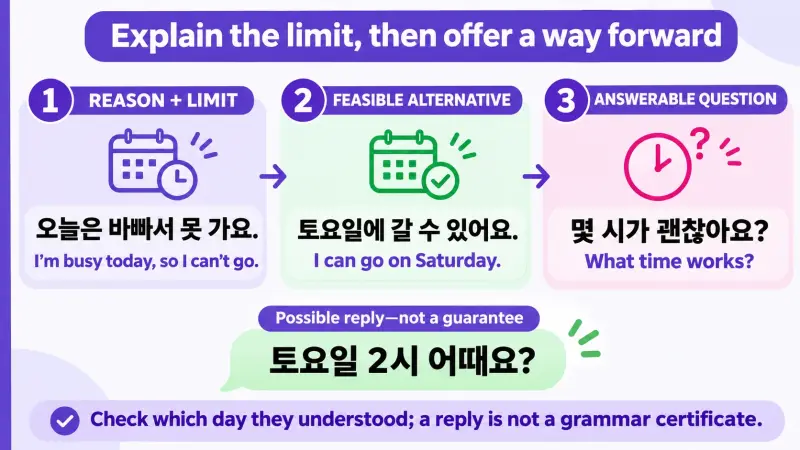
The most useful version of these messages combines a bounded reason, the negative that matches it, and a feasible alternative in one turn: 오늘은 바빠서 못 가요. 토요일에 갈 수 있어요. 몇 시가 괜찮아요? This reads as I'm busy today so I can't go. I can go on Saturday. What time works? The -(으)ㄹ 수 있어요 pattern here is a separate "can/able to" construction, not a negative, used to state the feasible option positively once the obstacle has been explained.
Sending that full message on HelloTalk to the person who proposed the plan is the point where a real reply tells you something. A partner's next reply can confirm which obstacle and which alternative they understood, not certify that the grammar is flawless. If they answer with something like 토요일 2시 어때요? (how about two o'clock on Saturday, shown here as a hypothetical example of what a reply might look like), that suggests the day and the open question came through, though it doesn't by itself confirm they understood the stated reason.
If instead their reply asks again about today, or proposes a day you didn't mean, that mismatch is useful information: revise the message, keep the same reason-then-alternative structure, and reuse the corrected wording the next time a similar plan comes up. The ending you choose in these messages, -아/어요 throughout the examples above, is a separate question from the negative meaning itself; a closer look at adjusting speech levels across Korean resources covers register separately from what's discussed here.
FAQ
What's the basic difference between 안 and 못 in Korean? 안 reports that an action isn't happening without naming a cause. 못 reports that something is preventing it. Neither word by itself states what the obstacle is unless you add a reason.
Is 못 always more polite than 안? No. Politeness comes from the sentence ending and the relationship, not from choosing 못 over 안. A flat 못 해요 can sound just as direct as a flat 안 해요 depending on tone and context.
Can 없어요 replace 안 or 못 in a sentence? Not generally. 없어요 negates having or being available, as in 시간이 없어요 for not having time, while 안 and 못 negate actions, so swapping it into an action sentence usually causes confusion rather than clarity.
Do I need to attach a reason every time I use 못? Not every time, but a bare 못 가요 only tells a partner you can't go, not why. Attaching a reason with -아/어서 can help them respond usefully, for instance by suggesting another day, though existing context sometimes already makes the reason clear.
How do I check what a Korean message partner actually understood? After sending your explanation and proposed alternative, ask a specific question tied to the plan, such as 몇 시가 괜찮아요?, then read their next reply to see whether the day or the obstacle you meant came through.
What if my partner's reply shows they misunderstood my message? Treat it as a signal to clarify, not a grammar failure. Resend a corrected version using the same reason-then-alternative structure, and reuse that corrected wording the next time a similar plan comes up.
Do I need advanced sentence endings to use these negatives? No. The examples here stay at the simple polite -아/어요 level common in early lessons; register and more advanced endings are a separate concern from choosing the right negative meaning.
Try sending one real message like this, with a reason and an alternative, to a partner on HelloTalk and see what their reply tells you about the plan.