
Spoken French Negatives: Catch the Meaning When You Do Not Hear Ne
Published on

When a short French reply drops ne, such as "Je travaille pas samedi," do not assume the sentence is positive: look at the word that remains, usually pas or plus, and the surrounding context to tell whether it is actually negative. This matters when a quick reply changes your plans, like confirming whether someone is free on a given day or whether a situation is still happening. In HelloTalk voice exchanges, you can ask a specific yes/no question and, when the answer is unclear, ask your partner to confirm what they meant rather than guessing from grammar alone.
Why Missing Ne Doesn't Mean You Heard a Positive Sentence
Spoken French often drops ne from negative sentences, but dropping ne from a negative sentence does not turn it into a positive statement. The negative meaning is still carried by the word that follows, usually pas or plus. If you only listen for ne as your signal that a sentence is negative, you will miss negatives that are spoken casually.
For example, compare two written practice sentences: "Je travaille samedi" (I work Saturday) and "Je travaille pas samedi" (I don't work Saturday). Both use the same subject and verb, so the only clue that the second sentence is negative is the word pas sitting where ne...pas would normally wrap around the verb.
How Formal and Informal French Negatives Differ
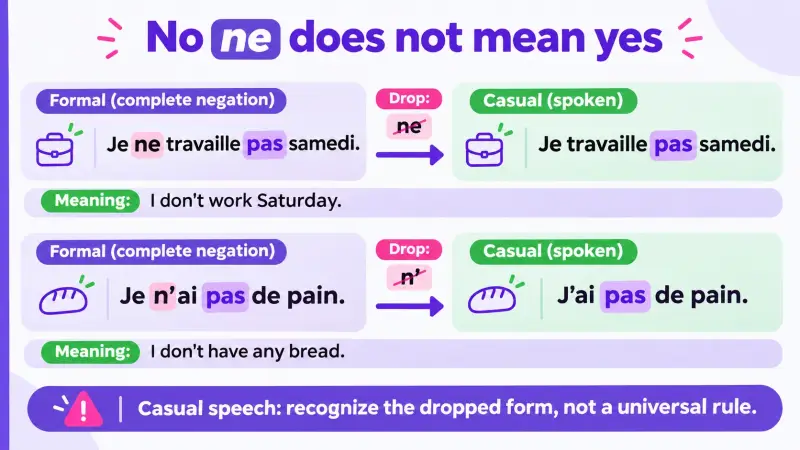
French negation has a formal pattern and a casual spoken pattern that are easy to tell apart once you know what to look for. Formal and written French keeps both parts of the negation, ne and pas or ne and plus, wrapped around the verb. In relaxed conversation, ne can be left out, so only the second part remains audible.
The table below lines up the formal form with the informal form so you can see what each one leaves out and what it keeps.
| Negation type | Formal / written form | Meaning | Informal spoken form |
|---|---|---|---|
| Simple negative | Je ne travaille pas samedi. | I don't work Saturday. | Je travaille pas samedi. |
| No longer true | Je ne travaille plus ici. | I don't work here anymore. | Je travaille plus ici. |
| Negative with object | Je n'ai pas de pain. | I don't have any bread. | J'ai pas de pain. |
In every informal column, ne has disappeared but pas or plus is still doing the negating. The "no longer true" row's plus example is meant to carry that negative sense, as its meaning column shows, in a context such as someone who has stopped working there; on its own, the bare informal string does not settle the sense without more context, and plus can also mean "more," as the next section explains.
In a ne...pas sentence like these, pas is the word that carries the negative meaning once ne is dropped in casual spoken French. This pattern shows up often enough in relaxed conversation that it is worth training your ear for it, though it is a casual-speech tendency rather than a rule that applies in every register or every speaker.
Listening for Pas and Plus Without Relying on Ne
Once you stop waiting for ne, pas and plus become your main negation signals, but plus needs extra care. Plus can signal either "more" or a negative meaning, so its sense depends on the rest of the sentence. "Il y a plus de pain" on its own could mean there is more bread or there is no more bread, depending on context and what else is being discussed.
Rather than trying to catch a single sound, listen to the whole short sentence and the situation around it. If someone is talking about a supply running out, a plus construction likely means something is finished. If they are comparing quantities, the same word often points to "more." Context carries weight that an isolated word cannot.
Confirming What a Short Reply Actually Means
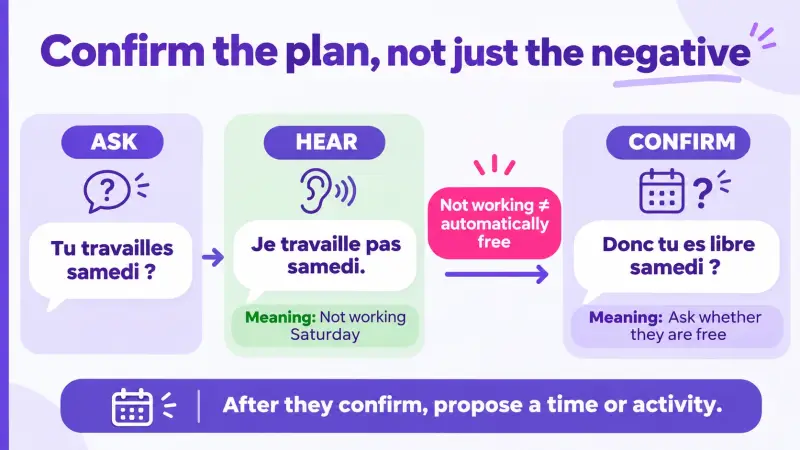
Grammar patterns narrow down what a reply probably means, but they do not replace an actual confirmation when the stakes are real, like making a plan. A short spoken reply like "Je travaille pas samedi" answers "Tu travailles samedi ?" negatively, not affirmatively, so it tells you the person is not working that day, not that they are automatically free for something else.
In a HelloTalk voice exchange, you can ask a specific question such as "Tu travailles samedi ?" and, if the reply is short or unclear, follow up in the same conversation with something like "Donc tu es libre samedi ?" to confirm the day rather than the grammar. Confirming an ambiguous reply with a follow-up question gives you information a grammar rule alone cannot, because your partner is telling you what they actually meant in that moment, not demonstrating a textbook pattern.
If you first met this kind of sentence while turning a French course lesson into a voice message exchange, the same follow-up habit applies: ask, listen for pas or plus, and check your understanding before you act on it.
Responding to the Content Instead of the Grammar
Once you have confirmed what a reply means, the next step is to respond to the information, not to repeat the negative structure back. If a partner confirms they are free Saturday, a useful reply proposes a possible time or activity instead of simply repeating "tu es libre." This keeps the exchange moving as a conversation rather than a grammar check.
It also helps to save the confirmed phrase in your own notes so you recognize it faster the next time a similar reply comes up. The same confirm-then-respond habit works well in other French listening situations, including the short clips covered in French Listening to Speaking: Retell a Short Clip and Get a Real Response, where catching the speaker's actual meaning comes before you reply to what was said.
For a broader set of daily practice material to pair with this kind of listening work, see Best French Courses, Apps, and Resources for Daily Practice.
FAQ
Does every French speaker drop ne in casual conversation?
No. Dropping ne is common in relaxed spoken French, but formal speech, written French, and some speakers keep it. Treat the dropped form as something you may hear, not a universal rule.
How is ne...plus different from ne...pas in meaning?
Ne...pas is a general negative, similar to "not." Ne...plus specifically marks that something that used to happen or exist is no longer the case, similar to "not anymore."
Can plus mean something positive in French?
Yes. Plus can also mean "more," so a sentence with plus is not automatically negative. The surrounding words and topic decide which meaning applies.
What should I do if I am not sure whether a reply was negative?
Ask a short follow-up question that targets exactly what you need to know, such as confirming a day, a quantity, or whether something is still happening, instead of guessing from the sentence structure alone.
Is it correct for me to drop ne when I speak French?
Dropping ne is a feature of informal spoken French among native speakers. As a learner, you can choose to keep ne in your own speech while still training yourself to recognize it when others drop it.
How is this different from the negative examples in a course lesson transcript?
A course transcript can be written with or without ne, depending on how formal the example is. This task is about interpreting what a spoken reply means in context when you hear it, rather than simply recognizing a printed grammar pattern on the page.
What if the person I am practicing with does not reply right away?
A delayed or missing reply does not tell you whether your question was clear. Keep the question specific and short so that whenever a reply does come, it is easy to interpret.
Try asking a short yes/no question in your next voice exchange on HelloTalk and confirm the reply before you respond to it.