
Ask Your Own Questions in English: From App Exercises to Real Answers
Published on

If you can pick the correct question in a grammar app but freeze when you need to ask your own, the task is building a question from a statement you already know, not choosing among options someone else wrote.
This matters the moment you want an answer from a real person: a missing do or a misplaced be can make the question hard to understand. HelloTalk is where a willing partner can answer a question you send and, if you ask, point out which form fits what you meant.
When You Can Choose an Answer but Cannot Ask Your Own Question
If your own practice in a grammar app has included exercises where you choose the correct question from a set of options, that kind of practice is useful for recognizing a correct pattern. Building the same question yourself from a statement is a separate task this article adds alongside it, and The 8 Best English Learning Apps for Beginners (2026): An Honest Guide is a broader resource if you are comparing apps for that kind of practice.
For example, recognizing "Does she work on Saturdays?" as correct shows you can spot the right pattern. It does not by itself show whether you can start from "She works on Saturdays" and build that question when you genuinely want to know the answer.
This is close to the gap described in I Can Read a Language but Cannot Speak It: What to Practice Next, where recognizing a correct form differs from producing it under real pressure. This article covers present-simple yes/no questions only: questions built with be, and questions built with do or does for ordinary verbs. The next two sections cover each pattern on its own, so you are not trying to learn every English question type at once.
Turning a Statement Into a Question With Be
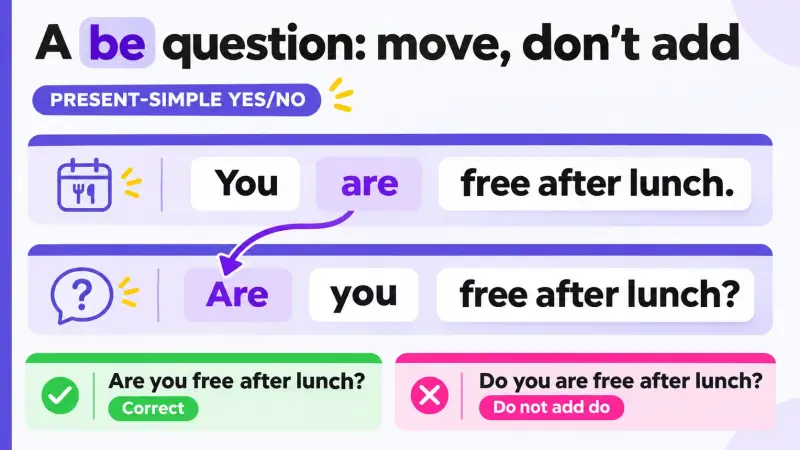
A statement with be becomes a question by moving am, is, or are in front of the subject, not by adding do or does. Be can be followed by a noun, an adjective, or a prepositional phrase, and the question keeps that same word after the subject.
Take the statement "You are free after lunch." To ask about this, move are in front of you: "Are you free after lunch?" A common wrong form here is "Do you are free after lunch?" which fails because be is already doing the job that do would do in other sentences; adding do on top of be does not fit this pattern.
The check for this pattern is simple: if the statement already has am, is, or are in it, the question only needs that same word moved to the front. Nothing else gets added.
Turning a Statement Into a Question With Do and Does
A statement with an ordinary present-simple verb needs do or does in front of the subject, and the main verb stays in its base form even for he, she, or it. This is a separate rule from the be pattern above, used for ordinary main verbs such as like, work, or walk rather than for be itself.
Take the statement "You like tea." Since like is an ordinary verb, not be, the question needs do: "Do you like tea?" A wrong form to watch for is "Are you like tea?" which mixes the be pattern into a sentence that does not have be in it at all.
For a third-person subject, does replaces do, and the verb loses its final s. Take "Your sister works from home." The question is "Does your sister work from home?" A tempting but incorrect version is "Does your sister works from home?" which keeps the s on works even though does has already marked that the subject is third person singular.
The table below collects all three pairs together so you can check your own sentences against a known-correct version before you send them to anyone.
| Statement | Question | Pattern | Common wrong form | Why it is wrong |
|---|---|---|---|---|
| You are free after lunch. | Are you free after lunch? | be | Do you are free after lunch? | be already moves to the front; do is not added on top of it |
| You like tea. | Do you like tea? | do | Are you like tea? | like is an ordinary verb, not be, so do is needed instead |
| Your sister works from home. | Does your sister work from home? | does | Does your sister works from home? | does already marks third person; the verb should lose its s |
Choosing a Question You Actually Need Answered
Once the be and do/does patterns are familiar, the next step for this exercise is choosing a question whose answer you genuinely do not already know. Practice sentences in an app are often useful for rehearsing the form itself, even when the fact behind them is not something you actually need to find out; this exercise is about asking for information you do not already have.
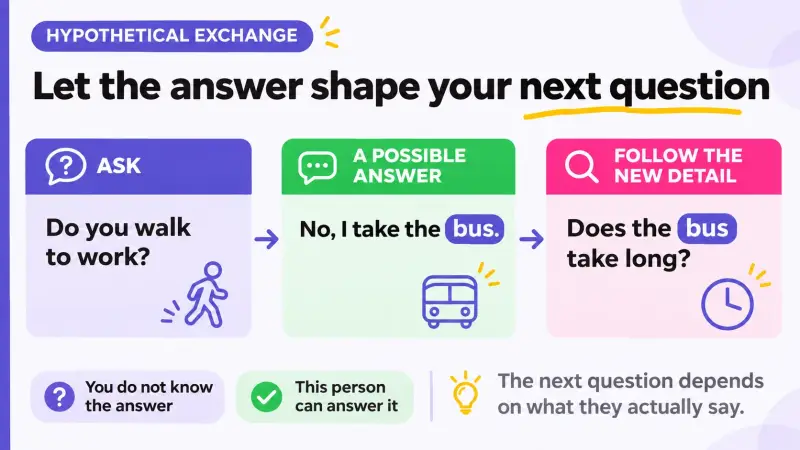
For this real-information exchange, a useful question meets two conditions: you do not already know the answer, and the person you are asking can realistically answer it. Examples like "Are you free today?", "Do you walk to work?", or "Does your city get cold in winter?" can work well with a particular partner who is willing to answer, though not every question fits every person you ask.
If you are not sure you know enough grammar yet to start asking real questions like these, Can You Learn a Language Through Conversation Before You Know Much? looks at that broader question in more depth. This article assumes you already have the two structures above and just need a reason to use them.
Asking a Partner and Following Up on Their Answer
The next step is to actually send one of these questions on HelloTalk, where a willing partner can give you a real answer and, if you ask, a short note on whether the question itself sounded right. This is the point where app practice turns into an actual exchange of information.
For example, you might send "Do you walk to work?" as a message or a short voice message. A follow-up question that picks up the specific new information in a partner's answer responds to what they actually said, rather than to a question prepared before they replied. If the reply is something like "No, I take the bus," a question such as "Does the bus take long?" picks up on that new detail instead of moving to an unrelated topic planned in advance.
When you want feedback, keep the request narrow. Asking a partner on HelloTalk "Can you tell me if that question sounded natural, just that one line?" keeps the request focused on the one sentence you sent, rather than a review of everything you have written to them. Once a question has been confirmed as correct, you can write it down in your own notes and reuse the same wording the next time you want to ask someone else about their day, their city, or their habits.
FAQ
Do I need to finish an app's whole grammar section before asking real questions? No. The be and do/does patterns in this article cover present-simple yes/no questions built from statements, and you can start using them with a partner once you can build a correct question from a statement you already know.
Why does "Do you are free?" sound wrong if do usually comes before you in a question? Do and does are only used with ordinary verbs like like or work in the present-simple yes/no questions covered in this article. When the sentence already contains be, be itself moves to the front, so adding do creates two verbs doing the same job.
How do I know if does or do is correct for a given subject? Use does for he, she, it, and singular nouns standing in for a third person, and do for I, you, we, and they. The main verb after either word stays in its base form without an added s.
What if my partner does not understand the question I send on HelloTalk? You can ask them to point out which part was unclear, then check it against the be or do/does pattern it was supposed to follow. A single unclear word is often easier to fix than the whole sentence.
Can I ask a question I already know the answer to, just for practice? You can, but a question with a real answer you do not know gives you a reason to actually listen to the reply and build a follow-up question from it.
Should my follow-up question always be planned in advance? Not necessarily. A follow-up that responds to the specific new information in a partner's answer engages with what they actually said, while a question prepared in advance may not match it.
Is this method only for complete beginners? The be and do/does patterns are basic structures, but choosing a real question and following up on the answer is useful at any level where you are moving from app exercises to real conversation.
If you want to put these two patterns into practice, open HelloTalk and ask a partner one question you genuinely need answered today.