
What to Say When You Forget a Word in English
Published on

When a single word disappears mid-sentence in English, describing what the thing does can keep the sentence moving instead of leaving it stuck. The real task is choosing a clue precise enough for someone who hasn't been shown your target word this round to guess it, then correcting that guess if it comes out wrong.
Planning a description like this on your own is useful, but finding out whether it actually works takes another person's reply, which is where HelloTalk fits in. A partner who hasn't been shown the word you're circling around for this round, whether they reply right away or later, can tell you whether your clue pointed at the right thing or something else entirely.
Why Freezing on a Word Doesn't Mean the Conversation Stops
Forgetting a word mid-sentence is not the same as not knowing the idea behind it. You usually still know what category the thing belongs to, what it's used for, or what makes it different from something similar, even when the exact label won't come.
That gap between recognizing a word and producing it on demand is the same pattern covered in I Can Read a Language but Cannot Speak It: What to Practice Next: understanding something passively doesn't automatically mean you can retrieve it under pressure. The difference here is narrower. This article isn't about building general speaking fluency from reading; it's about what to do in the specific thirty seconds after a word won't come, so the sentence you were already building doesn't just stop.
Describing what something is for, rather than only naming its general category, usually gives a listener more to work with when guessing. A vague category clue like "it's a thing you use in the kitchen" leaves too many possibilities open. A function clue narrows the field fast.
Describing What Something Is For Instead of Naming It
Say you're telling a language partner about your morning routine and the word "thermos" won't come. Instead of pausing, you can build the description in layers: what group it belongs to, then what it actually does.
| Clue type | What it tells the listener | Example for the word "thermos" |
|---|---|---|
| Category | The general group the thing belongs to | "It's a container you carry drinks in." |
| Function | What the thing is used for | "It keeps a hot drink hot for a while, even hours later." |
| Distinguishing detail | What sets it apart from something similar | "It's not just any bottle, the heat stays in." |
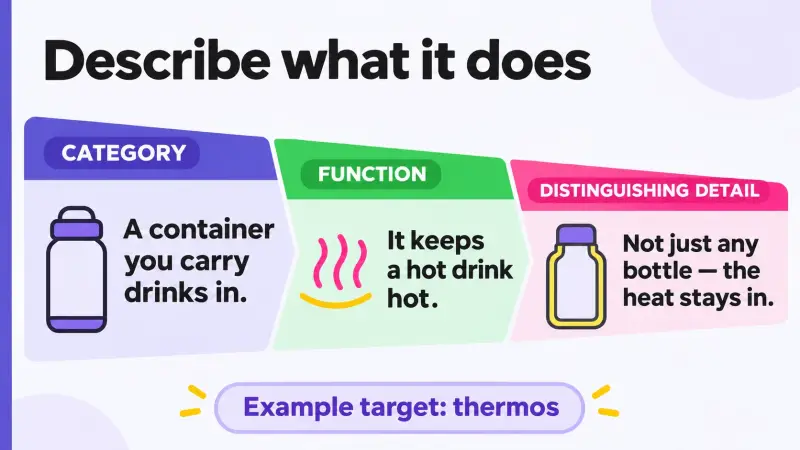
The category clue alone often isn't enough, since plenty of containers hold drinks. The function clue is usually what actually narrows a guess down, because it points at a behavior the object has rather than just the shelf it sits on.
If you've already read or heard useful phrases for describing objects, you can reuse that wording here instead of building a description from scratch; the approach in How to Turn Sentences You Read Into Phrases You Can Say applies directly to this kind of on-the-spot description.
Adding a Clue That Rules Out the Wrong Guess
A first guess that misses isn't a failed attempt, it's information. If your partner guesses "a bottle?" after your category clue, that guess suggests which detail might still be missing, in this case something that sets your object apart from a plain bottle.
A wrong first guess is not a dead end; for an example like this, it can point toward which part of your description still needs a clue. One option is to add a detail that separates your target from whatever was just guessed; restarting the description or switching to a different word can work too.
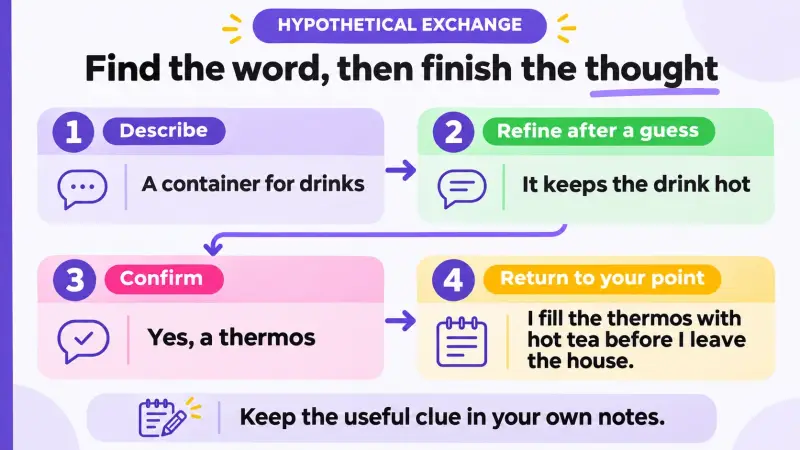
Here's a possible exchange built around the same example, shown as one way this could play out on HelloTalk:
| You send | Purpose | A possible reply |
|---|---|---|
| "I forgot the word, but it's a container you carry drinks in, like tea or coffee." | Give the category clue first | "A bottle?" |
| "Close, but it keeps the drink hot for hours, even if it's cold outside." | Add the clue that rules out the wrong guess | "Oh, a thermos!" |
| "Yes, exactly, 'thermos.' Thanks." | Confirm the word and close the loop | - |
This is a hypothetical sequence to illustrate the method, not a transcript of an actual conversation. The same structure, category clue, then a clue that narrows out the nearest wrong guess, can work for other concrete objects as well, though some fit it more easily than others.
Practicing With a Partner Who Hasn't Seen the Target Word
The exercise works best when the other person hasn't been shown which word you're aiming for this round, so they're guessing based on your description rather than confirming something they already expect. On HelloTalk, you can set this up directly: pick an everyday object, describe it in two or three sentences without naming it, and send that description as a voice or text message to a language partner.
Ask a narrow question afterward rather than a broad one, such as "Was that enough to guess it, or was one part confusing?" A specific question like that is answerable in one line; a broad "was my English okay?" usually isn't. Your partner's role here is to tell you what they understood from the description, not to grade your sentence.
You can try the same approach with a different pair of objects, such as a paper clip and a stapler, describing that one holds papers together temporarily without putting holes in them, while the other fastens them more permanently. Keep the clue itself built from words you already know comfortably; if explaining the clue requires harder vocabulary than the target word itself, the exercise stops saving you any effort.
Returning to Your Original Point Once the Word Is Clear
Once the word is confirmed, the description exercise isn't finished until you go back and finish the sentence you were originally building. If you were explaining your morning routine, that means returning to it directly: "Right, so I fill the thermos with hot tea before I leave the house."
Returning to the sentence you were originally building, once the word is settled, is what turns a vocabulary gap into a completed thought instead of a stalled one. Skipping this step and moving straight to a new topic means the original point you wanted to make never actually gets said.
This return-and-continue pattern is itself a small repair, in the same sense described in Why Is Repairing a Misunderstanding a Language-Learning Event?: confusion gets resolved, and then the conversation picks back up from where it paused rather than starting over. If the word turns out to be one you'll likely need again, it's worth keeping in a personal note along with the clue that got it recognized, so you have a ready description the next time the same word slips away.
FAQ
What if my partner guesses something close but not the exact word? Treat the close guess as useful information rather than a failed attempt. Add one clue that separates your target from what they guessed, rather than restarting the whole description.
Do I need advanced vocabulary to describe a word this way? No. The method works with simple words describing category and function. If the clue itself needs harder vocabulary than the missing word, pick a different clue or a different object to practice with.
What if the word I forgot doesn't fit neatly into an obvious category? Start with function instead of category. What something is used for is often easier to describe than what group it technically belongs to, especially for less common objects.
Is it better to just ask someone for the word directly? Asking directly works too, but only if your partner already knows the word you're missing. Describing it is also useful when your partner knows the word perfectly well but simply hasn't been told which object you mean yet, as well as when neither of you is sure what the exact word is, or when you want to practice working around a gap instead of relying on a translation.
How is this different from asking someone to repeat what they said? Asking someone to repeat themselves addresses something you didn't catch. This task addresses the opposite situation: you know what you want to say, but one specific word isn't coming, so you build around it instead of stopping.
Can I prepare this kind of description before a conversation? You can think through category and function clues for words you expect to need, but the actual value of the exercise comes from a real listener reacting to your description and guessing, since that's what tells you whether the clue was clear enough.
What if my partner also doesn't know the word in English? That's a normal outcome, not a failure of the exercise. You can look the word up together afterward, or simply keep using the description itself next time, since a clear description can carry the meaning even without the exact label.
If you want to try this with a language partner who hasn't been shown the word you're aiming for this round, HelloTalk is a reasonable place to start the exchange.