
Learn Italian Nouns With Their Articles: Build Phrases You Can Actually Use
Published on

If you recognize an Italian noun's translation but cannot turn it into your own sentence, learn its article and a useful plural together, not the bare word. You might know libro means book, yet not know whether it takes il, lo, or l', or what it looks like with more than one. A dictionary or course can check both forms, and a willing partner on HelloTalk can respond to a short message you actually write.
Choosing the Right Article and Plural for an Italian Noun
Before writing a noun into a sentence, there are three separate things to check, and none of them can be guessed from the English translation alone. Gender decides which article family applies, the noun's first sound decides which exact article form fits, and the plural can follow a common pattern or an exception that only shows up with that specific word.
| Check | What to look at | Why it matters | Example |
|---|---|---|---|
| Gender | Whether the noun is masculine or feminine, checked in a dictionary entry rather than guessed from the ending | Gender decides which definite and indefinite article family applies | il problema is masculine despite ending in -a |
| Initial sound | Whether the noun starts with a vowel, s plus a consonant or a similar group, or a plain consonant | This picks il, lo, or l' for masculine nouns and la or l' for feminine nouns | lo studente is used because studente starts with st |
| Plural pattern | Whether the noun follows a common ending shift or keeps an irregular or unchanged form | Some nouns change a typical ending, others stay identical in singular and plural | la mano becomes le mani, while la città stays le città |
The next two sections work through the article check and the plural check in more detail. If you are still mapping out a broader study routine, the step-by-step plan in How to Learn Italian Online as a Beginner covers where practice like this fits into a longer sequence.
Matching definite and indefinite articles to a noun's gender and sound
Gender alone does not finish the job, because the same masculine or feminine noun can still take a different article depending on its first letter or sound. Italian uses il, lo, and l' for singular masculine nouns, and la or l' for singular feminine nouns, with the plural forms i, gli, and le following the same logic.
| Noun | Gender | Singular definite | Plural definite | Singular indefinite |
|---|---|---|---|---|
| libro (book) | masculine | il libro | i libri | un libro |
| studente (student) | masculine | lo studente | gli studenti | uno studente |
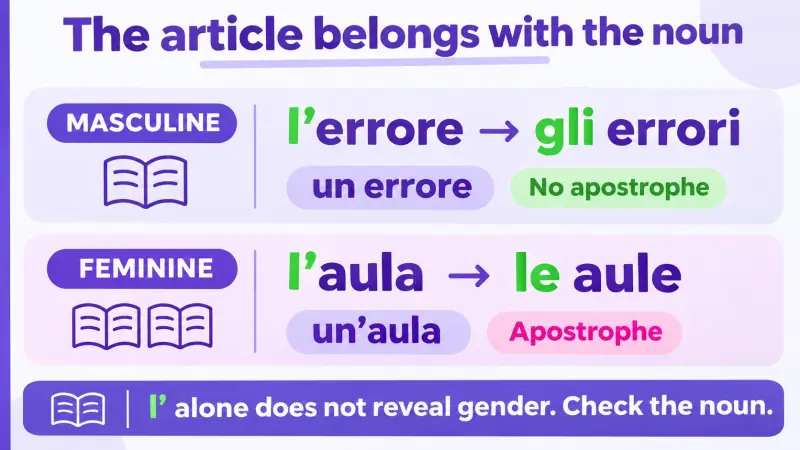
| errore (error) | masculine | l'errore | gli errori | un errore |
| sedia (chair) | feminine | la sedia | le sedie | una sedia |
| aula (classroom) | feminine | l'aula | le aule | un'aula |
Notice that a singular noun starting with l' does not reveal its gender through the article alone: l'errore and l'aula look similar in the singular. The singular article l' does not show a noun's gender, but the plural article makes it visible through gli or le, which is why l'errore becomes gli errori while l'aula becomes le aule. A dictionary entry can confirm the gender directly, without waiting for the plural.
The indefinite article follows a related but separate rule. The masculine indefinite article un keeps the same spelling before a vowel, while the feminine un' takes an apostrophe, marking the gender difference in writing, so un errore stays as written but una aula shortens to un'aula. Context, not number, decides whether a speaker means un libro or il libro: switching from indefinite to definite reflects whether the book is already known to the listener, not a plural change.
Plural patterns that change with the noun, not just its ending
Once an article is settled, the plural is the second place where guessing from the ending goes wrong. Most Italian nouns do follow a predictable shift, but several common everyday words do not, so it helps to check the actual plural rather than assume one pattern covers every noun. An Italian noun's plural form can shift its final vowel, stay unchanged, or follow an irregular pattern, so the singular ending by itself does not predict it.
| Singular | Gender | Pattern type | Plural |
|---|---|---|---|
| limone (lemon) | masculine | common: -e to -i | limoni |
| sedia (chair) | feminine | common: -a to -e | sedie |
| arancia (orange) | feminine | common ending shift (checked form) | arance |
| pesca (peach) | feminine | common ending shift (checked form) | pesche |
| problema (problem) | masculine | gender exception (ends in -a but masculine); plural follows the regular -a to -i pattern | problemi |
| mano (hand) | feminine | gender exception (ends in -o but feminine); plural follows the regular -o to -i pattern | mani |
| città (city) | feminine | noun form unchanged; only the article changes | città |
| computer (computer) | masculine | noun form unchanged; only the article changes | computer |
The first four rows follow a pattern you can expect for many new nouns you learn, but the last four show why checking an unfamiliar word is worth the extra step before using it in a sentence. Gender is not reliably predictable from a noun's final letter, since masculine nouns such as problema and feminine nouns such as mano break the common -o/-a pattern.
Different Italian learning resources are built for different parts of this process, as What Each Type of Italian Learning Resource Is Actually Built to Do explains, and a grammar reference is usually a better fit for checking an exception like this than a vocabulary app alone.
Building and checking noun-plus-article phrases in real messages with a partner on HelloTalk
Once you have chosen a noun's article and confirmed its plural, the next step is to put the phrase inside a sentence describing something real, not another flashcard. On HelloTalk, write a short text message or a Moments post listing two or three objects actually in your room or bag, and add one specific question a partner can answer, such as whether a particular article or plural choice is correct.
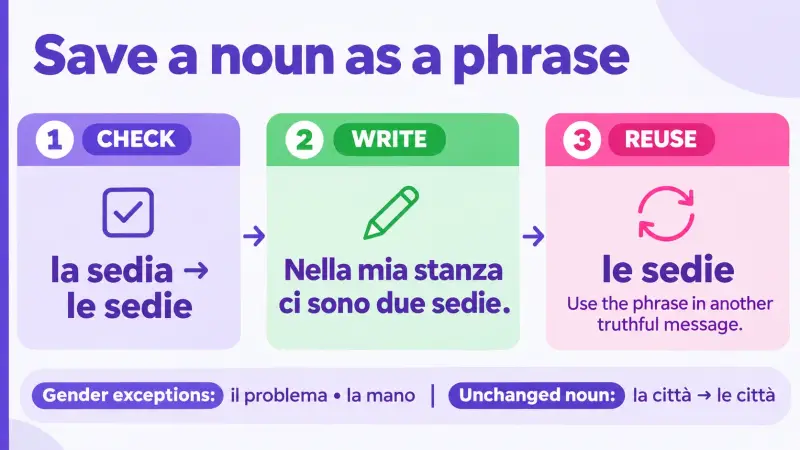
For example, as an original practice message you might send separately: Nella mia stanza ci sono due sedie. C'è anche un libro sul tavolo. È corretto il plurale "due sedie"? (In my room there are two chairs. There is also a book on the table. Is the plural "due sedie" correct?) A willing Italian speaking partner on HelloTalk can read a message like this and answer that one specific plural question, which is more precise feedback than asking generally whether the whole message sounds right.
The HelloTalk platform's chat tools let a partner mark the exact word they are correcting inside your message, so you can see which noun or article changed rather than guessing from an entirely rewritten sentence.
If you are unsure about a single apostrophe or plural ending, ask about that one point instead of requesting a full grammar explanation. A message such as Ho scritto un'arancia e due limoni: la forma con l'apostrofo è giusta? (I wrote un'arancia and due limoni. Is the apostrophe form correct?) asks about exactly one choice, which is easier for a partner to answer precisely.
Saving a noun together with its checked article and plural form keeps those details ready to reuse, rather than leaving you to reconstruct them from a bare translation each time. Once a partner confirms or corrects a phrase, keep the whole noun phrase, such as le sedie or un'arancia, and reuse it in a different truthful message later, for example a different room or a different quantity.
This kind of exchange is part of why Why Does Beginner Italian Need Real Responses, Not Just More Study Material? matters: a specific response to your own sentence checks something a static exercise cannot.
FAQ
How can I find an Italian noun's gender if the ending does not make it obvious?
Check a dictionary entry or memorize the noun together with its article instead of guessing from the final letter, since exceptions such as problema (masculine) and mano (feminine) break the usual -o/-a pattern.
What is the difference between il and lo for masculine nouns?
il is used before most consonants, as in il libro, while lo is used before groups such as s plus a consonant, as in lo studente.
Why does un not take an apostrophe before a vowel while un' does?
Masculine nouns take un or uno depending on the noun's first sound, and un keeps the same spelling before a vowel with no apostrophe, such as un errore, while the feminine una elides to un' before a vowel, such as un'aula.
Does every Italian plural just change the final vowel?
No. Common nouns like libro and sedia do change their final vowel, but for others such as città and computer, the noun itself stays identical in the plural and only the article changes, as in la città becoming le città. Mano is feminine but follows the regular -o to -i pattern to form mani, and problema is masculine but follows the regular -a to -i pattern to form problemi; the exception in each case is the noun's gender, not an irregular plural shift.
How does a HelloTalk partner help with noun and article practice specifically?
A partner can read a short original message describing real objects and say whether a specific article or plural choice sounds natural, which gives feedback on that exact phrase rather than a general rule.
Should I memorize an article separately from its noun?
Store the noun together with the article that actually goes with it, such as la sedia or lo studente, since the article depends on each noun's gender and sound rather than being a fact you can apply later from memory alone.
What should I do once a partner corrects my phrase?
Save the complete corrected phrase, then write it again in a different truthful sentence, such as a different quantity or a different room, so the correction becomes something you can reuse.
If you want to test a noun phrase you just built, open HelloTalk and send it to a willing Italian speaking partner today.