
Spelling Names in English: Hear the Letters and Make Yours Clear
Published on

If you can recite the alphabet in order but still mishear a letter someone spells aloud, or your own name comes back misspelled after you spelled it, that gap is specific: alphabet drills do not show what a particular listener actually heard.
Spelling a name aloud, asking a partner to write back what they heard, and comparing the two spellings checks that directly. On HelloTalk, you can send a short voice message spelling a name and ask a willing partner for that write-back, though the platform cannot guarantee a reply.
Why Knowing the Alphabet Does Not Mean You Can Hear It
Reciting A to Z in order and pulling one letter name out of a fast spoken sequence are two different skills. When someone spells a name quickly, you only have a fraction of a second to catch each letter before the next one starts, and there is no visual alphabet chart to check against. Knowing the alphabet in order does not guarantee you can isolate individual letter names inside a fast spoken sequence.
Letter Names vs. Letters Inside Words
This task is also different from judging how a letter sounds inside a word. The letter N's name is read as "en," and that same letter's sound inside a word like "net" is a separate thing to test. If your actual goal is checking whether your pronunciation of words is understood, the methods in How to Know If Your Pronunciation Is Correct: 5 Practical Ways to Check cover that task directly. Here, the target is narrower: hearing and producing the letter names themselves when a name is spelled out loud.
Spelling Out a Name Letter by Letter in English
Take a name like Lena Moss. Said as a whole, it is one quick phrase. Spelled out, it becomes a sequence of individual letter names: L, E, N, A, then M, O, S, S, with a short pause between each letter so the listener has time to register it before the next one arrives.
Some English letter names sound close enough to each other that a name spelled out loud can still be misheard even when every letter is said clearly on its own. One optional habit is adding a short illustrative phrase to a letter you suspect might be unclear, such as saying "M as in Mary" after the letter M. It is simply one extra clue you can offer if the bare letter name does not land.
The table below uses two fictional practice names, Lena Moss and Nina Cole, to show how spelling letters and a possible write-back or clarification might work together. These are examples, not a record of an actual exchange.
| Intended name | How to say the letters | Possible write-back or clarification |
|---|---|---|
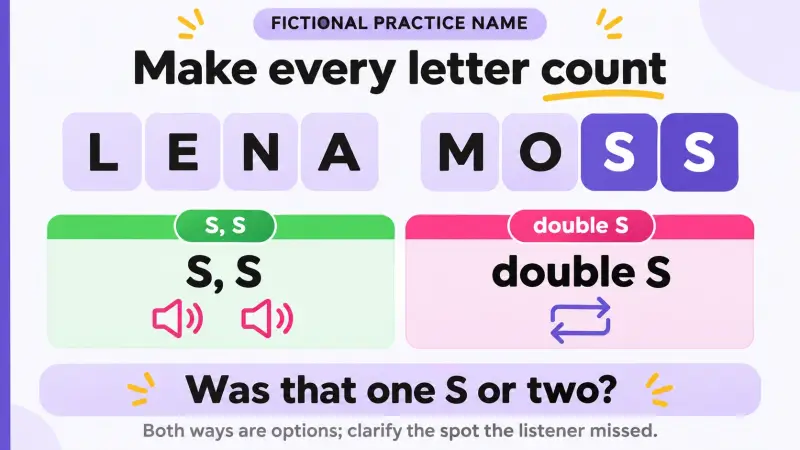
| Lena Moss | L-E-N-A (pause) M-O-S-S, saying "S, S" or "double S" for the repeated letter | A partner might write "Lena Mos," missing one S; you could ask "Was that one S or two?" |
| Nina Cole | N-I-N-A (pause) C-O-L-E | A partner might write "Nina Coal," where the last two written letters differ from what you intended; you could ask "Did you hear C-O-L-E, with L then E, or C-O-A-L, with A then L?" |
Choosing When to Add an Anchor Phrase
You do not need to attach an anchor phrase to every letter; that would slow the spelling down more than it helps. Save it for a letter you think might be unclear in a specific name, say the plain letter name first, and add the anchor phrase only if the listener hesitates or asks you to repeat it.
If you are still deciding which resource to use for broader beginner study alongside this kind of focused practice, the comparison in The 8 Best English Learning Apps for Beginners (2026): An Honest Guide covers app selection; this article stays with the narrower spelling task itself.
Handling Repeated Letters Without Losing the Listener
Moss has two S letters in a row. Repeated letters in a row can be a point where a spelled name breaks down for the listener, because the second letter may blur into the first instead of registering as a separate sound.
There are at least two ways to handle a repeated letter: saying the letter twice on its own, "S, S," or saying "double S" once. Neither is the single correct form. If you spell the name once and your partner's write-back is missing a letter or has an extra one, that is a sign to clarify just the repeated-letter spot, for example by asking "Was that one S or two?" rather than switching your whole approach in advance.
Sending a Name for a Partner to Write Back
Once you have a name spelled out in a way that feels clear to you, a written reply from a partner who did not already know the name is one useful way to check whether what you said matches what they heard. On HelloTalk, you can send a short voice message that spells a name letter by letter, without saying the whole name aloud or typing it in the same message, and ask your partner to type back exactly what they heard.
For example, a possible voice message could start "Here is a name, please write down what you hear: L-E-N-A, M-O-S-S" and end with "Can you write back what you heard?" A possible reply might be "Lena Mos," missing one of the two S letters, or something else entirely.
Once a spelling pattern works for one name, you can reuse the same pacing and clarification habit for a new name, such as Nina Cole, which connects to starting real exchanges before you have a large vocabulary. Can You Learn a Language Through Conversation Before You Know Much? covers why this kind of short, specific exchange does not require broad fluency first.
Fixing the One Letter That Gets Misheard
A name spelled correctly on your end can still arrive wrong if the listener never writes back what they understood, so asking for that written reply is one way to reveal whether anything was actually misheard. A missing or wrong letter in a partner's write-back does not by itself prove your pronunciation was incorrect; attention, background noise, or recording quality can also affect what gets written down.
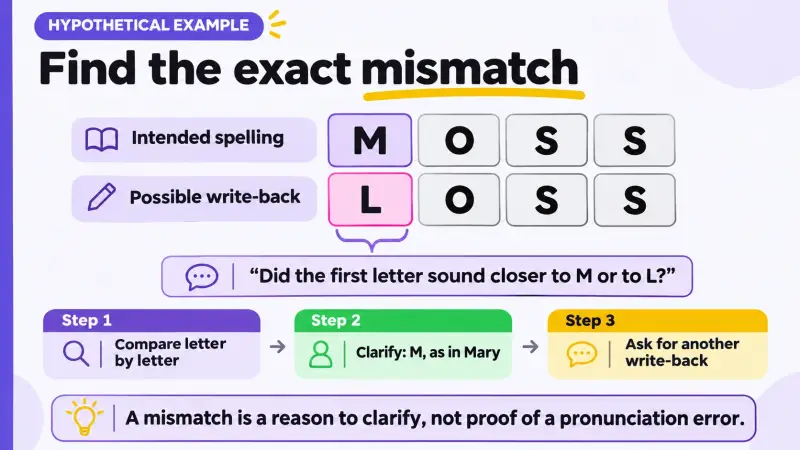
Once you have a partner's write-back, place it next to the name you intended and compare letter by letter rather than judging the whole word as simply right or wrong.
For example, if your partner wrote "Loss" instead of "Moss," comparing the two spellings narrows the question to the first letter, M versus L, rather than the whole name. At that point, ask a narrow question such as "Did the first letter sound closer to M or to L?" instead of resending the entire name again. A possible next step is confirming with "M, as in Mary," and a second write-back might come back as "Moss," closing out that one letter.
Asking for Feedback on One Letter, Not the Whole Name
Asking about one specific letter tells a partner exactly which part of the spelling to check, instead of asking them to listen to the whole name again. A request this focused also gives you a clear anchor phrase to attach to that one letter the next time you spell a similar name.
FAQ
Do I need to recite the whole alphabet correctly before I try this? No. This task is about isolating individual letter names inside a spoken sequence, which is a different skill from reciting the alphabet in order, and you can start practicing it directly.
What if my partner writes down the wrong word, not just the wrong letter? Compare the written result to your intended spelling letter by letter rather than judging the whole word at once, so you can see exactly which letters differ.
Is "double S" the only correct way to say a repeated letter? No. Saying the letter twice on its own or saying "double" before it are both options. If a repeated letter causes confusion, you can clarify it as "S, S" or "double S" when you check the write-back.
Can I practice this before I know much English? Yes. Spelling a short name out loud and reading back a written reply does not require broad vocabulary, which is part of why this kind of focused exchange works early on.
What if the letter that gets misheard changes every time? Treat each spelling attempt as its own check rather than expecting one fixed error to repeat; add an anchor phrase only where a specific attempt actually went wrong.
Does a missed letter always mean my pronunciation is wrong? Not necessarily. A missed letter in a write-back can also come from a partner's attention, background noise, or recording quality, so treat it as a signal to clarify rather than an automatic verdict on your pronunciation.
Do I need a native English speaker specifically for this? A willing partner who did not already know the name you are spelling is what makes the written reply a useful check; the exchange does not depend on a specific speaker background.
If you want to try this with a real partner, you can start with HelloTalk.