
French Resources for Talking About Past Experiences: From Tense Exercises to a Real Story

You can fill in the blank. Given "Hier, je ___ (aller) au marché", you write "suis allé" without stopping to think. Then a French speaker asks "Tu as fait quoi ce week-end ?", what comes out is "J'ai mangé au restaurant", and the conversation stalls there. The forms are fine. The story is missing.
Gap-fill exercises do what they are built to do, which is train the form. What they do not ask you to do is decide which parts of an event are background, which parts move the story forward, and in what order to say them. For that task you need material organised around narration plus a listener who reacts to what you said. Three resources cover it between them: the Lawless French lesson comparing passé composé and imparfait, the episode of The Coffee Break French Show devoted to the same contrast, and a real conversation where someone asks you what happened next.
Quick Picks: Lawless French, Coffee Break French, and HelloTalk
These three are not competing for the same slot. One gives you written examples to study, one gives you the same contrast explained out loud, and one gives you a person who responds to the story you built from the first two. If you are still assembling the wider toolkit for your whole study period, the overview of methods and resources for learning French in three months covers that decision. This article stays on one task: telling a past experience.
Read the table below by the last two columns first. The narrative task tells you what each resource helps you finish, and the baseline column tells you whether it fits this week or is better saved for later.
| Resource and material | Format | Narrative task it helps with | Baseline it assumes | How it feeds real conversation |
|---|---|---|---|---|
| Lawless French, the lesson comparing passé composé and imparfait | Reading, with written example sentences and short sample narratives | Sorting your own sentences into background and events | You already recognise both tense forms; the lesson covers many cases at once, so take one section at a time | Gives you a story shape you can draft before you speak |
| The Coffee Break French Show, Season 2 Episode 5 on the two past tenses | Podcast audio, explanation built around example sentences | Hearing both tenses used inside the same stretch of speech | Some previous contact with both tenses; play a few minutes to judge whether you can follow | Gives you spoken phrasing you can reuse in your own story |
| HelloTalk, text and voice messages, voice and video calls, public Moments posts | Interactive, with people who speak French | Telling the story and answering what a listener asks back | A draft of a few sentences, written or spoken | Turns what you could not say into your next study item |
The sequence that holds this together is source material, a draft, telling it to someone, their response, then a revision pass. Keep the response step in the loop: a listener reacts to your story as meaning rather than as a set of verb forms, and shows you where the thread was lost.
Lawless French: See How Background and Events Work Together in a Story
Lawless French has a grammar lesson dedicated to comparing the two tenses rather than teaching each one separately. Lawless French's passé composé versus imparfait lesson contrasts background against events and includes sample narratives written with one tense alone and with both tenses mixed together. The mixed narrative is worth slowing down on, because it shows one story carrying both tenses across the same few lines. The site's practice exercises sit behind a login, so treat the lesson as reading material and do your own writing in a notebook or a notes app.
Be honest about the level. The full comparison covers habitual actions, interrupted actions, changes of state and several other cases on one page, which is more than most learners want in a single sitting during a three-month plan. Read one category, close the page, and use it. Come back for the next category after the first one has shown up in something you wrote.
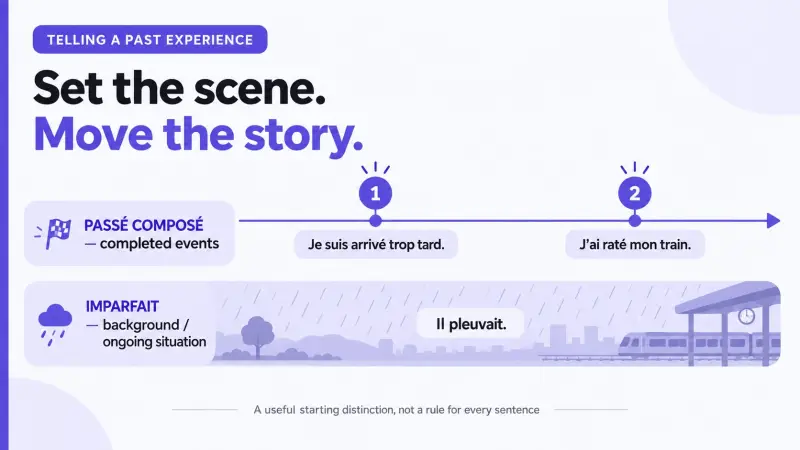
In everyday narration, imparfait usually carries background and situations that were still going on, while passé composé usually carries completed events that move the story forward. That split is a working start rather than a rule that settles every sentence, and a few of your lines will still need a second look.
Here is a suggested practice, not a study result and not a text from the site. Write five lines about something that actually happened to you last weekend, then label each line before checking any rule.
-
Background lines describe weather, mood, place, who was there, what was already going on.
-
Event lines describe completed events seen as a whole, the ones that carry the story forward.
A short original example to show the sorting: "Samedi matin, il pleuvait et la gare était pleine de monde" is background. "Je suis arrivé trop tard à la gare et j'ai raté mon train" is events. Watch the agreement in that second line, since the participle of arriver is built with être and agrees with the subject, so a woman writing it would put "je suis arrivée". Once your lines are labelled, most of the tense choices follow, and the mixed examples in the lesson give you something to compare your sequence against.
Coffee Break French: Hear Passé Composé and Imparfait Explained in Context
Reading a comparison tells you which tense to write. It does not tell you what the switch sounds like at speaking speed, which is the moment that breaks down when someone asks you a question in person. The Coffee Break French Show covers the imparfait and passé composé contrast in Season 2 Episode 5, working through example sentences with explanation instead of presenting a tense table. Note that this is the show rather than the numbered course seasons, so you are not hunting through the main lesson series for an episode that lives elsewhere.
The episode plays as a podcast, and the episode page also mentions a worksheet. The audio carries the explanation on its own, so treat any extra download as optional rather than as something to sort out before pressing play.
You also do not need to work through anything earlier first. Play a few minutes and see whether you can follow; if the example sentences are moving faster than you can parse, spend a week on whichever of the two tenses is shakier and come back. Suggested practice for one episode: listen once with nothing in your hands, just following the meaning. Listen a second time and write down only the sentences where the speakers move between the two tenses inside a single sentence. Three or four of those, said aloud until they sit comfortably in your mouth, give you phrasing you can borrow the same week.
Build a Short Story About Yesterday Before Adding More Grammar
Both resources above give you input. Now you need one small output you can carry into a conversation, because a story you have never said out loud tends to fall apart the moment someone interrupts it. Build it in three steps, in this order: pick an event that is small and real, sort it into the skeleton below, then say the whole thing through without stopping.
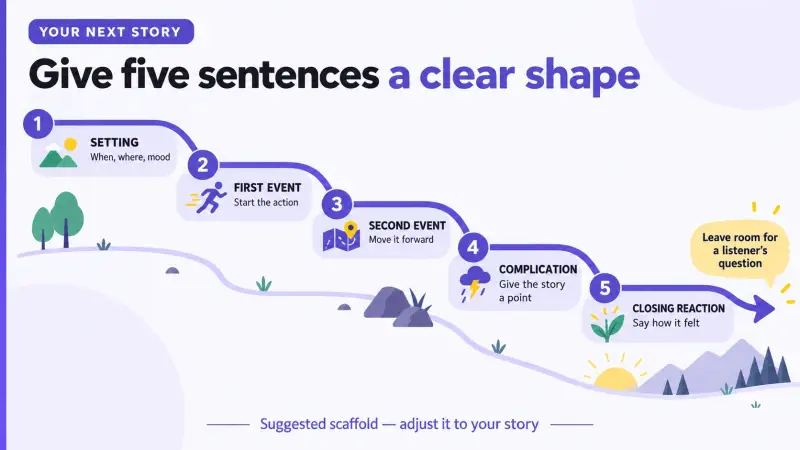
The table below is a task template rather than a reference chart. Fill each slot with one sentence about your own week. The example column is suggested practice written for this article, so replace it rather than memorising it.
| Slot | What it does | Tense that usually fits | Suggested example sentence |
|---|---|---|---|
| Setting | Places the listener in time and mood | Imparfait | Vendredi soir, j'étais fatigué et il faisait très chaud |
| First event | Starts the action | Passé composé | Je suis sorti pour acheter quelque chose à manger |
| Second event | Moves it forward | Passé composé | J'ai rencontré Emma devant le supermarché |
| Complication | Gives the story a point | Passé composé for the event, imparfait for what was going on around it | On a décidé de cuisiner ensemble, mais le magasin fermait déjà |
| Closing reaction | Tells the listener how to feel about it | Imparfait for the overall impression, passé composé if you add one last event | C'était une soirée bizarre, mais j'ai bien ri |
Five sentences is a starting point you can adjust. Say it once from the page, once from memory, and once while walking around so you are not reading. If a sentence keeps collapsing, cut it rather than repairing it, and add the complexity back after the simple version runs clean. The aim is a story you can use, not a paragraph you recite. That same idea of stacking listening, speaking and review instead of studying grammar in isolation runs through the three-month French method stack aimed at B1.
HelloTalk: Tell the Story and Respond to a Listener's Follow-Up Questions
A story tested only against your own ear keeps the gaps you cannot hear. This is where a real listener joins the loop, and the point is not to hand your verbs in for marking. The point is that someone tries to follow what happened and tells you when they lose the thread.
HelloTalk carries text and voice messages, voice and video calls, and public Moments posts, so the same short story can be sent as writing, recorded as audio, or told live. HelloTalk's Moments are public community posts, which suits a written draft you want read by people you have not messaged yet. HelloTalk's Voicerooms are live multi-person audio spaces and its Live sessions are real-time broadcasts, and joining either as a listener first is one way to hear how French speakers tell small everyday stories before you tell yours.
Exchange tends to go better as an invitation than as a request for grading. Post or send the story, say plainly that you are practising past tenses, and offer the same help back in whatever language you speak well. Then ask one specific comprehension question rather than asking for a list of mistakes, for example whether the order of events was clear: "Est-ce que l'ordre des événements était clair ?"
The replies do two different jobs, and it helps to tell them apart. Some follow-ups come from genuine interest, like "Tu étais avec qui ?" or "C'était où exactement ?", and those are simply the conversation continuing. Others show that something did not land, such as a listener asking again when it happened or who Emma is. The second kind points at the sentence to rewrite; the first kind points at vocabulary you will want next time.
Close the loop from there. Write down the two or three things you could not say, and bring them back to the Lawless comparison lesson or that Coffee Break episode as a specific question instead of as general study. A suggested review pass: rewrite the story with the missing piece added, retell it to a different person a few days later, and aim at one observable goal, which is getting the sequence out in order without reading from your notes and answering one new question about it.
Fit Story Practice Into Your Three-Month French Plan
Story practice is not a separate project competing with your schedule. It is an output slot you can shape around the time you already have. One workable arrangement: one short reading session on a single Lawless category, one podcast episode listened to twice, one story drafted and told, and one revision pass after the responses come in. Stretch or compress that to fit your week rather than treating it as a fixed hour.
Rotate the topic so you are not polishing the same paragraph. Last weekend, a trip, a difficult day at work, the first time you cooked a dish, something that went wrong at a station. Each new topic pulls in different vocabulary while the narrative structure stays the same, and that repetition with variation is what makes the structure easier to reach for. If you want the routine slotted into a fuller weekly timetable, the three-month French study plan built around online resources shows where the speaking block usually sits.
One caution on outcomes: no lesson page, podcast episode or conversation routine guarantees a level or a certificate in three months, and none of the resources here claims to. What you can set up is the conversation half of the loop on HelloTalk while keeping your reading and listening wherever you already do them, so that every story you tell sends you back to the material with a sharper question.
Frequently Asked Questions About Practising Past Experiences in French
Do I need to learn all the French past tenses before I can talk about past experiences?
No. Passé composé and imparfait handle most casual spoken narration about your own life. Plus-que-parfait is worth adding once you need to say what had already happened before the story started, and passé simple appears mainly in written literature and formal narration rather than in a conversation about your weekend.
Which Lawless French page helps most with storytelling?
The grammar lesson that compares passé composé and imparfait, rather than the two separate tense pages. It contrasts background against events and includes sample narratives written with each tense alone and with both mixed, which is the combination a story needs. Its practice exercises require logging in, so plan to do your own writing separately.
Do I have to listen to The Coffee Break French Show from the beginning to reach the past tense episode?
No. Season 2 Episode 5 of the show deals with the imparfait and passé composé contrast and can be played on its own. Earlier episodes give you more context, but for this one narrative task you can start there. Listen to a few minutes first to check that the example sentences are within reach, and review the basics of either tense if they are not.
How long should my first French story be?
Around five sentences is a practical first draft, told without stopping. Longer versions often break down in the middle, and an abandoned story gives you less to work with than a short finished one. Add more sentences once the short version runs from memory, and keep adjusting the length to the story rather than to a number.
What should I ask a language partner to check?
Ask whether the story made sense and whether the order of events was clear, before asking about individual mistakes. Meaning-level feedback tells you which sentence to rebuild, and you can always ask for word-level corrections on the second telling.
What do I do when someone asks a follow-up question I cannot answer in French?
Answer the part you can, then note the gap. Say the missing piece however you manage, including a single word or your own language, and write it down afterwards. That note becomes a specific study item for your next session, which is a sharper target than opening another general grammar page.
Does weekly story practice mean I am ready for a B1 exam?
Not on its own. Describing past experiences is a common speaking task at that level, so the practice is relevant, but a level is confirmed by an assessment with its own criteria and scoring, not by how a conversation went. Treat story practice as preparation for that kind of task, and check exam requirements separately if a certificate matters to you.